


Bigger Heat Exchanger


Banned
Joined: 06-28-06
Posts: 1,083
Likes: 0
From: Long Island, NY
Originally Posted by blown06
if your going to be doing a smaller pulley etc, then yes, otherwise being stock not much

Banned
Joined: 06-28-06
Posts: 1,083
Likes: 0
From: Long Island, NY
Originally Posted by L.P.
well see i hit a dog the other nigth and my stock heat exchanger was demolished so I have a chance to get one now with the insurance money.
And what happeend to the AC condensor and then radiator?
Banned
Joined: 06-28-06
Posts: 1,083
Likes: 0
From: Long Island, NY
Originally Posted by blown06
how are you seeing a 3lbs of boost increase being stock just curious I am not calling BS or anything
The front mount H/E just cools things off that much more. Its not plastered next to the radiator thats running at 181 F so right there you're gonna see a big difference in the IAT2 temps.

Banned
Joined: 06-28-06
Posts: 1,083
Likes: 0
From: Long Island, NY
Originally Posted by Allshot
I have it and your not goint to see a big drop in temps. Maybe 5-10. The main benefeit is the amount of time it takes to cool your coolant off. It will drop temps much faster.
You're talking about a bigger H/E right?
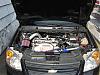
yeah thats what e-x got .... well since it being cold out I"ve been seeing a little over 14 psi with the stock pulley myself and thats logging through hp tuners... e-town runs... oh yeah
you probably won't see that kinda of increase unless its real cold out (30's) but you;ll def stay in the lower IAT2 range which will keep your timing steady and advanced, so yeah head gasket should be done above 18 psi anyway just for insurance,

Senior Member
Joined: 10-28-06
Posts: 1,216
Likes: 0
From: United States
Originally Posted by e to the x
On the contrary, I have consistently seen 15 lbs of boost since I added my C-A front mount H/E with my stock pulley, so there are some benefits on a stock car.
Umm.. if you add an upgrated Heat exchanger, meaning that the intake manifold temps are colder, then the Boost pressure goes DOWN! not up.
there is somthing wrong if your boost presure goes up as a result of intercooler modifications without changing supercharger pulley ratio.
Lets assume the volumetric efficiency of the supercharger is relatively constant since its positive displacement (not exactly the case but close enough for this example)
First, assume your inlet air temperature and pressure is not changing (standard atmospheric conditions), neither is your supercharger speed. which means you get approximately the same mass flow of air and as you cool that given amount of mass, the density increases and your pressure decreases. Basic thermodynamics.
Now taking that one step further, as you increse the density and decrese the pressure in your intake manifold, your supercharger is now operating at a decreased pressure ratio and in a more isentropcially efficient region, plus its 'slightly' more volumetrically efficient.
Try this.. take out your intercooler, see what your boost pressure goes up to. (edit: not really reccomend anyone do this.. )
Last edited by TVS_SS; Nov 8, 2006 at 07:17 PM.
Senior Member
Joined: 04-03-06
Posts: 7,570
Likes: 0
From: Mesa, AZ
Originally Posted by TVS_SS
Try this.. take out your intercooler, see what your boost pressure goes up to. (edit: not really reccomend anyone do this.. )

Senior Member
Joined: 10-28-06
Posts: 1,216
Likes: 0
From: United States
Originally Posted by Blown 4-banger
Not saying I've done this, but my boost would usually be .5-1 psi higher when my IAT2 were more than 140 degrees.
yup Thats exactly why intercoolers are used.
Same air mass, same intake volume, hotter air temps = more pressure