


Shout out to HRM


New Member
Joined: 07-20-09
Posts: 116
Likes: 0
From: HFX
In 2005 our cars were brought forward by gm as Holden to challenge the European FWD Rally challenge. To compete in the races there were many rules to follow including having a rear wing Defined as the following :A rear wing is defined as a non-OE surface with an airfoil shaped cross section mounted above the body contour. They only did it for one year due to cost, however this is common for American car manufacturers to this. There is a minimum amount of cars that must be produced in order to compete in the races and GM was unable to do this with the Cobalt. They changed to the Turbo due to emission laws in the USA....if the laws had not gone through I would guess they would have kept the SC.(Even though the stock TC is a bit faster then the Stock SC)
The Holden Tigra: Ecotec LSJ 2.0L Supercharger. Now the HSV VXR 2.0-litre Ecotec-4 Turbo
The Holden Tigra: Ecotec LSJ 2.0L Supercharger. Now the HSV VXR 2.0-litre Ecotec-4 Turbo
New Member
Joined: 07-20-09
Posts: 116
Likes: 0
From: HFX
My Spam:
GTC VXR Engine information
Type: 2.0L I4 Turbo
Displacement: 1998 cc ( 122 ci )
Engine Orientation: L ( longitudinal ) T ( transverse ) L
Compression ratio: 9.2:1
Valve configuration: dual overhead camshafts
valves per cylinder: 4
Assembly site: Spring Hill, Tennesee
Valve lifters: hydraulic roller finger follower
Firing order: 1-3-4-2
Bore x stroke: 86.00 x 86.00
Fuel system: Direct Injection
Fuel Type: Premium Fuel Recommended
Fuel shut off: 6350 rpm
Engine Redline: 6300 rpm
Emissions controls: Three-way catalyst, Positive Crankcase Ventilation, Evaporative System
MATERIALS
Block: 319 Aluminum
Cylinder head: Semi-permanent-mold 356 Al cylinder head
Intake manifold: Aluminum
Exhaust manifold: Cast stainless steel
Crankshaft: forged steel
Camshaft: cast nodular iron
Connecting rods: forged steel
Additional features: DI ( direct injection )
Dual-scroll turbocharger
Dual CVCP ( continuously variable cam phasing )
Sodium-filled Iconel exhaust valves
cast pistons with oil squirters
forged connecting rods
steel crankshaft
Semi-permanent-mold 356 Al cylinder head
Variable pressure fuel rail ( 50-150 bar )
Stronger block bulkhead and deeper water jacket
Coil-on-plug ignition
Direct injection high-pressure multi hole injectors
58x engine position sensing
Stainless steel fuel system components
FWD applications have dual converter system
Cam driven high pressure fuel pump
TRANSMISSIONS MATED TO:
Manual
GME F35-5 FWD
GME F40-6 FWD
F40-6 AWD
Automatic
Hydra-Matic 5L40 (M82) RWD
Aisin AF33-5 (M09) FWD
US APPLICATIONS SO FAR:
Chevrolet HHR - SS & Cobalt SS (SuperSport)
Saab 9-3 - Sport Sedan, Convertible & Sport Combi
GM OFFICIAL DOCUMENTATION UPON RELEASE (Note all references are to US vehicles)
2008 Ecotec 2.0L I4 VVT DI Turbo ( LNF )
ECOTEC 2.0L TURBO I4 (LNF) CAR and TRUCK ENGINE
2008 Model Year Summary
Carryover content and benefits from 2007 model year.
• New Engine for 2008 Chevrolet HHR SS and Cobalt SS
• Direct Injection
• Twin-Scroll Turbocharger
• Air-to-Air Intercooler
• Unique Cylinder Head with Sodium Filled Exhaust Valves
• Continuously Variable Valve Timing
• Gen II Engine Block
• Aluminum Pistons With Jet-Spray Cooling
• Forged Steel Crankshaft
• Cam-Driven High-Pressure Fuel Pump
Full Description of New and Updated Features
New Engine for 2008 Chevrolet HHR SS and Cobalt SS
The Ecotec 2.0L I4 VVT DI Turbo (RPO LNF) powers the Chevrolet HHR SS for 2008 model year. This Ecotec engine is installed transversely, and equipped with either a Hydra-Matic 4T45 four-speed automatic or GM F35 five-speed manual transmission. Additionally, with the introduction of the LNF for 2008 model year, we now carry this Ecotec 2.0L I4 VVT DI Turbo engine offering into the popular Chevrolet Cobalt as it sports the “SS” moniker. The Cobalt SS is equipped with a GM F35 five-speed manual transmission.
Carryover applications from 2007 model year include the Solstice GXP and Sky Redline roadsters. This Ecotec engine is installed longitudinally, and equipped with either a Hydra-Matic 5L40 five-speed automatic or Aisin AR5 five-speed manual transmission in these applications.
The 2.0L Turbo is GM Powertrain’s first North American engine with direct injection. With advanced turbocharging technology, this is a true high-performance inline four, generating 260 horsepower and 260 lb.-ft. of torque. The 2.0L Turbo is not only the most powerful Ecotec engine: At 130 horsepower per liter, or 2.1 horsepower per cubic inch, it has the highest specific output of any GM production engine, ever.
Direct Injection
Given more than a century of development behind the internal-combustion engine, direct fuel injection is new technology. Direct injection is the culmination of the engineer’s quest to move the point where fuel feeds into an engine closer to the point where it ignites. The advantage is greater combustion efficiency. Direct injection allows the Ecotec 2.0L Turbo to generate outstanding power, while consuming fuel at the more frugal rate of a conventional small-displacement port-injected engine.
In a port-injected engine, the combustion process begins when air and fuel are mixed in the intake manifold or intake port before they are introduced into the combustion chamber. Direct injection delivers fuel directly into the combustion chamber, where it is mixed with air drawn in during the engine’s intake stroke. On the Ecotec 2.0L Turbo, the fuel injectors are located just beneath the intake ports. They spray gasoline into the combustion chamber during the intake stroke, where it is swirled with the in-rushing air. As the piston moves upward again, it compresses the air-fuel mixture. The spark plug ignites the mix as the piston approaches top dead-center.
Engineers have long understood the potential benefits of direct injection. The difficulty, until recently, has been technology to make it work properly: advanced fuel and spark timing to avoid detonation, or self-combustion out of sync with the spark; fuel delivery systems that can reliably generate and contain the extreme pressure required for direct injection. The 2.0L Turbo’s fuel system operates at pressure as high as 2,250 psi, compared to as little as 60 psi in some conventional port-injected engines.
The benefits of direct injection are pronounced. The system allows a more complete burn of the fuel in the air-fuel mixture, and it operates at lower temperature than port injection. That allows the mixture to be leaner, meaning less fuel, more air. Less fuel is required to generate a given amount of horsepower, particularly at part-throttle operation. Bottom line: A turbocharged engine with direct injection can deliver comparable power to a much larger displacement port-injected engine, with significant fuel savings.
Direct injection also reduces exhaust emissions. Other things equal, using less fuel to do a given amount of work means fewer emissions generated when that work is finished. With direct injection, more thorough combustion means fewer potentially harmful emissions—essentially, residue—left to flow out the exhaust system after each combustion cycle.
Twin-Scroll Turbocharger
The Ecotec 2.0L Turbo uses an advanced, electronically controlled turbocharger to increase power. With a turbocharger, exhaust gas leaving the cylinders spins a turbine on one end of the turbo shaft. An impeller at the opposite end of the shaft forces compressed air into the induction system, increasing the amount of oxygen available for the combustion process.
The 2.0L Turbo’s turbocharger applies a unique, twin-scroll design. Each of two scrolls on the turbine is fed by a separate exhaust passage—one from cylinders one and four, the other from cylinders two and three. The twin-scroll design virtually eliminates turbo lag at low engine speed—the time it takes for the impeller to spool up and generate boost pressure—and delivers the throttle response of a high-performance naturally aspirated engine
The turbocharger generates maximum boost of 20 psi. Because direct injection cools the intake process compared to port injection, it allows the 2.0L Turbo to safely operate at higher boost and higher compression (9.2:1) than a conventional turbo engine, increasing both output and efficiency.
Air-to-Air Intercooler
An intake charge cooler enhances the power-increasing benefits of the turbocharging system. The Ecotec 2.0L Turbo’s air-to-air intercooler draws fresh air through a heat exchanger—much like a radiator--to reduce the temperature of compressed air that’s forced through the intake system by the turbocharger. Inlet temperature is reduced as much as 212 degrees. Cooler air is denser air, which means more oxygen, optimal combustion and more power.
Unique Cylinder Head with Sodium Filled Exhaust Valves
The Ecotec 2.0L Turbo’s A356 aluminum cylinder head is cast with advanced semi-permanent mold technology for high strength, reduced machining and improved port flow, and it is designed specifically for direct injection. In other Ecotec engines, the fuel injectors are mounted in the intake ports. The 2.0-liter Turbo head has unique injector mounting locations below the ports. Apart from injector installation, the head has conventional port and combustion chamber designs, both optimized for direct injection and high boost pressures.
The Turbo’s stainless steel intake valves are undercut to improve flow and reduce weight. The exhaust valves have sodium-filled stems that promote valve cooling—a technology developed for Powertrain’s Corvette V-8s. At normal engine operating temperatures, the sodium inside the valve stem fuses and becomes liquid. The liquid sodium improves conductivity, promoting heat transfer away from the valve face and valve guide to the cooler end of the stem, where it more readily dissipates. This helps maintain a lower, more uniform valve temperature, reducing wear on the valve guide for better alignment and a consistent seal between the valve seat and valve face over the life of the engine.
Performance was the priority with the 2.0L Turbo, so its exhaust manifold is manufactured of cast stainless steel. Steel radiates slightly more noise than conventional cast iron, but it’s extremely durable, and it smoothes the flow of air so exhaust gas can be rapidly expelled.
Continuously Variable Valve Timing
Continuously variable valve timing (VVT) optimizes the 2.0L Turbo’s turbocharging system by adjusting valve timing at lower rpm for improved turbo response and more even torque delivery. Both the intake and exhaust cams have hydraulically operated vane-type phasers that are managed by a solenoid and directed by the engine control module (ECM). The phasers turn the camshaft relative to the drive sprocket, allowing intake and exhaust valve timing to be adjusted independently.
Cam phasing changes the timing of valve operation as conditions such as rpm and engine load vary. It allows an outstanding balance of smooth torque delivery over a broad rpm range, high specific output and good specific fuel consumption. Cam phasing also provides another effective tool for controlling exhaust emissions. Because it manages valve overlap at optimum levels, it eliminates the need for a separate exhaust gas recirculation (EGR) system. Variable valve timing can be even more valuable in turbocharged engine. The ECM can adjust valve overlap at low rpm to optimize turbo response, delivering a more immediate rush of acceleration-producing torque.
The 2.0L Turbo cams feature 4X timing reluctors with digital sensors. This state-of –the-art control system allows the ECM to accurately measure and adjust valve timing, with consistent performance over the engine’s anticipated useful life. The cam reluctors work in conjunction with a 58X crankshaft position encoder to ensure the precisely accurate spark timing required of a direct-injection engine. This dual timing system also provides a reliable back up in the event either a cam or crank sensor fails.
Gen II Engine Block
The Ecotec 2.0L Turbo starts with a refined engine block, introduced for 2006 with the Ecotec 2.4L VVT (LE5). The Gen II block was developed with data acquired in racing programs and the latest math-based tools. Both the bore walls and bulkheads, or the structural elements that support the crank bearings, have been strengthened, with only a minimal weight increase (approximately 2.5 pounds). The coolant jackets have been expanded, allowing more precise bore roundness and improving the block’s ability to dissipate heat. Coolant capacity increases approximately .5 liter.
The cylinder block is the engine’s foundation, and crucial to its durability, output and smooth operation. The common Gen II Ecotec block increases assembly efficiency at engine plants. It also means more efficient cooling, more strength to accommodate the 2.0L’s Turbo’s increased power, and better noise, vibration and harshness control.
Aluminum Pistons with Jet-Spray Cooling
Pistons in the 2.0L Turbo are cast aluminum, and lighter than conventional steel pistons. This means less reciprocating mass inside the engine, increasing efficiency and enhancing the feeling of performance as the engine builds revs. The tops of the pistons have a dish shape that deflects injected fuel toward the spark plugs, optimizing the thorough-combustion benefits of direct injection.
Each piston has its own directed jet that sprays oil toward its skirt, coating its underside and the cylinder wall with an additional layer of lubricant. The extra lubrication cools the pistons, reducing both friction and operational noise and helping ensure durability to match the 2.0L Turbo’s high output.
Forged Steel Crankshaft
Other reciprocating parts in the Ecotec 2.0L Turbo are enhanced for strength and durability. The crankshaft is a drop forged steel, with induction heat-treated fillets and cross-drilled, chamfered oil passages for racing-grade lubrication characteristics. The steel connecting rods incorporate a larger, forged I-beam cross section for added strength.
High Pressure Cam-Driven Fuel Pump
A high-pressure, cam-driven pump provides the fuel pressure required of the 2.0L Turbo’s direct injection system. The engine mounted fuel pump is augmented by a conventional electrically operated supply pump in the fuel tank. The fuel delivery system features a high-pressure stainless steel feed line and a pressure-regulated fuel rail, without a conventional fuel return line from the engine to the tank. Fuel pressure varies from about 750 psi at idle to 2,250 psi at wide-open throttle.
Overview
The Ecotec 2.0L Turbo is perfectly suited for high-performance applications like the Pontiac Solstice GXP and Saturn Sky Redline—two-place roadsters geared toward enthusiast drivers who put a premium on power. This engine delivers specific output—horsepower per liter of displacement—that was almost unimaginable from anything other than a pure race engine just a short time ago. Yet the 2.0L Turbo is impressively smooth and tractable in street driving, and like every Ecotec engine, it has been subjected to the toughest, most comprehensive validation process ever carried out at GM Powertrain. It has passed every dynamometer and vehicle test traditionally run by various GM organizations worldwide, not just in North America. The process has included millions of miles of real-world road testing in an extreme range of climates.
The 2.0L Turbo is the fourth North American engine in GM’s innovative line of Ecotec four-cylinders, and the most powerful Ecotec to date. It once again demonstrates the sound strategy behind this family of engines often referred to as the global four-cylinders. The Ecotecs harness Powertrain’s global design and engineering capability by applying the best practices of technical centers in Europe and North America.
Launched for model year 2000, the Ecotec 2.2L created a blueprint for subsequent global powertrain development and such engines as Powertrain’s global V-6 VVT. It also laid the foundation for a line of engines that share core components with minimal casting changes, yet deliver unique performance and market characteristics with a range of displacements, direct or conventional injection, turbocharging, supercharging, hybrids and front-, rear- and all-wheel drive application in both cars and trucks. At 305 pounds fully dressed, the Ecotec 2.2L is the lightest engine GM has produced in its displacement class, and one of the most compact four-cylinders in the world.
All Ecotecs features durability enhancements and technology familiar in premium V-type engines, including low-friction hydraulic roller finger valve operation and electronic “drive-by-wire” throttle in most applications. A hydraulic tensioner keeps the timing chain adjusted for life, and extended-life spark plugs deliver 100,000 miles of service. Routine maintenance is limited to oil and filter changes, and even those are made as easy as possible with a paper filter replacement cartridge and GM’s industry-leading Oil Life System, which determines oil-change intervals according to real-world operation rather than a predetermined mileage interval. Every engine in the Ecotec line has aluminum-intensive construction and:
• Dual overhead camshafts (DOHC) with four valves per cylinder
• Twin counter-rotating balance shafts to cancel the second-order vibration typical in four-cylinder inline engines
• Direct mounting of accessories like the alternator and compressor to eliminate common sources of noise, vibration and harshness
• Full circle transmission attachment and a structural oil pan that bolts to both the engine block and transmission bell housing.
For all its design and production efficiencies and multitude of applications, the Ecotec family succeeds for one reason. Each member is world-class four-cylinder that delivers excellent performance without sacrificing durability, economy or smooth, quiet operation.
With 2.1 horsepower per cubic inch of displacement in the 2.0L Turbo, one of the Ecotecs now has the highest specific output of any production engine GM has offered.
Spam is over, enjoy the read.
GTC VXR Engine information
Type: 2.0L I4 Turbo
Displacement: 1998 cc ( 122 ci )
Engine Orientation: L ( longitudinal ) T ( transverse ) L
Compression ratio: 9.2:1
Valve configuration: dual overhead camshafts
valves per cylinder: 4
Assembly site: Spring Hill, Tennesee
Valve lifters: hydraulic roller finger follower
Firing order: 1-3-4-2
Bore x stroke: 86.00 x 86.00
Fuel system: Direct Injection
Fuel Type: Premium Fuel Recommended
Fuel shut off: 6350 rpm
Engine Redline: 6300 rpm
Emissions controls: Three-way catalyst, Positive Crankcase Ventilation, Evaporative System
MATERIALS
Block: 319 Aluminum
Cylinder head: Semi-permanent-mold 356 Al cylinder head
Intake manifold: Aluminum
Exhaust manifold: Cast stainless steel
Crankshaft: forged steel
Camshaft: cast nodular iron
Connecting rods: forged steel
Additional features: DI ( direct injection )
Dual-scroll turbocharger
Dual CVCP ( continuously variable cam phasing )
Sodium-filled Iconel exhaust valves
cast pistons with oil squirters
forged connecting rods
steel crankshaft
Semi-permanent-mold 356 Al cylinder head
Variable pressure fuel rail ( 50-150 bar )
Stronger block bulkhead and deeper water jacket
Coil-on-plug ignition
Direct injection high-pressure multi hole injectors
58x engine position sensing
Stainless steel fuel system components
FWD applications have dual converter system
Cam driven high pressure fuel pump
TRANSMISSIONS MATED TO:
Manual
GME F35-5 FWD
GME F40-6 FWD
F40-6 AWD
Automatic
Hydra-Matic 5L40 (M82) RWD
Aisin AF33-5 (M09) FWD
US APPLICATIONS SO FAR:
Chevrolet HHR - SS & Cobalt SS (SuperSport)
Saab 9-3 - Sport Sedan, Convertible & Sport Combi
GM OFFICIAL DOCUMENTATION UPON RELEASE (Note all references are to US vehicles)
2008 Ecotec 2.0L I4 VVT DI Turbo ( LNF )
ECOTEC 2.0L TURBO I4 (LNF) CAR and TRUCK ENGINE
2008 Model Year Summary
Carryover content and benefits from 2007 model year.
• New Engine for 2008 Chevrolet HHR SS and Cobalt SS
• Direct Injection
• Twin-Scroll Turbocharger
• Air-to-Air Intercooler
• Unique Cylinder Head with Sodium Filled Exhaust Valves
• Continuously Variable Valve Timing
• Gen II Engine Block
• Aluminum Pistons With Jet-Spray Cooling
• Forged Steel Crankshaft
• Cam-Driven High-Pressure Fuel Pump
Full Description of New and Updated Features
New Engine for 2008 Chevrolet HHR SS and Cobalt SS
The Ecotec 2.0L I4 VVT DI Turbo (RPO LNF) powers the Chevrolet HHR SS for 2008 model year. This Ecotec engine is installed transversely, and equipped with either a Hydra-Matic 4T45 four-speed automatic or GM F35 five-speed manual transmission. Additionally, with the introduction of the LNF for 2008 model year, we now carry this Ecotec 2.0L I4 VVT DI Turbo engine offering into the popular Chevrolet Cobalt as it sports the “SS” moniker. The Cobalt SS is equipped with a GM F35 five-speed manual transmission.
Carryover applications from 2007 model year include the Solstice GXP and Sky Redline roadsters. This Ecotec engine is installed longitudinally, and equipped with either a Hydra-Matic 5L40 five-speed automatic or Aisin AR5 five-speed manual transmission in these applications.
The 2.0L Turbo is GM Powertrain’s first North American engine with direct injection. With advanced turbocharging technology, this is a true high-performance inline four, generating 260 horsepower and 260 lb.-ft. of torque. The 2.0L Turbo is not only the most powerful Ecotec engine: At 130 horsepower per liter, or 2.1 horsepower per cubic inch, it has the highest specific output of any GM production engine, ever.
Direct Injection
Given more than a century of development behind the internal-combustion engine, direct fuel injection is new technology. Direct injection is the culmination of the engineer’s quest to move the point where fuel feeds into an engine closer to the point where it ignites. The advantage is greater combustion efficiency. Direct injection allows the Ecotec 2.0L Turbo to generate outstanding power, while consuming fuel at the more frugal rate of a conventional small-displacement port-injected engine.
In a port-injected engine, the combustion process begins when air and fuel are mixed in the intake manifold or intake port before they are introduced into the combustion chamber. Direct injection delivers fuel directly into the combustion chamber, where it is mixed with air drawn in during the engine’s intake stroke. On the Ecotec 2.0L Turbo, the fuel injectors are located just beneath the intake ports. They spray gasoline into the combustion chamber during the intake stroke, where it is swirled with the in-rushing air. As the piston moves upward again, it compresses the air-fuel mixture. The spark plug ignites the mix as the piston approaches top dead-center.
Engineers have long understood the potential benefits of direct injection. The difficulty, until recently, has been technology to make it work properly: advanced fuel and spark timing to avoid detonation, or self-combustion out of sync with the spark; fuel delivery systems that can reliably generate and contain the extreme pressure required for direct injection. The 2.0L Turbo’s fuel system operates at pressure as high as 2,250 psi, compared to as little as 60 psi in some conventional port-injected engines.
The benefits of direct injection are pronounced. The system allows a more complete burn of the fuel in the air-fuel mixture, and it operates at lower temperature than port injection. That allows the mixture to be leaner, meaning less fuel, more air. Less fuel is required to generate a given amount of horsepower, particularly at part-throttle operation. Bottom line: A turbocharged engine with direct injection can deliver comparable power to a much larger displacement port-injected engine, with significant fuel savings.
Direct injection also reduces exhaust emissions. Other things equal, using less fuel to do a given amount of work means fewer emissions generated when that work is finished. With direct injection, more thorough combustion means fewer potentially harmful emissions—essentially, residue—left to flow out the exhaust system after each combustion cycle.
Twin-Scroll Turbocharger
The Ecotec 2.0L Turbo uses an advanced, electronically controlled turbocharger to increase power. With a turbocharger, exhaust gas leaving the cylinders spins a turbine on one end of the turbo shaft. An impeller at the opposite end of the shaft forces compressed air into the induction system, increasing the amount of oxygen available for the combustion process.
The 2.0L Turbo’s turbocharger applies a unique, twin-scroll design. Each of two scrolls on the turbine is fed by a separate exhaust passage—one from cylinders one and four, the other from cylinders two and three. The twin-scroll design virtually eliminates turbo lag at low engine speed—the time it takes for the impeller to spool up and generate boost pressure—and delivers the throttle response of a high-performance naturally aspirated engine
The turbocharger generates maximum boost of 20 psi. Because direct injection cools the intake process compared to port injection, it allows the 2.0L Turbo to safely operate at higher boost and higher compression (9.2:1) than a conventional turbo engine, increasing both output and efficiency.
Air-to-Air Intercooler
An intake charge cooler enhances the power-increasing benefits of the turbocharging system. The Ecotec 2.0L Turbo’s air-to-air intercooler draws fresh air through a heat exchanger—much like a radiator--to reduce the temperature of compressed air that’s forced through the intake system by the turbocharger. Inlet temperature is reduced as much as 212 degrees. Cooler air is denser air, which means more oxygen, optimal combustion and more power.
Unique Cylinder Head with Sodium Filled Exhaust Valves
The Ecotec 2.0L Turbo’s A356 aluminum cylinder head is cast with advanced semi-permanent mold technology for high strength, reduced machining and improved port flow, and it is designed specifically for direct injection. In other Ecotec engines, the fuel injectors are mounted in the intake ports. The 2.0-liter Turbo head has unique injector mounting locations below the ports. Apart from injector installation, the head has conventional port and combustion chamber designs, both optimized for direct injection and high boost pressures.
The Turbo’s stainless steel intake valves are undercut to improve flow and reduce weight. The exhaust valves have sodium-filled stems that promote valve cooling—a technology developed for Powertrain’s Corvette V-8s. At normal engine operating temperatures, the sodium inside the valve stem fuses and becomes liquid. The liquid sodium improves conductivity, promoting heat transfer away from the valve face and valve guide to the cooler end of the stem, where it more readily dissipates. This helps maintain a lower, more uniform valve temperature, reducing wear on the valve guide for better alignment and a consistent seal between the valve seat and valve face over the life of the engine.
Performance was the priority with the 2.0L Turbo, so its exhaust manifold is manufactured of cast stainless steel. Steel radiates slightly more noise than conventional cast iron, but it’s extremely durable, and it smoothes the flow of air so exhaust gas can be rapidly expelled.
Continuously Variable Valve Timing
Continuously variable valve timing (VVT) optimizes the 2.0L Turbo’s turbocharging system by adjusting valve timing at lower rpm for improved turbo response and more even torque delivery. Both the intake and exhaust cams have hydraulically operated vane-type phasers that are managed by a solenoid and directed by the engine control module (ECM). The phasers turn the camshaft relative to the drive sprocket, allowing intake and exhaust valve timing to be adjusted independently.
Cam phasing changes the timing of valve operation as conditions such as rpm and engine load vary. It allows an outstanding balance of smooth torque delivery over a broad rpm range, high specific output and good specific fuel consumption. Cam phasing also provides another effective tool for controlling exhaust emissions. Because it manages valve overlap at optimum levels, it eliminates the need for a separate exhaust gas recirculation (EGR) system. Variable valve timing can be even more valuable in turbocharged engine. The ECM can adjust valve overlap at low rpm to optimize turbo response, delivering a more immediate rush of acceleration-producing torque.
The 2.0L Turbo cams feature 4X timing reluctors with digital sensors. This state-of –the-art control system allows the ECM to accurately measure and adjust valve timing, with consistent performance over the engine’s anticipated useful life. The cam reluctors work in conjunction with a 58X crankshaft position encoder to ensure the precisely accurate spark timing required of a direct-injection engine. This dual timing system also provides a reliable back up in the event either a cam or crank sensor fails.
Gen II Engine Block
The Ecotec 2.0L Turbo starts with a refined engine block, introduced for 2006 with the Ecotec 2.4L VVT (LE5). The Gen II block was developed with data acquired in racing programs and the latest math-based tools. Both the bore walls and bulkheads, or the structural elements that support the crank bearings, have been strengthened, with only a minimal weight increase (approximately 2.5 pounds). The coolant jackets have been expanded, allowing more precise bore roundness and improving the block’s ability to dissipate heat. Coolant capacity increases approximately .5 liter.
The cylinder block is the engine’s foundation, and crucial to its durability, output and smooth operation. The common Gen II Ecotec block increases assembly efficiency at engine plants. It also means more efficient cooling, more strength to accommodate the 2.0L’s Turbo’s increased power, and better noise, vibration and harshness control.
Aluminum Pistons with Jet-Spray Cooling
Pistons in the 2.0L Turbo are cast aluminum, and lighter than conventional steel pistons. This means less reciprocating mass inside the engine, increasing efficiency and enhancing the feeling of performance as the engine builds revs. The tops of the pistons have a dish shape that deflects injected fuel toward the spark plugs, optimizing the thorough-combustion benefits of direct injection.
Each piston has its own directed jet that sprays oil toward its skirt, coating its underside and the cylinder wall with an additional layer of lubricant. The extra lubrication cools the pistons, reducing both friction and operational noise and helping ensure durability to match the 2.0L Turbo’s high output.
Forged Steel Crankshaft
Other reciprocating parts in the Ecotec 2.0L Turbo are enhanced for strength and durability. The crankshaft is a drop forged steel, with induction heat-treated fillets and cross-drilled, chamfered oil passages for racing-grade lubrication characteristics. The steel connecting rods incorporate a larger, forged I-beam cross section for added strength.
High Pressure Cam-Driven Fuel Pump
A high-pressure, cam-driven pump provides the fuel pressure required of the 2.0L Turbo’s direct injection system. The engine mounted fuel pump is augmented by a conventional electrically operated supply pump in the fuel tank. The fuel delivery system features a high-pressure stainless steel feed line and a pressure-regulated fuel rail, without a conventional fuel return line from the engine to the tank. Fuel pressure varies from about 750 psi at idle to 2,250 psi at wide-open throttle.
Overview
The Ecotec 2.0L Turbo is perfectly suited for high-performance applications like the Pontiac Solstice GXP and Saturn Sky Redline—two-place roadsters geared toward enthusiast drivers who put a premium on power. This engine delivers specific output—horsepower per liter of displacement—that was almost unimaginable from anything other than a pure race engine just a short time ago. Yet the 2.0L Turbo is impressively smooth and tractable in street driving, and like every Ecotec engine, it has been subjected to the toughest, most comprehensive validation process ever carried out at GM Powertrain. It has passed every dynamometer and vehicle test traditionally run by various GM organizations worldwide, not just in North America. The process has included millions of miles of real-world road testing in an extreme range of climates.
The 2.0L Turbo is the fourth North American engine in GM’s innovative line of Ecotec four-cylinders, and the most powerful Ecotec to date. It once again demonstrates the sound strategy behind this family of engines often referred to as the global four-cylinders. The Ecotecs harness Powertrain’s global design and engineering capability by applying the best practices of technical centers in Europe and North America.
Launched for model year 2000, the Ecotec 2.2L created a blueprint for subsequent global powertrain development and such engines as Powertrain’s global V-6 VVT. It also laid the foundation for a line of engines that share core components with minimal casting changes, yet deliver unique performance and market characteristics with a range of displacements, direct or conventional injection, turbocharging, supercharging, hybrids and front-, rear- and all-wheel drive application in both cars and trucks. At 305 pounds fully dressed, the Ecotec 2.2L is the lightest engine GM has produced in its displacement class, and one of the most compact four-cylinders in the world.
All Ecotecs features durability enhancements and technology familiar in premium V-type engines, including low-friction hydraulic roller finger valve operation and electronic “drive-by-wire” throttle in most applications. A hydraulic tensioner keeps the timing chain adjusted for life, and extended-life spark plugs deliver 100,000 miles of service. Routine maintenance is limited to oil and filter changes, and even those are made as easy as possible with a paper filter replacement cartridge and GM’s industry-leading Oil Life System, which determines oil-change intervals according to real-world operation rather than a predetermined mileage interval. Every engine in the Ecotec line has aluminum-intensive construction and:
• Dual overhead camshafts (DOHC) with four valves per cylinder
• Twin counter-rotating balance shafts to cancel the second-order vibration typical in four-cylinder inline engines
• Direct mounting of accessories like the alternator and compressor to eliminate common sources of noise, vibration and harshness
• Full circle transmission attachment and a structural oil pan that bolts to both the engine block and transmission bell housing.
For all its design and production efficiencies and multitude of applications, the Ecotec family succeeds for one reason. Each member is world-class four-cylinder that delivers excellent performance without sacrificing durability, economy or smooth, quiet operation.
With 2.1 horsepower per cubic inch of displacement in the 2.0L Turbo, one of the Ecotecs now has the highest specific output of any production engine GM has offered.
Spam is over, enjoy the read.
Last edited by Leveticus; Jul 6, 2012 at 02:51 PM. Reason: Automerged Doublepost
ah, I see. thanks!
good read! I didn't expect myself to read it all but I did haha. I've seen most of this info scattered in different online articles before I bought the Cobalt. their marketing definitely worked on me lol but it lived up to and exceeded expectations. If money weren't an issue, I would have definitely kept the Cobalt.
good read! I didn't expect myself to read it all but I did haha. I've seen most of this info scattered in different online articles before I bought the Cobalt. their marketing definitely worked on me lol but it lived up to and exceeded expectations. If money weren't an issue, I would have definitely kept the Cobalt.

Thread Starter
Member
Joined: 07-23-10
Posts: 287
Likes: 0
From: NS
Leveticus
did me and the mrs see you on the peggy's cove loop maybe a month or so ago? we were headed to timberlea and a yellow SS was in other lane going towards peggys cove and flashed lights at us. i waved, was it you dude?
haven't seen many actual yellow SS's around here...
did me and the mrs see you on the peggy's cove loop maybe a month or so ago? we were headed to timberlea and a yellow SS was in other lane going towards peggys cove and flashed lights at us. i waved, was it you dude?
haven't seen many actual yellow SS's around here...


Senior Member
Joined: 06-11-08
Posts: 798
Likes: 0
From: Halifax canada
08 victory red TC with highrise, and cobaltSS.net decals in the little side windows. clayton park area is home. im rarely on here anymore, but I peek in now and then.
by the way, is anyone local selling a K&N SRI? I really want to haz one!
by the way, is anyone local selling a K&N SRI? I really want to haz one!
Last edited by Gyrocon; Jul 20, 2012 at 05:09 PM.

Senior Member
Joined: 03-14-11
Posts: 3,928
Likes: 5
From: Halifax, NS
PUqpp.jpgp
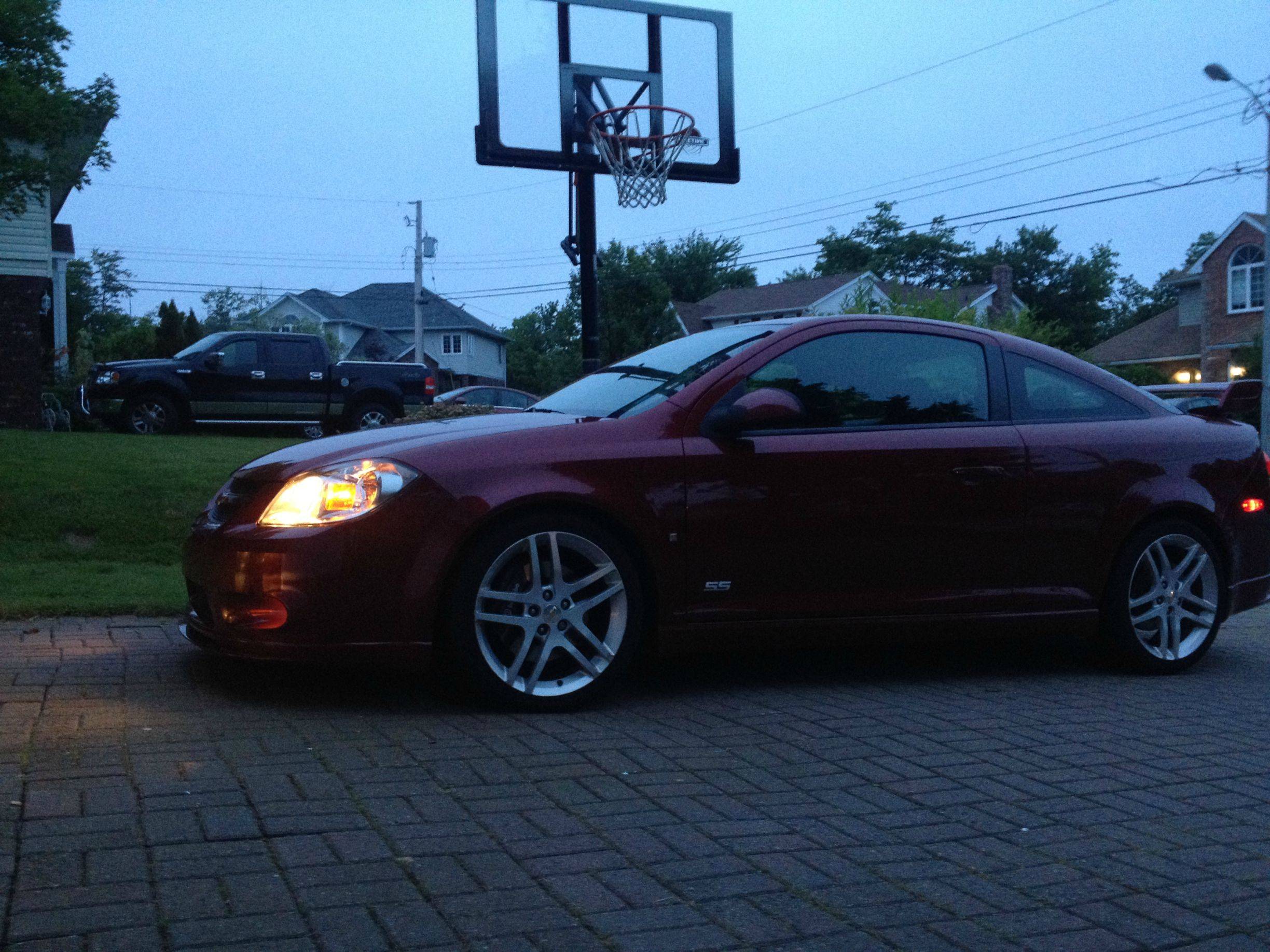
There's my baby. Sorry for big pics lol... taken with my iphone. Recently lowered on CM springs.
There's my baby. Sorry for big pics lol... taken with my iphone. Recently lowered on CM springs.
looks great man.. I had the same colour but I had the low rise. makes me miss my Cobalt lol. I wish I had taken the K&N off of mine before I sold it but I was impatient to get the new keys lol


New Member
Joined: 07-20-09
Posts: 116
Likes: 0
From: HFX
Leveticus
did me and the mrs see you on the peggy's cove loop maybe a month or so ago? we were headed to timberlea and a yellow SS was in other lane going towards peggys cove and flashed lights at us. i waved, was it you dude?
haven't seen many actual yellow SS's around here...
did me and the mrs see you on the peggy's cove loop maybe a month or so ago? we were headed to timberlea and a yellow SS was in other lane going towards peggys cove and flashed lights at us. i waved, was it you dude?
haven't seen many actual yellow SS's around here...

Senior Member

Joined: 08-07-12
Posts: 1,223
Likes: 13
From: Dartmouth


