


Whipple or Turbo?


Senior Member
Joined: 10-28-06
Posts: 1,216
Likes: 0
From: United States
Why doesnt anyone believe it takes power to run a turbo?
No. turbo's are not free energy.
You'd be surprised how close turbo's actually are to superchargers.
Here is a few key points.
PMEP (pump mean effective pressure). The excessive exhaust manifiold pressure vs. intake manifold pressure takes power away from the engine through pumping losses. Trade off will be pumping loss vs. transient response. More ex. manifold pressure means smaller turbine and quicker response. A properly sized oem turbo will have high pumping loss at the top end.
On a supercharger, its the exact opposite, the high intake pressure and low exhaust actually puts engergy back into the engine through positive puming work. This esentially reduces the amount of energy the supercharger takes from the engine.
However, in the low rpm range, the turbo will have a significant edge in terms of lower power consuption.. but it also has a hard time with transient response in that area as well.. (remember... your not using power if your not producing boost!)
Everyone measures intake manifold pressure.. but with a turbo, you want to watch exhaust manifold pressure as well.
No. turbo's are not free energy.
You'd be surprised how close turbo's actually are to superchargers.
Here is a few key points.
PMEP (pump mean effective pressure). The excessive exhaust manifiold pressure vs. intake manifold pressure takes power away from the engine through pumping losses. Trade off will be pumping loss vs. transient response. More ex. manifold pressure means smaller turbine and quicker response. A properly sized oem turbo will have high pumping loss at the top end.
On a supercharger, its the exact opposite, the high intake pressure and low exhaust actually puts engergy back into the engine through positive puming work. This esentially reduces the amount of energy the supercharger takes from the engine.
However, in the low rpm range, the turbo will have a significant edge in terms of lower power consuption.. but it also has a hard time with transient response in that area as well.. (remember... your not using power if your not producing boost!)
Everyone measures intake manifold pressure.. but with a turbo, you want to watch exhaust manifold pressure as well.

Senior Member
Joined: 07-08-05
Posts: 6,200
Likes: 0
From: Niceville, FL
I understand a turbo takes exhaust energy to spool it. It doesn't however take power from the engines belt system to spin it like a supercharger. The supercharger causes a direct pararsititc drag on the engine, whereas the turbo utilizes the engines "by-product" exhaust energy creating a very minimal amount of drag on the engine. With a proper turbo and exhaust size, the exhaust will still flow freely. Once the turbo is in full motion, it will require even less effort to keep it spinning at that speed as well. Newton's laws here. That is also why turbos have great top end.
Senior Member
Joined: 10-28-06
Posts: 1,216
Likes: 0
From: United States
I understand a turbo takes exhaust energy to spool it. It doesn't however take power from the engines belt system to spin it like a supercharger. The supercharger causes a direct pararsititc drag on the engine, whereas the turbo utilizes the engines "by-product" exhaust energy creating a very minimal amount of drag on the engine. With a proper turbo and exhaust size, the exhaust will still flow freely. Once the turbo is in full motion, it will require even less effort to keep it spinning at that speed as well. Newton's laws here. That is also why turbos have great top end.
Here is a theoretical situation.. your boosting at 20psi.. and you instantly uncouple the turbine and compressor wheel, The compressor wheel would slow down nearly instantly and your boost would be zero before you could blink. Even supercharger with LOTS of inertia slow down VERY fast once the belt breaks under full boost.
You have completely miss how turbos work, the energy is not put into spooling the turbo. The reason turbo's take a while to spool is the fact air is compressible and you must create enough mass flow through the turbine wheel to spin the compressor wheel..
The most energy used by a turbo is during full boost high rpm situations.
The only reason most people dont understand is because they cant see it like they can see a belt.
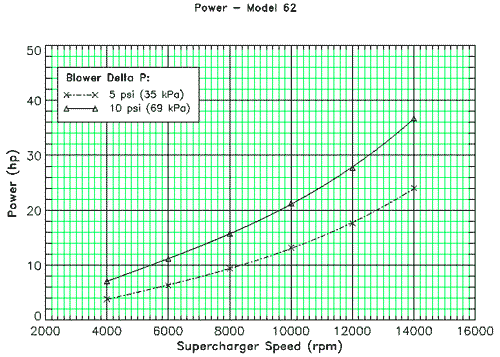
Your parasitic drag argument is also not completely correct... Parasitic losses would be under no boost conditions.. where the pressure on the INLET of the supercharger is the same as the pressure of the OUTLET of the supercharger.. if the supercharger is still requiring energy in this condition, its considered parasitic loss. And FYI.. your M62 uses less than 0.5hp under these conditions.. Why do you think OEM's dont use screw type SC's??? Internal compresson! you must use more energy to compress air inside the supercharger and then spit it out back to the same pressure as the inlet. This happens during cruising conditions.. i.e. driving down the highway.. your using more energy for no real reason. The Roots type has no internal compression, so once the bypass valve opens, it doesnt compress air and uses very little engergy.
The belt losses can be calculated in terms of efficiency... It takes work to compress air, and the belt consumes this theoretical amount plus some inefficiecy due to bearings and gears.. but that is minimal.. just think, if you were loosing tons of energy through the bearings and gears... you would be heating the crap out of it and melting down the system.. Where else would that energy go? Do you need to run a cooler through the supercharger oil? Nope... Basic laws of Thermodynamics.
It requires energy to compress air, you cannot avoid this. Turbo's are not exempt
Last edited by TVS_SS; Dec 29, 2006 at 11:51 AM.

Senior Member
Joined: 07-27-06
Posts: 603
Likes: 0
From: Georgia

New Member
Joined: 10-01-06
Posts: 37
Likes: 0
From: Delaware
A little off topic, what is the final goal of your car (besides a hp number.) What I'm saying is what are you going to do with 400whp, is it going to be a track car, a dd, an auto-x car? What is your reasoning i demand to know!

New Member
Joined: 09-20-05
Posts: 47
Likes: 0
From: Flint, MI
The obvious thing about a turbo i believe someone forgot to metion is you can change the boost pressure without going haveing to change the pulley. it makes it very easy to dial in a set boost you would like. not saying changing a pulley is too difficult.

Senior Member
Joined: 06-30-06
Posts: 2,647
Likes: 0
From: Langley AFB, VA

Senior Member
Joined: 05-29-06
Posts: 1,084
Likes: 0
From: Pennsylvania, Greensburg
I'm going with the blower swap. Love the sound, instant torque, and the time it would take to go back to stock. It just seems more practical and being able to hit between 350hp and 400hp is enough for a fwd car. I plan on getting it as soon as I see what others responses to the swap are. Yeah, I'm a chicken.

Senior Member
Joined: 03-03-06
Posts: 4,958
Likes: 0
From: Pittsburgh, PA
Senior Member
Joined: 11-30-06
Posts: 506
Likes: 0
From: Kansas City
I still don't see why ppl just don't build a High compression 2.2 and put a good bit of Nitrous through it. yeah I know people like the s/c and the turbo's but nothing is more consistent then Nitrous. for what you are going to spend on a turbo you could buil a 2.2. just a thought


Banned
Joined: 01-28-06
Posts: 890
Likes: 0
From: Depew, NY
Thats a stupid statement. Superchargers have a bypass valve to get rid of excess air. Just run the smallest pulley you can then use a boost controller to limit the amount of boost. This will cause full boost earlier if being limited lower then what the pulley wants to spit out.

Senior Member
Joined: 06-28-06
Posts: 2,755
Likes: 0
From: Illinois
Well I was talking to the guys at SLS, about custom fabbing a turbo kit for me. They said it could be done for roughly 3,500-4,000. Thats with everything, FMIC, Turbo, Hard Pipes, Badass manifold, BOV, and tuning. Now my question to you guys is this, go turbo or go with Tag's Lysolm? They both will net me the roughly the same gains. But Nick told why take power to make it? He has a point, these guys do awesome work. He told me when he was at PIR when they were at the booth Hahn was asking them all sorts of questions. He told me not go with Hahn either he said quality is below average for the price you pay. SLS also has a 10 second Integra which is the fastest FF daily driver within 4 states.
By the way I have no affiliation with Hahn, I've never used their products, and I have never had any contact with them. Their product may very well be inferior, if so this is the place to hear it, not from a guy trying to sell you his stuff. It's just everytime I hear a vendor run down another I just roll my eyes because it seems childish.

Senior Member
Joined: 10-08-05
Posts: 5,295
Likes: 0
From: AZ
I'm interested. On Blown 4-bangers car the computer is commanding a .8 pulse width with the idle set at 1050rpm. Minimum recomended by Siemens is 1.0 if I remember correctly.
Senior Member
Joined: 07-08-05
Posts: 6,200
Likes: 0
From: Niceville, FL
hmm.. well i hate to break the news to you.. but "once the turbo is in full motion" statement is false. If the turbine and compressor wheels had large moments of inertia, i may agree, however, with lighter and lighter wheels, the ineria effect is very minimal. Newtons laws are at work.. but you must apply them properly.
Here is a theoretical situation.. your boosting at 20psi.. and you instantly uncouple the turbine and compressor wheel, The compressor wheel would slow down nearly instantly and your boost would be zero before you could blink. Even supercharger with LOTS of inertia slow down VERY fast once the belt breaks under full boost.
You have completely miss how turbos work, the energy is not put into spooling the turbo. The reason turbo's take a while to spool is the fact air is compressible and you must create enough mass flow through the turbine wheel to spin the compressor wheel..
The most energy used by a turbo is during full boost high rpm situations.
The only reason most people dont understand is because they cant see it like they can see a belt.
Your parasitic drag argument is also not completely correct... Parasitic losses would be under no boost conditions.. where the pressure on the INLET of the supercharger is the same as the pressure of the OUTLET of the supercharger.. if the supercharger is still requiring energy in this condition, its considered parasitic loss. And FYI.. your M62 uses less than 0.5hp under these conditions.. Why do you think OEM's dont use screw type SC's??? Internal compresson! you must use more energy to compress air inside the supercharger and then spit it out back to the same pressure as the inlet. This happens during cruising conditions.. i.e. driving down the highway.. your using more energy for no real reason. The Roots type has no internal compression, so once the bypass valve opens, it doesnt compress air and uses very little engergy.
The belt losses can be calculated in terms of efficiency... It takes work to compress air, and the belt consumes this theoretical amount plus some inefficiecy due to bearings and gears.. but that is minimal.. just think, if you were loosing tons of energy through the bearings and gears... you would be heating the crap out of it and melting down the system.. Where else would that energy go? Do you need to run a cooler through the supercharger oil? Nope... Basic laws of Thermodynamics.
It requires energy to compress air, you cannot avoid this. Turbo's are not exempt
Here is a theoretical situation.. your boosting at 20psi.. and you instantly uncouple the turbine and compressor wheel, The compressor wheel would slow down nearly instantly and your boost would be zero before you could blink. Even supercharger with LOTS of inertia slow down VERY fast once the belt breaks under full boost.
You have completely miss how turbos work, the energy is not put into spooling the turbo. The reason turbo's take a while to spool is the fact air is compressible and you must create enough mass flow through the turbine wheel to spin the compressor wheel..
The most energy used by a turbo is during full boost high rpm situations.
The only reason most people dont understand is because they cant see it like they can see a belt.
Your parasitic drag argument is also not completely correct... Parasitic losses would be under no boost conditions.. where the pressure on the INLET of the supercharger is the same as the pressure of the OUTLET of the supercharger.. if the supercharger is still requiring energy in this condition, its considered parasitic loss. And FYI.. your M62 uses less than 0.5hp under these conditions.. Why do you think OEM's dont use screw type SC's??? Internal compresson! you must use more energy to compress air inside the supercharger and then spit it out back to the same pressure as the inlet. This happens during cruising conditions.. i.e. driving down the highway.. your using more energy for no real reason. The Roots type has no internal compression, so once the bypass valve opens, it doesnt compress air and uses very little engergy.
The belt losses can be calculated in terms of efficiency... It takes work to compress air, and the belt consumes this theoretical amount plus some inefficiecy due to bearings and gears.. but that is minimal.. just think, if you were loosing tons of energy through the bearings and gears... you would be heating the crap out of it and melting down the system.. Where else would that energy go? Do you need to run a cooler through the supercharger oil? Nope... Basic laws of Thermodynamics.
It requires energy to compress air, you cannot avoid this. Turbo's are not exempt
Oh, and on the supercharger oil changing, it's different for your stock Eaton. Please do not get worried. I'm not sure what the Eaton's requirements are off the top of my head. I pulled that oil change info off Kenne Bell's website for the twinscrew applications.

Banned
Joined: 01-28-06
Posts: 890
Likes: 0
From: Depew, NY
How does a supercharger not help itself? It creates more forces inside of the chamber and foces the piston down which rotates the crank which spins the supercharger. How could make such a stupid statement as a supercharger does not help itself create power?
Senior Member
Joined: 04-03-06
Posts: 7,570
Likes: 0
From: Mesa, AZ

Senior Member
Joined: 07-08-05
Posts: 6,200
Likes: 0
From: Niceville, FL
Put it this way. Take the same car with a turbo and take the same car with a supercharger. If both the turbo and supercharger theoretically put out the same CFM's, the turbo'd car would make more power in the end because it isn't directly pulling power from the crank to drive it. This is where I am going with this whole ordeal. No more and no less.
Senior Member
Joined: 10-28-06
Posts: 1,216
Likes: 0
From: United States
Put it this way. Take the same car with a turbo and take the same car with a supercharger. If both the turbo and supercharger theoretically put out the same CFM's, the turbo'd car would make more power in the end because it isn't directly pulling power from the crank to drive it. This is where I am going with this whole ordeal. No more and no less.
Now finding the best setup for your engine will be a compromise of a number of factors and energy used to drive the boost system will only be one part..
Senior Member
Joined: 10-08-05
Posts: 5,295
Likes: 0
From: AZ
I understand what you are saying but i think your thinking about it wrong. Look at it this way: It doesnt matter where the energy comes from (belt or pumping losses) power is power. If your using 35hp to drive a supercharger through a belt and then get 5hp back in positive puming work for a grand total of 30 hp used. Then if you have a turbo that takes 30hp in negative pumping work you will end up at the same point... does not matter if your driving through a belt or not, again, power is power. Pumping losses DO pull energy from the crank.. the pistons are acted on by the pressure, forces sent through connecting rod and finally.. the crank!
Now finding the best setup for your engine will be a compromise of a number of factors and energy used to drive the boost system will only be one part..
Now finding the best setup for your engine will be a compromise of a number of factors and energy used to drive the boost system will only be one part..
Senior Member
Joined: 07-08-05
Posts: 6,200
Likes: 0
From: Niceville, FL
I think were at a stand still here.  I just did some more research, and to an extent we're both right. Added exhaust backpressure caused by the turbines impeller will rob power. Superchargers pull power from the crank to create power. Both systems rob power and do not give "free" power. The turbocharger is usually more efficient however at making the total net power. The supercharger is great at making torque and power down low.
The decision is based on what the person wants ideally here in the end. I hope we all can at least agree on that. I personally am going with the Lysholm 1200AX twin-screw swap because I want the flat torque curve, great power down low, and a decent gain overall.
articzap, I'm sorry if I offended or pissed you off somehow because it seems like you’re angry with me for some reason. I'm not sure if you were intentionally being rude or just came off that way, but I was just trying to provide a decent and informational comparison with the assistance of the fellow ss.net members here to answer the question that started this whole post. Either way I'm hoping we can just end the confrontation and go about our business on here.
I just did some more research, and to an extent we're both right. Added exhaust backpressure caused by the turbines impeller will rob power. Superchargers pull power from the crank to create power. Both systems rob power and do not give "free" power. The turbocharger is usually more efficient however at making the total net power. The supercharger is great at making torque and power down low.The decision is based on what the person wants ideally here in the end. I hope we all can at least agree on that.
I personally am going with the Lysholm 1200AX twin-screw swap because I want the flat torque curve, great power down low, and a decent gain overall. articzap, I'm sorry if I offended or pissed you off somehow because it seems like you’re angry with me for some reason. I'm not sure if you were intentionally being rude or just came off that way, but I was just trying to provide a decent and informational comparison with the assistance of the fellow ss.net members here to answer the question that started this whole post. Either way I'm hoping we can just end the confrontation and go about our business on here.
Senior Member
Joined: 03-03-06
Posts: 4,958
Likes: 0
From: Pittsburgh, PA
I think were at a stand still here. I just did some more research, and to an extent we're both right. Added exhaust backpressure caused by the turbines impeller will rob power. Superchargers pull power from the crank to create power. Both systems rob power and do not give "free" power. The turbocharger is usually more efficient however at making the total net power. The supercharger is great at making torque and power down low.
The decision is based on what the person wants ideally here in the end. I hope we all can at least agree on that. I personally am going with the Lysholm 1200AX twin-screw swap because I want the flat torque curve, great power down low, and a decent gain overall.
articzap, I'm sorry if I offended or pissed you off somehow because it seems like you’re angry with me for some reason. I'm not sure if you were intentionally being rude or just came off that way, but I was just trying to provide a decent and informational comparison with the assistance of the fellow ss.net members here to answer the question that started this whole post. Either way I'm hoping we can just end the confrontation and go about our business on here.
I just did some more research, and to an extent we're both right. Added exhaust backpressure caused by the turbines impeller will rob power. Superchargers pull power from the crank to create power. Both systems rob power and do not give "free" power. The turbocharger is usually more efficient however at making the total net power. The supercharger is great at making torque and power down low.The decision is based on what the person wants ideally here in the end. I hope we all can at least agree on that.
I personally am going with the Lysholm 1200AX twin-screw swap because I want the flat torque curve, great power down low, and a decent gain overall. articzap, I'm sorry if I offended or pissed you off somehow because it seems like you’re angry with me for some reason. I'm not sure if you were intentionally being rude or just came off that way, but I was just trying to provide a decent and informational comparison with the assistance of the fellow ss.net members here to answer the question that started this whole post. Either way I'm hoping we can just end the confrontation and go about our business on here.
Banned
Joined: 01-28-06
Posts: 890
Likes: 0
From: Depew, NY
snip....
articzap, I'm sorry if I offended or pissed you off somehow because it seems like you’re angry with me for some reason. I'm not sure if you were intentionally being rude or just came off that way, but I was just trying to provide a decent and informational comparison with the assistance of the fellow ss.net members here to answer the question that started this whole post. Either way I'm hoping we can just end the confrontation and go about our business on here.
articzap, I'm sorry if I offended or pissed you off somehow because it seems like you’re angry with me for some reason. I'm not sure if you were intentionally being rude or just came off that way, but I was just trying to provide a decent and informational comparison with the assistance of the fellow ss.net members here to answer the question that started this whole post. Either way I'm hoping we can just end the confrontation and go about our business on here.