


LNF stock Turbo


Thread Starter
Senior Member
Joined: 02-23-07
Posts: 1,120
Likes: 0
From: Orange, CA
LNF stock Turbo
Since a lot of people have been asking what the stock LNF turbo is, I did the research.
Update: BW K04 Compressor Map
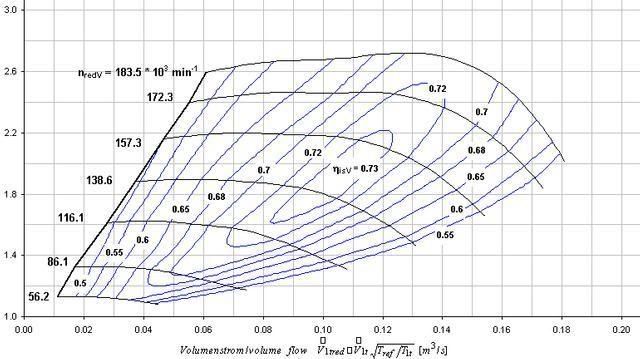
Thanks go to NJHK, Witt, and Beau (solstice forums)
Borg Warner K04 Turbo
Maximum flow:......... .21 kg/s or 380.6 cfm
Optimum output:....... 185 kW or 248chp
It looks like a possible upgrade would be swapping to a K24 turbo (I will be doing more research on this swap: bolt patterns, size, etc)
Borg Warner K24 Turbo
Maximum flow:......... .30 kg/s or 543 cfm
Optimum output:....... 250 kW or 335chp
They both have an efficiency range of 15-25psi.
These two turbochargers are both twin scroll, both have the same type of surgevalve, and both are good to 1050 degrees C.
To give a comparison of turbos, the BW K24 turbo is approximately equal to the flow and power levels as the APS SR30. This is a common street/low hp upgrade for the WRX STI.
Instead of the K24, you could swap to a different brand of turbo rated for higher flow levels, but nothing has been tried yet either way, so all of this is uncharted territory. Currently Hahn is working on a turbo upgrade.
Update: BW K04 Compressor Map
Thanks go to NJHK, Witt, and Beau (solstice forums)
Borg Warner K04 Turbo
Maximum flow:......... .21 kg/s or 380.6 cfm
Optimum output:....... 185 kW or 248chp
It looks like a possible upgrade would be swapping to a K24 turbo (I will be doing more research on this swap: bolt patterns, size, etc)
Borg Warner K24 Turbo
Maximum flow:......... .30 kg/s or 543 cfm
Optimum output:....... 250 kW or 335chp
They both have an efficiency range of 15-25psi.
These two turbochargers are both twin scroll, both have the same type of surgevalve, and both are good to 1050 degrees C.
To give a comparison of turbos, the BW K24 turbo is approximately equal to the flow and power levels as the APS SR30. This is a common street/low hp upgrade for the WRX STI.
Instead of the K24, you could swap to a different brand of turbo rated for higher flow levels, but nothing has been tried yet either way, so all of this is uncharted territory. Currently Hahn is working on a turbo upgrade.
Last edited by Archie; Oct 27, 2007 at 01:29 AM.








Banned
Joined: 12-18-05
Posts: 17,838
Likes: 1
From: North Jersey
pretty sure it's something to do with keeping the boost, and having less lag. the first scroll is used at lower speeds, and the 2nd scroll is used at higher speeds to let more air go through. i think anyways. basically it's to make it more efficient.


Senior Member
Joined: 04-08-06
Posts: 2,395
Likes: 3
From: Charlotte, NC
twin scroll has the exhaust inlet on the turbo seperated into two sections....same with the exhaust manifold. It is divided into two runners, two cylinders per runner...so when each cylinder when it fires has a constant down flow into the turbo. Basically it always has constant pressure to spool the turbo to minimize lag.


Banned
Joined: 09-17-06
Posts: 6,266
Likes: 1
From: between heaven and hell
Thank Wikipedia and this thread over at http://www.supercars.net/PitLane?vie...3344&tID=70114
Sequential twin-turbo
Sequential twin-turbo refers to a set up in which the motor can utilize only one turbocharger for lower engine speeds, and both turbochargers at higher engine speeds. During low to mid engine speeds, when available spent exhaust energy is minimal, only one turbocharger (the primary turbocharger) is active. During this period, all of the engine's exhaust energy is directed to the primary turbocharger only, lowering the boost threshold, and increasing power output at low engine speeds. Towards the end of this cycle, the secondary turbocharger is partially activated (both compressor and turbine flow) in order to pre-spool the secondary turbocharger prior to its full utilization. Once a preset engine speed or boost pressure is attained, valves controlling compressor and turbine flow through the secondary turbocharger are opened completely. At this point the engine is functioning in a full twin-turbocharger form, providing maximum power output. Sequential twin-turbocharger systems provide a way to decrease turbo lag without compromising ultimate boost output and engine power. Examples of cars with a sequential twin-turbo setup include the 1993-2009 Toyota Supra Turbo (JZA8x), the 1992-2002 Mazda RX-7 Turbo (FD3S), and the 1986-1988 Porsche 959. With recent advancements in turbocharger design, sequential twin turbo systems have fallen out of favor because they are seen as unnecessarily costly and complex.
Sequential twin-turbo refers to a set up in which the motor can utilize only one turbocharger for lower engine speeds, and both turbochargers at higher engine speeds. During low to mid engine speeds, when available spent exhaust energy is minimal, only one turbocharger (the primary turbocharger) is active. During this period, all of the engine's exhaust energy is directed to the primary turbocharger only, lowering the boost threshold, and increasing power output at low engine speeds. Towards the end of this cycle, the secondary turbocharger is partially activated (both compressor and turbine flow) in order to pre-spool the secondary turbocharger prior to its full utilization. Once a preset engine speed or boost pressure is attained, valves controlling compressor and turbine flow through the secondary turbocharger are opened completely. At this point the engine is functioning in a full twin-turbocharger form, providing maximum power output. Sequential twin-turbocharger systems provide a way to decrease turbo lag without compromising ultimate boost output and engine power. Examples of cars with a sequential twin-turbo setup include the 1993-2009 Toyota Supra Turbo (JZA8x), the 1992-2002 Mazda RX-7 Turbo (FD3S), and the 1986-1988 Porsche 959. With recent advancements in turbocharger design, sequential twin turbo systems have fallen out of favor because they are seen as unnecessarily costly and complex.

Senior Member
Joined: 10-01-06
Posts: 5,134
Likes: 0
From: Maidstone, SK
Twin scroll trubos work like this:
There are 2 exhaust entry paths into the turbine housing to drive the turbo. At low-medium speeds one is closed off. This causes a higher exhuast velocity, thus resulting in a quick spin-up. At a predetermined engine speed, the second path opens up, allowing full boost.
Of course there is almost no lag with these turbos, but you won't see full boost until higher engine speeds. Small trade off.
There are 2 exhaust entry paths into the turbine housing to drive the turbo. At low-medium speeds one is closed off. This causes a higher exhuast velocity, thus resulting in a quick spin-up. At a predetermined engine speed, the second path opens up, allowing full boost.
Of course there is almost no lag with these turbos, but you won't see full boost until higher engine speeds. Small trade off.

Senior Member
Joined: 04-08-06
Posts: 2,395
Likes: 3
From: Charlotte, NC
The 2.0 turbocharger has two scolls, each is fed by seperate exhaust passage. One passage from cylinders 1 and 4, the other from 2 and 3. On a four cylinder endine, the firing order for the motor is 1-3-4-2...cylinder 1 is ending it's power stroke and opening it's exhaust valve while cylinder 2 still has it's exhaust valve open (cylinder 2 is in it's overlap period). In a conventional exhaust manifold the pressure pulse from cylinder 1's exhaust blowdown event is more likley to contaminate cylinder 2 with high pressure exhaust gas. This not only hurts cylinder 2's ability to breath propery, but this pulse energy would have better been utilized in the turbine....
seperates by firing order to prevent pressure bleeing off of the turbo...allowing for constant pressure to the turbine to minimize lag at low engine speeds....
seperates by firing order to prevent pressure bleeing off of the turbo...allowing for constant pressure to the turbine to minimize lag at low engine speeds....
Thread Starter
Senior Member
Joined: 02-23-07
Posts: 1,120
Likes: 0
From: Orange, CA
The 2.0 turbocharger has two scolls, each is fed by seperate exhaust passage. One passage from cylinders 1 and 4, the other from 2 and 3. On a four cylinder endine, the firing order for the motor is 1-3-4-2...cylinder 1 is ending it's power stroke and opening it's exhaust valve while cylinder 2 still has it's exhaust valve open (cylinder 2 is in it's overlap period). In a conventional exhaust manifold the pressure pulse from cylinder 1's exhaust blowdown event is more likley to contaminate cylinder 2 with high pressure exhaust gas. This not only hurts cylinder 2's ability to breath propery, but this pulse energy would have better been utilized in the turbine....
seperates by firing order to prevent pressure bleeing off of the turbo...allowing for constant pressure to the turbine to minimize lag at low engine speeds....
seperates by firing order to prevent pressure bleeing off of the turbo...allowing for constant pressure to the turbine to minimize lag at low engine speeds....
The WRX uses the mitsu TD04 turbo.
The K04 is also used on the Audi TT 225 1.8t.
Cars that are using the K04 as an upgrade are the Golf, Jetta, Beetle, but all of them make power to about 230-250whp and then make a bigger upgrade. The LNF is more efficient than those cars, but I expect only around 300-310whp on the stock turbo before it is toast, and an upgrade is necessary.

