


Heat Exchanger Coolant


Thread Starter
Senior Member
Joined: 07-08-09
Posts: 1,592
Likes: 0
From: Chandler, Az
Heat Exchanger Coolant
So after installing the new 1/2 gallon tank, things are looking pretty good. Before with the "stock" cobalt setup in there, the system was at its peak temp less then a mile from home. and would stay within 2-3 degrees while cruising, and would always come back to that same temp after a pull. 3 days ago in 100* weather, i was seeing 129-132 on the way to work while cruising, after it was at temp. Today on the way to work, in 101* it reached 122 about a mile before i go to work. So I'd say that just introducing more liquid into the system make a big big big difference.
Now my question is, what is everyone using mixture wise for their coolant and what temps are you seeing from your IAT's? I mixed half a gallon of 50/50 dexcool with half a gallon of DI water, and am running a full gallon of fluid in my system. So really I have a 25/75 mixture coolant to water. Is there anything better that would drop the temp more?
Now my question is, what is everyone using mixture wise for their coolant and what temps are you seeing from your IAT's? I mixed half a gallon of 50/50 dexcool with half a gallon of DI water, and am running a full gallon of fluid in my system. So really I have a 25/75 mixture coolant to water. Is there anything better that would drop the temp more?

Distiller water an a bottle of water wetter is the best you can do. But if u live in an area that gets below freezing or close just use 50/50 cause chafing every season sucks for minimal gains
Thread Starter
Senior Member
Joined: 07-08-09
Posts: 1,592
Likes: 0
From: Chandler, Az
what kinda temps do you see? thanks for the opinion, but im looking for concrete numbers here. I live one of the hottest climates in the country, so I am trying not to experiment and go with what is best.
Well do research than. Distilled water dissipates heat the best. End thread. I don't remember my numbers as I haven't driven my lsj on just distiller water for like 3 years cause it freezes up here. Now I drive my lnf in the summer an the lsj in the winter


ya gotta measure air density; it can change a lot, day to day, even in AZ, and that influences cooling . Also, without option B, there is continual entrained air in the coolant and that dramatically affects laminova heat transfer of the inlet charge.

Thread Starter
Senior Member
Joined: 07-08-09
Posts: 1,592
Likes: 0
From: Chandler, Az
im gonna update this everyday just so i can look back at it later and see how it all changed.
left for work today, turned the car on and iats were 95.2 basically ambient temp. drove a mile to get on the freeway, and iat was 107 by then. got on the freeway, and it climbed to 120.2 over a 8 mile drive, and stayed there till i full boosted off the transition from one freeway to another. then it climbed to 136, and back down to 130 and stayed there for the last 2 miles of freeway driving.
with ambient temps outside over 100, and the air in the engine bay, it wouldnt surprise me if the manifold was 140ish degrees to the touch, so I think that 120 at cruise, and climbing to 130 after boost is pretty good.
what do you guys think?
keep in mind, i have a stock cobalt pump, with a cobra heat exchanger only, and i am running about 3/4's of a gallon of 25/75 coolant to water.
left for work today, turned the car on and iats were 95.2 basically ambient temp. drove a mile to get on the freeway, and iat was 107 by then. got on the freeway, and it climbed to 120.2 over a 8 mile drive, and stayed there till i full boosted off the transition from one freeway to another. then it climbed to 136, and back down to 130 and stayed there for the last 2 miles of freeway driving.
with ambient temps outside over 100, and the air in the engine bay, it wouldnt surprise me if the manifold was 140ish degrees to the touch, so I think that 120 at cruise, and climbing to 130 after boost is pretty good.
what do you guys think?
keep in mind, i have a stock cobalt pump, with a cobra heat exchanger only, and i am running about 3/4's of a gallon of 25/75 coolant to water.
im gonna update this everyday just so i can look back at it later and see how it all changed.
left for work today, turned the car on and iats were 95.2 basically ambient temp. drove a mile to get on the freeway, and iat was 107 by then. got on the freeway, and it climbed to 120.2 over a 8 mile drive, and stayed there till i full boosted off the transition from one freeway to another. then it climbed to 136, and back down to 130 and stayed there for the last 2 miles of freeway driving.
with ambient temps outside over 100, and the air in the engine bay, it wouldnt surprise me if the manifold was 140ish degrees to the touch, so I think that 120 at cruise, and climbing to 130 after boost is pretty good.
what do you guys think?
keep in mind, i have a stock cobalt pump, with a cobra heat exchanger only, and i am running about 3/4's of a gallon of 25/75 coolant to water.
left for work today, turned the car on and iats were 95.2 basically ambient temp. drove a mile to get on the freeway, and iat was 107 by then. got on the freeway, and it climbed to 120.2 over a 8 mile drive, and stayed there till i full boosted off the transition from one freeway to another. then it climbed to 136, and back down to 130 and stayed there for the last 2 miles of freeway driving.
with ambient temps outside over 100, and the air in the engine bay, it wouldnt surprise me if the manifold was 140ish degrees to the touch, so I think that 120 at cruise, and climbing to 130 after boost is pretty good.
what do you guys think?
keep in mind, i have a stock cobalt pump, with a cobra heat exchanger only, and i am running about 3/4's of a gallon of 25/75 coolant to water.


Do you have working A/C on your car and do you use it? The stock Cobalt heat exchanger is behind the A/C Condensor, so if you only have it in the stock location, you will see some heat transfer. I would recomend placing it in the stock location if you do have working A/C and use the secondary Cobra unit in front of the A/C Condensor.
Route it so that the stock exchanger is first out of the end plate. This would basicly give you a pre-cool, then from there to the Cobra unit to drop the temps down further. It is arguable as to whether to plumb the pump in so that it pushes to the intake or pushes to the heat exchangers. My preference would be to push to the intake, so the pump does not have to take all of the heat straight out of the intake.
Route it so that the stock exchanger is first out of the end plate. This would basicly give you a pre-cool, then from there to the Cobra unit to drop the temps down further. It is arguable as to whether to plumb the pump in so that it pushes to the intake or pushes to the heat exchangers. My preference would be to push to the intake, so the pump does not have to take all of the heat straight out of the intake.
Do you have working A/C on your car and do you use it? The stock Cobalt heat exchanger is behind the A/C Condensor, so if you only have it in the stock location, you will see some heat transfer. I would recomend placing it in the stock location if you do have working A/C and use the secondary Cobra unit in front of the A/C Condensor.
Route it so that the stock exchanger is first out of the end plate. This would basicly give you a pre-cool, then from there to the Cobra unit to drop the temps down further. It is arguable as to whether to plumb the pump in so that it pushes to the intake or pushes to the heat exchangers. My preference would be to push to the intake, so the pump does not have to take all of the heat straight out of the intake.
Route it so that the stock exchanger is first out of the end plate. This would basicly give you a pre-cool, then from there to the Cobra unit to drop the temps down further. It is arguable as to whether to plumb the pump in so that it pushes to the intake or pushes to the heat exchangers. My preference would be to push to the intake, so the pump does not have to take all of the heat straight out of the intake.
Thread Starter
Senior Member
Joined: 07-08-09
Posts: 1,592
Likes: 0
From: Chandler, Az
Today was pretty much the same as yesterday, except about 2 miles from work (had not boosted the entire drive) it jumped from 122 all the way to 136 instantly and stayed there the rest of the drive. i wonder if i have an air bubble...
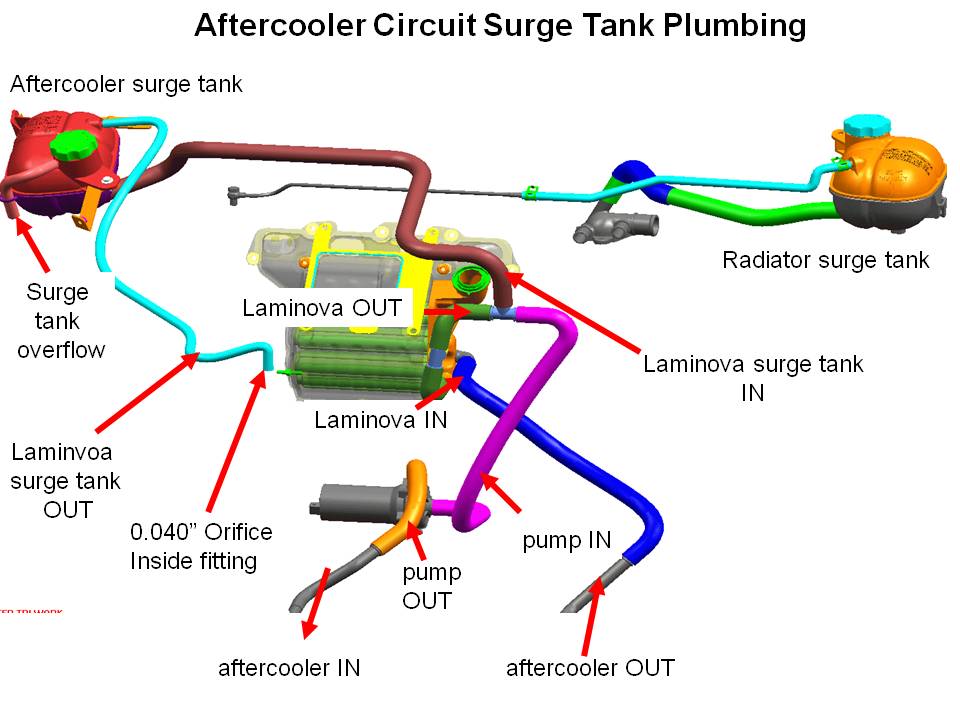
of course this is for option B plumbing with dual pass end plate. If you ran an FMIC it would go OUT of the aftercooler, IN to the FMIC, then OUT of the FMIC and resume its route to laminova IN which in a dual pass is the center port. So supercooled fluid is now accepting and transferring heat from the inlet air charge through the laminova cores.
interesting.
interesting.
