


General Suspension: Bleeding the brakes

Thread Starter
I'm old school
Joined: 02-16-05
Posts: 6,905
Likes: 3
From: Nashville
Bleeding the brakes
This is actually a very easy job, but requires that the steps be followed exactly and carefully to avoid any complications. You will need two people for this job.
As Halfj99 points out below, this is done with the car off.
First, get your car on stands and take the wheels off. Then top off your reservoir using a quality DOT 3 fluid.
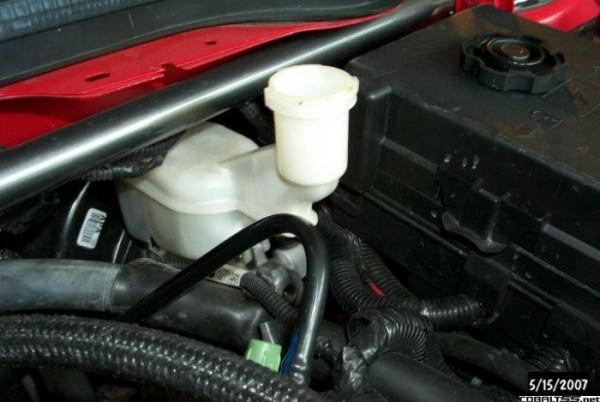
There really aren't any "FULL" lines on it. Just fill it to the seam at the top.
The proper order to bleed in is right rear, left front, left rear, right front. The pictures below are not in order.
Fronts first for this how to. Prepare the bleeder plug for the wheel you are going to work on. Slip a 10mm box end wrench over it (not pictured) and then a length of 1/4 I.D. vinyl tubing. You want it to be clear so you can see the fluid. Use a waste bottle to catch fluid.

Here is a rear drum. This bleeder nut is an 8mm.

With your helper, get your signals straight. I use "on-on", "off-off". Tell your helper that when they hear you say "on", they are to apply full brake pedal to the floor and hold it there, and then reply "on". Make sure they know to not release the pedal until commanded. Conversly, when you say "off", they are to fully release it and the let the pedal travel fully up and then reply "off".
Here we go. Crack the bleeder plug open. Only open it about a quarter to half turn. Any more can allow air to enter via the threads. Call "on". You may or may not get fluid at first. Once your recieve "on", close the bleeder. Call "off". Once you recieve "off", repeat the cycle.
Continue this until you no longer have any air flowing out of the line. Do one full cycle of full fluid, and then your done with that wheel.
Before moving on to the next wheel, top off your reservoir again. Do this before each wheel.
If you are simply bleeding your system, you are done. If you are replacing all your old brake fluid, now go back to the first wheel and start over again. This time, there won't be any air. You are looking for a color change in the fluid, indicating that you are now pumping fresh fluid. Repeat for the other wheels.
As Halfj99 points out below, this is done with the car off.
First, get your car on stands and take the wheels off. Then top off your reservoir using a quality DOT 3 fluid.
There really aren't any "FULL" lines on it. Just fill it to the seam at the top.
The proper order to bleed in is right rear, left front, left rear, right front. The pictures below are not in order.
Fronts first for this how to. Prepare the bleeder plug for the wheel you are going to work on. Slip a 10mm box end wrench over it (not pictured) and then a length of 1/4 I.D. vinyl tubing. You want it to be clear so you can see the fluid. Use a waste bottle to catch fluid.
Here is a rear drum. This bleeder nut is an 8mm.
With your helper, get your signals straight. I use "on-on", "off-off". Tell your helper that when they hear you say "on", they are to apply full brake pedal to the floor and hold it there, and then reply "on". Make sure they know to not release the pedal until commanded. Conversly, when you say "off", they are to fully release it and the let the pedal travel fully up and then reply "off".
Here we go. Crack the bleeder plug open. Only open it about a quarter to half turn. Any more can allow air to enter via the threads. Call "on". You may or may not get fluid at first. Once your recieve "on", close the bleeder. Call "off". Once you recieve "off", repeat the cycle.
Continue this until you no longer have any air flowing out of the line. Do one full cycle of full fluid, and then your done with that wheel.
Before moving on to the next wheel, top off your reservoir again. Do this before each wheel.
If you are simply bleeding your system, you are done. If you are replacing all your old brake fluid, now go back to the first wheel and start over again. This time, there won't be any air. You are looking for a color change in the fluid, indicating that you are now pumping fresh fluid. Repeat for the other wheels.
Last edited by Staged07SS; Nov 20, 2015 at 07:41 AM. Reason: correcting information

New Member
Joined: 03-15-06
Posts: 104
Likes: 0
From: Norfolk, VA
you only need to bleed the brakes if you open up any of the brake lines i.e taking your calipers off to paint them, for instance. if your just putting new pads on youll be fine. just gotta pump the pedal a few times before you try to drive off. if you dont bleed the brakes after you open a line, air will get in the system and you'll have a spongy pedal and little braking power.

Senior Member
Joined: 06-18-06
Posts: 4,883
Likes: 0
From: Madison,WI
one thing i wanna add to this, do not turn the cars power on at all when doing this. especially those with abs,with the power on, the brake booster will be on,...if you press the brakes with the car on, it will shoot that brake fluid out very hard, i've heard of it piercing skin, and death from that
Only if there is air in the system. Air can compress, the brake fluid can't. Air in the system means that you will get a spongy pedal, meaning that you have play in the system before the brakes actually start to grab, not a firm point like usual.

New Member
Joined: 02-25-07
Posts: 101
Likes: 0
From: Pell City,AL
Just did this & WOW my brake pedal is higher& car stops much better...I upgraded to DOT 4 fluid. The recommend order is to start @ the fartherest wheel from the master cylinder& move to closest....R/Rear, L/Rear, R/Front& last is L/Front. If you brake hard,run auto-x or track days I highly recommend doing this easy& cheap maintenance. NOTE: If changing to DOT 4 or higher use a suction bulb to remove almost all of the old fluid in reservoir to make flushing go much quicker.
A fluid upgrade is always good, but unnecessary for a street only car. Like you said, auto-x or track days you will see a nice difference. Just make sure that the new fluid is compatible, I forget if its DOT 5 or 5.1 that doesn't mix with the regular fluids, but I know one of them needs a 100% clean system to use.

has anyone heard of how to bleed the abs module or if this is even necessary? i was told that you had to hook up the tech 2 and it would electronically bleed the module...is there any truth to that statement?
Thread Starter
I'm old school
Joined: 02-16-05
Posts: 6,905
Likes: 3
From: Nashville
There is a shop procedure where they connect the Tech2 and command the ABS module to pump constantly. This is usually necessary if you have removed, replaced, or completely drained the module. If you just took off a caliper, you don't need to do that.

New Member
Joined: 08-16-08
Posts: 63
Likes: 0
From: Stittville, New York
This weekend I changed the brake fluid to DOT 4 on a SS/TC for one of my guys that does track days at Watkins Glen.
He ordered a Motive Products Power Bleeder.
I has a plastic tank with a pump so you can put 10 PSI on the system and a cap that replaces the stock with a clear plastic line between them.
We used ATE fluid which is blue in color and next time we will use the gold color, very cool.
This is the very best way I have ever found to bleed brakes.
You just replace the master cylinder cap, put new brake fluid in the bottle, pump it up to 10 PSI (20 PSI will blow the cap off) and go to each bleeder valve, open it and the new blue fluid will flow.
I took about 12 oz of new fluid to do the change.
The next morning I did a Corolla I'm working on for my daughter and from start to finish it was about 5 minutes because we figured out all the little problem on the SS/TC and the Rolla was up on jack stands.
The GM bleeder is around $65 but was out of stock so he ended up with the one that will bleed just about every brake systen ever made and that one was $150
He ordered a Motive Products Power Bleeder.
I has a plastic tank with a pump so you can put 10 PSI on the system and a cap that replaces the stock with a clear plastic line between them.
We used ATE fluid which is blue in color and next time we will use the gold color, very cool.
This is the very best way I have ever found to bleed brakes.
You just replace the master cylinder cap, put new brake fluid in the bottle, pump it up to 10 PSI (20 PSI will blow the cap off) and go to each bleeder valve, open it and the new blue fluid will flow.
I took about 12 oz of new fluid to do the change.
The next morning I did a Corolla I'm working on for my daughter and from start to finish it was about 5 minutes because we figured out all the little problem on the SS/TC and the Rolla was up on jack stands.
The GM bleeder is around $65 but was out of stock so he ended up with the one that will bleed just about every brake systen ever made and that one was $150

New Member
Joined: 01-30-08
Posts: 83
Likes: 0
From: Sherbrooke
I blead my brakes last night and for some reason my pedal is still soft. I did the handbrake trick that I read about in another forum, but it didn't work. I dont know what to do anymore. The brake pedals goes all the way down and never gets hard, even when the car is off it doesnt get hard. Any ideas ???
Thread Starter
I'm old school
Joined: 02-16-05
Posts: 6,905
Likes: 3
From: Nashville
Sounds like you messed up. Handbrake trick? Don't do whatever that is.
It sounds like you have introduced air into the line. This happens when you release the brake pedal during bleeding without having fully closed the bleeder port at the brake you are working on.
Do the procedure over again. You are using a helper, right?
It sounds like you have introduced air into the line. This happens when you release the brake pedal during bleeding without having fully closed the bleeder port at the brake you are working on.
Do the procedure over again. You are using a helper, right?

Senior Member
Joined: 09-24-08
Posts: 519
Likes: 1
From: Upstate NY
I blead my brakes last night and for some reason my pedal is still soft. I did the handbrake trick that I read about in another forum, but it didn't work. I dont know what to do anymore. The brake pedals goes all the way down and never gets hard, even when the car is off it doesnt get hard. Any ideas ???
New Member
Joined: 01-30-08
Posts: 83
Likes: 0
From: Sherbrooke
Sounds like you messed up. Handbrake trick? Don't do whatever that is.
It sounds like you have introduced air into the line. This happens when you release the brake pedal during bleeding without having fully closed the bleeder port at the brake you are working on.
Do the procedure over again. You are using a helper, right?
It sounds like you have introduced air into the line. This happens when you release the brake pedal during bleeding without having fully closed the bleeder port at the brake you are working on.
Do the procedure over again. You are using a helper, right?
Thread Starter
I'm old school
Joined: 02-16-05
Posts: 6,905
Likes: 3
From: Nashville
Did you do anything to the brakes themselves? For instance, if you have rear drums and you disassembled them, you need to adjust them. I should ask, why are you bleeding in the first place? What did you take apart?
New Member
Joined: 01-30-08
Posts: 83
Likes: 0
From: Sherbrooke
I took the calipers off to clean then up and look at my brake pads. Would it have matter if I pushed the front pistons back in but the back I didnt turn them back inm and push them back? because to me they should reajust themselves. is there a certain way you have to bleed when you have ABS brakes. and i have a ss/sc so i have discs all around.
Thread Starter
I'm old school
Joined: 02-16-05
Posts: 6,905
Likes: 3
From: Nashville
If you took off the caliper, then you need to completely compress the piston of that caliper before bleeding it. The bleeder will not be able to get out any air that might be in the caliper. You should only have to do that for the caliper you removed. So if you didn't take the rear ones off, then you shouldn't have to worry about it.

You need to rebleed the system....If the pedal is mushy or goes to the floor there is something wrong, or air in the system
The proper order is RR, LF, LR, RF, yes....thats right rear, left front, left rear, right front.
The proper order is RR, LF, LR, RF, yes....thats right rear, left front, left rear, right front.
Thread Starter
I'm old school
Joined: 02-16-05
Posts: 6,905
Likes: 3
From: Nashville

New Member
Joined: 01-05-09
Posts: 43
Likes: 0
From: MO
One thing that could be added to the how-to: I've always poured enough brake fluid into the catch bottle so that the bleed hose is submerged. Once the air in the hose is pushed out, the chances of air getting back into the hose and the caliper is greatly reduced in case there is miscommunication between you and your, um, pumper. Also, the res cap, fittings and surrounding areas should be cleaned prior to opening.
Brake fluid is hygroscopic and absorbs water (by design) and, even if you never open the system, water vapor will eventually be absorbed through the hoses and seals and deteriorate braking performance over time. It won't hurt to exchange the fluid every couple of years.
I've used the motive bleeder and it really makes the job easy when you have no help. Unfortunately, it's self defeating if you are concerned with minimizing the air and water content of fresh fluid. The fluid will absorb water vapor from just being exposed to air so introducing pressurized air is even worse. Since the motive bleeder has no diaphragm between the fluid and pressure source, air can actually permeate the fluid and reduce the fluids life span. It's not a bad product but it's not the best solution. You wouldn't add a pinch of dirt to a fresh quart of oil before putting it into your engine, would ya? For one-man bleeding you can buy a hose with a check valve at the end. I think Jeg's sells them for like $10. You'll have to do your own pumping and top off the resevoir but it'll save you money and time down the road.
Brake fluid is hygroscopic and absorbs water (by design) and, even if you never open the system, water vapor will eventually be absorbed through the hoses and seals and deteriorate braking performance over time. It won't hurt to exchange the fluid every couple of years.
I've used the motive bleeder and it really makes the job easy when you have no help. Unfortunately, it's self defeating if you are concerned with minimizing the air and water content of fresh fluid. The fluid will absorb water vapor from just being exposed to air so introducing pressurized air is even worse. Since the motive bleeder has no diaphragm between the fluid and pressure source, air can actually permeate the fluid and reduce the fluids life span. It's not a bad product but it's not the best solution. You wouldn't add a pinch of dirt to a fresh quart of oil before putting it into your engine, would ya? For one-man bleeding you can buy a hose with a check valve at the end. I think Jeg's sells them for like $10. You'll have to do your own pumping and top off the resevoir but it'll save you money and time down the road.

New Member
Joined: 06-09-07
Posts: 126
Likes: 0
From: Carol Stream, IL
OK I am bringing this back up, why is the pattern RR, LF, LR, RF and not the more traditional LR, RR, LF, RF? Also is there any other special procedures for bleeding brakes on a 07 LS? I have read something about having to wait between pupming up the pressure, is this true?
Sean
Sean
OK I am bringing this back up, why is the pattern RR, LF, LR, RF and not the more traditional LR, RR, LF, RF? Also is there any other special procedures for bleeding brakes on a 07 LS? I have read something about having to wait between pupming up the pressure, is this true?
Sean
Sean
Yes, you should pause between strokes of the pedal to allow the master cylinder piston to come all the wat back to its resting position.

New Member
Joined: 01-15-09
Posts: 164
Likes: 0
From: Houston, TX
Bleeding the brakes is very easy it CAN be time consuming tho, I had to change a ABS module in an explorer this week, we had the bleed the brakes for an hour before we got all the air out. it was a pain in the ass!

