


Do you need a scan tool when changing/flushing brake fluid?


Thread Starter
New Member
Joined: 11-18-08
Posts: 34
Likes: 0
From: Suburban Washington DC
Do you need a scan tool when changing/flushing brake fluid?
My '06 is 3 years old and it's time to change the brake fluid. I have a vacuum bleeder. Do you need a scan tool to activate the ABS solenoids in order to get the fluid to flow properly?

New Member
Joined: 01-30-08
Posts: 187
Likes: 1
From: Fort Wayne Indiana


No you dont need a scan tool.
Bleed order is right rear, left front, left rear, right front.
Theres actually a post here somewhere by me that has a step by step to help you reduce the need to have to use a scan tool
Bleed order is right rear, left front, left rear, right front.
Theres actually a post here somewhere by me that has a step by step to help you reduce the need to have to use a scan tool

Senior Member
Joined: 02-03-08
Posts: 3,454
Likes: 1
From: Port Perry Ontario
Copy abs bleed with Tech 2 not needed usually. I don't often disagree with you, Maven good buddy but i suggest hat you start furtherest from the master cyl / right rear, and move ever closer to the wheel cylinder closest to the master, so circle left rear/ right front and then left front closest to master. The car does not have an X division on failure ...agree or disagree?
Senior Member
Joined: 02-03-08
Posts: 3,454
Likes: 1
From: Port Perry Ontario
 lets have Maven reflect on this -
Must brakes be bled in a specific order?
From the web: this is done one wheel at a time. The "old timers" (HEY THATS ME!!)will tell you to start with the wheel furthest away from the master cylinder and then work your way closer. Typically, this would mean RR, LR, RF, then LF. However, it doesn't really matter if you start with the front or rear wheels, since they are on separate brake circuits on modern cars with ABS and/or dynamic stability control systems. However, you should start with the passenger side wheel and then do the driver's side
From a Porsche site (Hey Q> whats the difference between a Porsche driver and a porcupine? A. The Porcupine has the ****** on the outside....
When you are bleeding the system, start with the wheel that is farthest away from the master cylinder, and then work your way back towards the front left wheel. In other words bleed the system in this order: right-rear, left-rear, right-front, left-front. Bleeding in this order will minimize the amount of air that gets into the system. Always bleed each caliper more than once, because bleeding the other calipers can dislodge air into the system. You might be surprised thatafter 5 times around the car there still might be a little bit of air in the system. A good rule of thumb is the more you bleed, the better your brakes will be.
There are few little tricks that you can use when changing your brake fluid. The company ATE makes brake fluid that comes in two different colors. It’s a smart idea to fill your reservoir with a different colored fluid, and then bleed the brakes. When the new colored fluid exits out of the caliper, you will know that you have fresh fluid in your system. Make sure that you use DOT 3 or DOT 4 brake fluid in your car. Some of the later model 911s with anti-lock braking systems required the use of DOT 4. The use of silicone DOT 5 fluid is not recommended for street use.
You should also routinely flush and replace your brake fluid every two years. Deposits and debris can build up in the lines over time and decrease the efficiency of your brakes. Regular bleeding of your system can also help you spot brake problems that you wouldn’t necessarily notice simply by driving the car.


Senior Member
Joined: 06-08-05
Posts: 18,529
Likes: 1
From: Pittsburgh
Senior Member
Joined: 02-03-08
Posts: 3,454
Likes: 1
From: Port Perry Ontario
AND
Vacuum bleeding does not require that the front brake metering valve be held open. However, if pressure equipment is used, it will be necessary to hold the front brake metering valve open in order to bleed the front brakes. The valve can be held open with a tension clip tool or by hand. It will also be necessary that a suitable size pressure tank hose adapter be available for use on the master cylinder reservoir caps.
Recommended bleeding sequence for ABS brake system components is:
master cylinder
rear antilock valve
combination valve
front antilock valve
left rear wheel
right rear wheel
right front wheel
left front wheel
But the folks at MITYVAC say:
Q: What is the proper sequence in which to bleed my brakes when using the Mityvac® pump for vacuum brake bleeding?
A: When using the vacuum bleeding method to bleed brake systems on vehicles which are rear wheel drive the sequence should start with the wheel closest to the master cylinder and end with the wheel which is farthest from the master cylinder.
Example: LF wheel, RF wheel, LR wheel, RR wheel
However, when vacuum bleeding brake systems on vehicles which are front wheel drive the sequence will change. These systems use a diagonal configuration for safety purposes. On this system the sequence should start with the wheel closest to the master cylinder as before, however the next wheel in the sequence will be diagonally aligned with that wheel.
Example: LF wheel, RR wheel, RF wheel, LR wheel.
LF - Left Front RF - Right Front
LR - Left Rear RR - Right Rear
The problem is that Cobalts DO NOT have an X diagonal loss system...
FINALY SCANNING THE WEB EVERY MANUFACTURER AND FORUM except MityVac follow a bleed procedure starting furtherest away from the master cylinder
Hey Maven do you think i have flogged this thing to death

Last edited by qwikredline; Dec 3, 2008 at 10:40 AM. Reason: Automerged Doublepost
Qwik has flogged this nearly to death,but I am gonna introduce some new info. Everything Qwik has stated is accurate in my opinion, EXCEPT that the Cobalts dont have a diagonally split system. Even though i cant find an actual plumbing schemtaic right this second Ive looked at my car(non-ABS), the manuals and pictures and this is what I CAN tell you for a NON ABS car.
They do have a diagonal split. The pattern I recommended is the recommended pattern from GM, here is why:
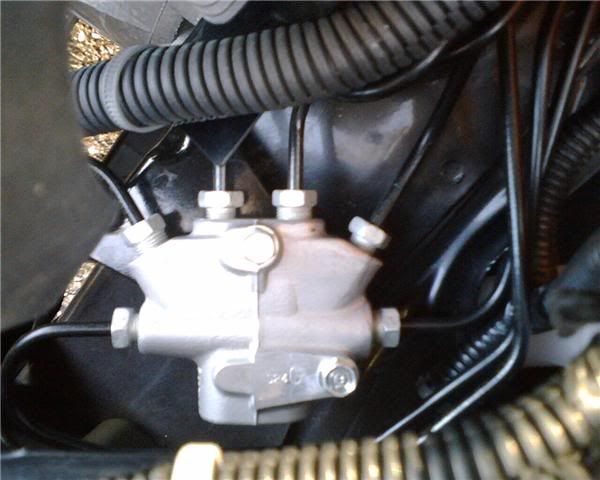
First is a pic of the actually proportioning valve in my car. You can see it has 6 lines attached, and a bolt in the middle holding it down, it you look you can see that there is a casting line that comes out from under that bolt, this line is where the valve is split in half, the left side feeds two wheels and the right side feeds the other two, the nub sticking out the bottom(below the two lines that are 180* across from each other) is what contains the springs in the valve, theres one for each side.....because each side has a front wheel and a rear wheel.
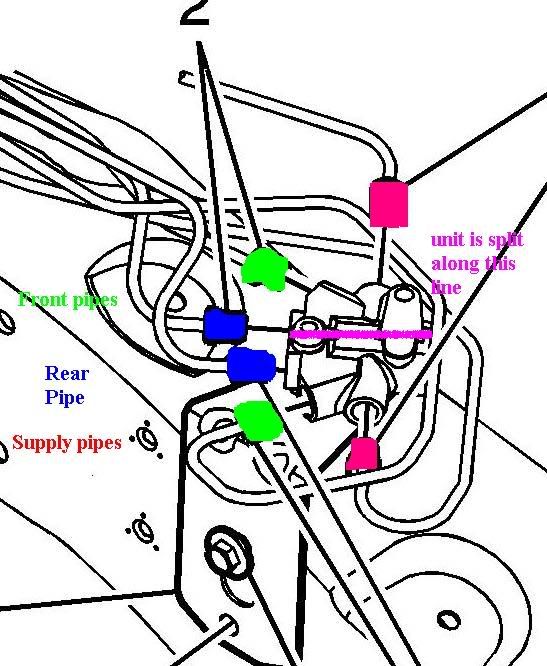
In my snazzy little art project here, Ive colorized the picture of the proportioning valve from the service manual, you can see it looks just like the actual photo I posted. The red fittings are the two that are directly across from each other(duh) and are in the 3 and 9 positions in my photo, these two lines are the supply lines FROM the master cylinder, one supplies fluid to each side of the valve. The two(blue) lines right next to each other that come out the top supply the rear brakes, one pipe comes from each side, The two green lines are the supply lines for the front calipers.
It is absolutely preferred practice to bleed farthest away and work to closest to the m/c, this helps reduce bubles from getting introduced into lines you may have already bled(more of an issue on vehicles that dont have 4 channel brake systems, IE one pipe feeds two or more wheels) its also important to bleed all wheels fed off the same m/c port before going to wheels fed by the other port, and this is why its important to know the hydraulic layout of the system.
,but I am gonna introduce some new info. Everything Qwik has stated is accurate in my opinion, EXCEPT that the Cobalts dont have a diagonally split system. Even though i cant find an actual plumbing schemtaic right this second Ive looked at my car(non-ABS), the manuals and pictures and this is what I CAN tell you for a NON ABS car.They do have a diagonal split. The pattern I recommended is the recommended pattern from GM, here is why:
First is a pic of the actually proportioning valve in my car. You can see it has 6 lines attached, and a bolt in the middle holding it down, it you look you can see that there is a casting line that comes out from under that bolt, this line is where the valve is split in half, the left side feeds two wheels and the right side feeds the other two, the nub sticking out the bottom(below the two lines that are 180* across from each other) is what contains the springs in the valve, theres one for each side.....because each side has a front wheel and a rear wheel.
In my snazzy little art project here, Ive colorized the picture of the proportioning valve from the service manual, you can see it looks just like the actual photo I posted. The red fittings are the two that are directly across from each other(duh) and are in the 3 and 9 positions in my photo, these two lines are the supply lines FROM the master cylinder, one supplies fluid to each side of the valve. The two(blue) lines right next to each other that come out the top supply the rear brakes, one pipe comes from each side, The two green lines are the supply lines for the front calipers.
It is absolutely preferred practice to bleed farthest away and work to closest to the m/c, this helps reduce bubles from getting introduced into lines you may have already bled(more of an issue on vehicles that dont have 4 channel brake systems, IE one pipe feeds two or more wheels) its also important to bleed all wheels fed off the same m/c port before going to wheels fed by the other port, and this is why its important to know the hydraulic layout of the system.

They share the same fluid. the clutch master clyinder gets its fluid from a line connectede to brake reservoir.
For some reaso the bigger cars and trucks all get a reservoir just for the clutch, Ive been thinking about putting one in, ive got one "in stock" just havent been motivated to do it yet
Senior Member
Joined: 02-03-08
Posts: 3,454
Likes: 1
From: Port Perry Ontario
Astra, Solstice, HHR,Terrain all the little Avea/G3/Wave/Optra/etc/etc foreign cousins, basically all thecurrent small and/or front wheel drive drive vehicles from GM.
For some reaso the bigger cars and trucks all get a reservoir just for the clutch, Ive been thinking about putting one in, ive got one "in stock" just havent been motivated to do it yet
For some reaso the bigger cars and trucks all get a reservoir just for the clutch, Ive been thinking about putting one in, ive got one "in stock" just havent been motivated to do it yet
 AND i know diddly about them so if they are x gee thats okay i guees. wanna find out? your tech buddy helped just replace the one line only each end and drive it? more
for all our race cobalts we used a cts v clutch reservoir to sperate the fluid. AND MAVEN my brain CANNOT COMPREHEND a NON ABS COBALT AND i know diddly about them so if they are x gee thats okay i guees. wanna find out? your tech buddy helped just replace the one line only each end and drive it? more
AND i know diddly about them so if they are x gee thats okay i guees. wanna find out? your tech buddy helped just replace the one line only each end and drive it? moreYeah, I am old school, no electronic driver aids

Last edited by Maven; Dec 3, 2008 at 10:05 PM. Reason: Automerged Doublepost
I looked into this more and I've found several cars with shared reservoirs. I understand that bleeding one system doesn't affect the other, but I don't see how flushing one system wouldn't affect the other.
Wouldn't the dirty or old or moisture filled fluid from the other system creep back into the flushed system?
What I'm getting at is - you can bleed the clutch or the brakes and be fine. But wouldn't you have to flush and then bleed both to change the fluid out in one??
Wouldn't the dirty or old or moisture filled fluid from the other system creep back into the flushed system?
What I'm getting at is - you can bleed the clutch or the brakes and be fine. But wouldn't you have to flush and then bleed both to change the fluid out in one??
I looked into this more and I've found several cars with shared reservoirs. I understand that bleeding one system doesn't affect the other, but I don't see how flushing one system wouldn't affect the other.
Wouldn't the dirty or old or moisture filled fluid from the other system creep back into the flushed system?
What I'm getting at is - you can bleed the clutch or the brakes and be fine. But wouldn't you have to flush and then bleed both to change the fluid out in one??
Wouldn't the dirty or old or moisture filled fluid from the other system creep back into the flushed system?
What I'm getting at is - you can bleed the clutch or the brakes and be fine. But wouldn't you have to flush and then bleed both to change the fluid out in one??
Bled/flush both regularly, but dont fret if you cant do clutch at same time
Senior Member
Joined: 02-03-08
Posts: 3,454
Likes: 1
From: Port Perry Ontario
Okay, its been verified(by me) ALL COBALTS have a diagonal split system........
So the RR, LF, LR, RF sequence I posted is definitely the proper sequence for all Cobalts.(and Solstice and other vehicles as well)
This is straight from the GM Service Manual:
The BPMV uses a 4 circuit configuration with a diagonal split. The BPMV directs fluid from the reservoir of the master cylinder to the left front and right rear wheels and fluid from the other reservoir to the right front and left rear wheels. The diagonal circuits are hydraulically isolated so that a leak or malfunction in one circuit will allow continued braking ability on the other.
So the RR, LF, LR, RF sequence I posted is definitely the proper sequence for all Cobalts.(and Solstice and other vehicles as well)
This is straight from the GM Service Manual:
The BPMV uses a 4 circuit configuration with a diagonal split. The BPMV directs fluid from the reservoir of the master cylinder to the left front and right rear wheels and fluid from the other reservoir to the right front and left rear wheels. The diagonal circuits are hydraulically isolated so that a leak or malfunction in one circuit will allow continued braking ability on the other.