


How does VVT work?


Thread Starter
Senior Member
Joined: 11-25-04
Posts: 1,278
Likes: 0
From: STL
How does VVT work?
So this is a feature on this new engine, but how does it work? Is it controled manually or electronicly and or automaticly? do u get more horses/torq? do u have to change to premium gas if u tune it up? any info would be great, thanks

Senior Member
Joined: 01-12-05
Posts: 568
Likes: 0
From: Cincinnati
I have a 3.0 VVT Mazda 6 and the way they described it to me is the valves are adjusted electronically to balance hp and torque thru the powerband under current driving conditions. One nice thing you also get with VVt is the ability to do traction control with a 5 speed, it actualy links to sensors so when a tire is sprinning it adjust the valve time to reduce the torque untill the tre stops spinning and gains traction again.

Senior Member
Joined: 04-17-04
Posts: 2,994
Likes: 0
From: Calgary Alberta Canada
Originally Posted by Archplsm
I have a 3.0 VVT Mazda 6 and the way they described it to me is the valves are adjusted electronically to balance hp and torque thru the powerband under current driving conditions. One nice thing you also get with VVt is the ability to do traction control with a 5 speed, it actualy links to sensors so when a tire is sprinning it adjust the valve time to reduce the torque untill the tre stops spinning and gains traction again.
Senior Member
Joined: 01-12-05
Posts: 568
Likes: 0
From: Cincinnati
Originally Posted by avro206
sounds about right. But a car does not need VVT to have traction control. Any ECM can be made to reduce power to a spining tire.

New Member
Joined: 05-22-05
Posts: 3
Likes: 0
From: canada
There is a replacement for displacement and it's called high compression and piston speed, why do you think that Ferrari and McLaren have 6.0-7.0 L engines that have 10- 12 cylinders?... do the math that’s 500 cc’s per cylinder, what’s 2.4 divided by 4? Well there you have it. Unless of course the best automotive manufacturers in the world are being proven wrong by ??Grumman?? Not likely
Senior Member
Joined: 04-17-04
Posts: 2,994
Likes: 0
From: Calgary Alberta Canada
Originally Posted by coreyd
I was into talk to a chev dealer in NS Canada and they didn't seem to know anything about the 2.4L SS, does anyone know if it's only released in the US?

New Member
Joined: 04-29-05
Posts: 57
Likes: 0
From: Texas
Originally Posted by Archplsm
Yes that is correct as for a ECM. But one really nice thing about VVT is it reduces torque only not hp.
So if you drop the amount of torque you are going to drop the amount of horsepower.
HP = RPM * (TQ/5252)

New Member
Joined: 04-08-05
Posts: 25
Likes: 0
From: Nebraska
Here goes nothing...
A camshaft is usually matched to an operating RPM range...the RPM range of which a cam works most efficiently is basically determined by 3 things - lift, duration, and overlap. Generally speaking, the more lift, duration, and overlap a cam has the higher the RPM range a cam can efficiently work...of course the compromise is it isn't as efficient at lower RPMs. Now wouldn't it be nice if you could change 1 or all 3 as the RPMs increase. That's were VVT comes in. Different methods are used by different manufacturers (different methods are used between different engines also) so I won't go into how here...that would take too much space.
A camshaft is usually matched to an operating RPM range...the RPM range of which a cam works most efficiently is basically determined by 3 things - lift, duration, and overlap. Generally speaking, the more lift, duration, and overlap a cam has the higher the RPM range a cam can efficiently work...of course the compromise is it isn't as efficient at lower RPMs. Now wouldn't it be nice if you could change 1 or all 3 as the RPMs increase. That's were VVT comes in. Different methods are used by different manufacturers (different methods are used between different engines also) so I won't go into how here...that would take too much space.
New Member
Joined: 04-29-05
Posts: 57
Likes: 0
From: Texas
Exactly. VVT is like having a constantly varying camshaft based on the current RPM.
It is a very good technology that really helps give engines more power across all the
powerband. You get the best of both worlds, low end torque and high end horspower.
I believe the new Mustangs use VVT now, or at least some variation of it.
VTEC has graduated beyond "imports" and is now invading US products.
It is a very good technology that really helps give engines more power across all the
powerband. You get the best of both worlds, low end torque and high end horspower.
I believe the new Mustangs use VVT now, or at least some variation of it.
VTEC has graduated beyond "imports" and is now invading US products.
New Member
Joined: 05-22-05
Posts: 3
Likes: 0
From: canada
Originally Posted by stlurbanpunk
yeah the dealers probably wont know about it till they notice the "2.4" on the window stickers.
im excited for their release!!
Thread Starter
Senior Member
Joined: 11-25-04
Posts: 1,278
Likes: 0
From: STL
ahh, screw boost. I'll take a 2.4 and polish it up nicely.you can add more horses (even more importainly torq) with out slaping turbos on it. its all the little things like ignition and underpullies. thanks for the info on VVT guys! it sounds nice,
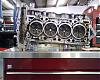
VVT as used on the LE5 will be an electronically controlled hydraulically actuated(engine oil) system that can vary camshaft timing of the intake AND exhaust cams helical spline actuators bolt to the cams and the timing sprockets are integrated into the actuator.. as oil is forced into or exhausted out of the actuator it will move on its splines changing the position of the cam relative to the crankshaft......the most worthwhile purpose of this is to increase efficiency and therefore hp...also emissions are reduced and higher levels of hp can be reached with little or no sacrifice to idle quality or driveability....when the exhaust cam is retarded the exhasut valve will stay open on the intake stroke scavenging exhaust gas into the cylinder to produce similar results as the digital EGR valve system does....when the intake cam is advanced the intake cam will start to open during the exhaust stroke allowing fresh air into the exhaust stream and performing a similar function to Secondary Air Injection Reaction systems.

Senior Member
Joined: 04-02-05
Posts: 976
Likes: 0
From: Connecticut
Originally Posted by coreyd
I was into talk to a chev dealer in NS Canada and they didn't seem to know anything about the 2.4L SS, does anyone know if it's only released in the US?
Thread Starter
Senior Member
Joined: 11-25-04
Posts: 1,278
Likes: 0
From: STL
Originally Posted by Maven
VVT as used on the LE5 will be an electronically controlled hydraulically actuated(engine oil) system that can vary camshaft timing of the intake AND exhaust cams helical spline actuators bolt to the cams and the timing sprockets are integrated into the actuator.. as oil is forced into or exhausted out of the actuator it will move on its splines changing the position of the cam relative to the crankshaft......the most worthwhile purpose of this is to increase efficiency and therefore hp...also emissions are reduced and higher levels of hp can be reached with little or no sacrifice to idle quality or driveability....when the exhaust cam is retarded the exhasut valve will stay open on the intake stroke scavenging exhaust gas into the cylinder to produce similar results as the digital EGR valve system does....when the intake cam is advanced the intake cam will start to open during the exhaust stroke allowing fresh air into the exhaust stream and performing a similar function to Secondary Air Injection Reaction systems.
no, i get most of it, its auto controled: initiated electronicly and actually carried out mechanicly, with oil.
thanks man!


New Member
Joined: 06-16-05
Posts: 36
Likes: 0
From: mooresville, NC
Originally Posted by Maven
VVT as used on the LE5 will be an electronically controlled hydraulically actuated(engine oil) system that can vary camshaft timing of the intake AND exhaust cams helical spline actuators bolt to the cams and the timing sprockets are integrated into the actuator.. as oil is forced into or exhausted out of the actuator it will move on its splines changing the position of the cam relative to the crankshaft......the most worthwhile purpose of this is to increase efficiency and therefore hp...also emissions are reduced and higher levels of hp can be reached with little or no sacrifice to idle quality or driveability....when the exhaust cam is retarded the exhasut valve will stay open on the intake stroke scavenging exhaust gas into the cylinder to produce similar results as the digital EGR valve system does....when the intake cam is advanced the intake cam will start to open during the exhaust stroke allowing fresh air into the exhaust stream and performing a similar function to Secondary Air Injection Reaction systems.
thank you im glad someone has the ability to answer these questions accurately
how long you been mr goodwrench?
No problem guys 
Solkacs, I have been an ASE certified technician for nearly 10 years, working almost exclusively on GM vehicles the entire time, I have been at my current employer(a South Jersey Chevy dealer) for three years as of August.
Solkacs, I have been an ASE certified technician for nearly 10 years, working almost exclusively on GM vehicles the entire time, I have been at my current employer(a South Jersey Chevy dealer) for three years as of August.


New Member
Joined: 07-18-08
Posts: 74
Likes: 0
From: West Chester, OH
alright I really have no clue how VVT works but I own a 2008 sport 2.4L with VVT and have heard/ wondered if there was anyway to control when VVT kicks in to produce more hp.... only reason why i'm even asking is because apparently it's controlled electronically and that makes me think that some kind of controller could be used to do this. maybe i'm wrong

No way did you just bump this thread. Here's your answer: http://en.wikipedia.org/wiki/Variable_valve_timing and http://auto.howstuffworks.com/camshaft2.htm
New Member
Joined: 07-18-08
Posts: 74
Likes: 0
From: West Chester, OH
No way did you just bump this thread. Here's your answer: http://en.wikipedia.org/wiki/Variable_valve_timing and http://auto.howstuffworks.com/camshaft2.htm
New Member
Joined: 07-18-08
Posts: 74
Likes: 0
From: West Chester, OH