


Cat back question


At a recent dyno meet, I ran the same tune on 2 cars, one car had a MPx catback as the only difference, they were otherwise both all stock. The catback car did make about 5whp more. Not sure if it was that you can atribute it to or what.
Catback ONLY!
Can somone tell me WHY you would get this with an SC, but not our TC?
Was the exhaust on the SC THAT restrictive? This catback is only 2 1/4"!!! So it can't be much bigger than the stocker.
https://www.cobaltss.net/forums/dyno...results-32554/
Can somone tell me WHY you would get this with an SC, but not our TC?
Was the exhaust on the SC THAT restrictive? This catback is only 2 1/4"!!! So it can't be much bigger than the stocker.
https://www.cobaltss.net/forums/dyno...results-32554/

Ronn, I had the MPx catted DP on for a while, and then added the Hahn exhaust. No noticeable change in power or spool. Just sound. 2.5" is what the stock system is, and it flows plenty for < 325 whp. You won't find any appreciable gains going to 3" with the stock turbo.
That's hard to pass up. I heard a clip of this unit and I gotta tell ya..the sound is the BEST of all cat backs I have listened to..by FAR. Agency has a very good reputation and I'm gonna asume they did their homework on this one...including maintaining the 2.5" instead of 3". They state that there is more torque lower down with this and I have read the same HERE from those that had it on. They only ones with 2.5"...maybe that's the key? Also, they're the ONLY ones to SPECIFICALLY single out dyno results for catback alone and the dyno used (Mustang). I may give this a shot.
Just got off the phone with Agency tech. He was very familiar with our car and the development of the CB for our car. Definitely said they went with 2.5" for a reason. His words "Bigger is not better in this application". Bigger turbo...yes 3". Said the same rationale was used in the Camero SS V8!..2.5 there as well.
Camero:
The new catback exhaust from Agency Power fits the 2010 and up V8 Camaro SS. The full exhaust system includes the X-Pipe as well. To tune the exhaust to give it that perfectly balanced exhaust tone, we use twin cylinder mufflers equipped with 2.5 inch 304 stainless steel. The entire exhaust system has been TIG welded and then polished to a show finish and something you will enjoy looking at for years to come. Giving the exhaust a tough stance out of the back bumper outlets are 2 4.5 inch round tips etched with the Agency Power logo. This exhaust has been designed, built, and tested here in Arizona. To show what our exhaust system would do on a completely stock Camaro SS, we strapped it down to a Mustang Dyno. The exhaust added an impressive 20 rear wheel horsepower and 31 ft/lbs of torque
The dyno on our car was for real..no BS. Admitted that most people don't understand the decision to go with the 2.5" and that did hurt sales since *3"* is the mantra. They're now priced to *move* it out. Take all this as you will.
Last edited by ronn; Nov 8, 2010 at 06:31 PM.

Member
Joined: 03-31-09
Posts: 208
Likes: 0
From: Chandler, AZ
Ronn- I went down to Agency Power (its 5 minutes from my house) and I actually got to listen to it live and check out the shop because I know the shipping manager. They are offering me a "friend price", which includes install. In my other post, you may remember I was asking about a Hahn DP, and this is exactly why. They are going to do the complete install for me.
They told me the same thing, no torque on the bottem end with the 3". Where did you hear the sound clip? I'd like to listen to it again before I pull the trigger and I couldn't find any on you tube.
It's deff louder than stock. I was actually surprised with how loud it is. But it comes with a silencer. It sounds really really good. Not ricer at all.
They told me the same thing, no torque on the bottem end with the 3". Where did you hear the sound clip? I'd like to listen to it again before I pull the trigger and I couldn't find any on you tube.
It's deff louder than stock. I was actually surprised with how loud it is. But it comes with a silencer. It sounds really really good. Not ricer at all.
Ronn- I went down to Agency Power (its 5 minutes from my house) and I actually got to listen to it live and check out the shop because I know the shipping manager. They are offering me a "friend price", which includes install. In my other post, you may remember I was asking about a Hahn DP, and this is exactly why. They are going to do the complete install for me.
They told me the same thing, no torque on the bottem end with the 3". Where did you hear the sound clip? I'd like to listen to it again before I pull the trigger and I couldn't find any on you tube.
It's deff louder than stock. I was actually surprised with how loud it is. But it comes with a silencer. It sounds really really good. Not ricer at all.
They told me the same thing, no torque on the bottem end with the 3". Where did you hear the sound clip? I'd like to listen to it again before I pull the trigger and I couldn't find any on you tube.
It's deff louder than stock. I was actually surprised with how loud it is. But it comes with a silencer. It sounds really really good. Not ricer at all.
https://www.cobaltss.net/forums/part...atback-214941/
 although, that sounds great! Gives you an idea as to how throaty and non-ricer it is...
They state that there is more torque lower down with this and I have read the same HERE from those that had it on. They only ones with 2.5"...maybe that's the key? Also, they're the ONLY ones to SPECIFICALLY single out dyno results for catback alone and the dyno used (Mustang). I may give this a shot.
Just got off the phone with Agency tech. He was very familiar with our car and the development of the CB for our car. Definitely said they went with 2.5" for a reason. His words "Bigger is not better in this application".
The dyno on our car was for real..no BS. Admitted that most people don't understand the decision to go with the 2.5" and that did hurt sales since *3"* is the mantra. They're now priced to *move* it out. Take all this as you will.
Just got off the phone with Agency tech. He was very familiar with our car and the development of the CB for our car. Definitely said they went with 2.5" for a reason. His words "Bigger is not better in this application".
The dyno on our car was for real..no BS. Admitted that most people don't understand the decision to go with the 2.5" and that did hurt sales since *3"* is the mantra. They're now priced to *move* it out. Take all this as you will.
My thought process tells me downstream restriction would fight the turbo to get rid of the exhaust gases , thus "trying to slow turbine speed.
I'll be the first to admit that I'm not a turbo expert ........ so take the above statement as a question more than a differing opinion . Any info is appreciated . Thx.
One more thing ..... is see differing numbers on the size of our stock catback . I was under the impression that it starts out at 2.75" and tapers to 2.5'' as it goes back . Does anyone have a concrete number or had measured it personally?
I don't want to be argumentative but going to a 2.5" exhaust for low end on a turbo car seems to go against pretty much everything I have read in the past.
My thought process tells me downstream restriction would fight the turbo to get rid of the exhaust gases , thus "trying to slow turbine speed.
I'll be the first to admit that I'm not a turbo expert ........ so take the above statement as a question more than a differing opinion . Any info is appreciated . Thx.
One more thing ..... is see differing numbers on the size of our stock catback . I was under the impression that it starts out at 2.75" and tapers to 2.5'' as it goes back . Does anyone have a concrete number or had measured it personally?
My thought process tells me downstream restriction would fight the turbo to get rid of the exhaust gases , thus "trying to slow turbine speed.
I'll be the first to admit that I'm not a turbo expert ........ so take the above statement as a question more than a differing opinion . Any info is appreciated . Thx.
One more thing ..... is see differing numbers on the size of our stock catback . I was under the impression that it starts out at 2.75" and tapers to 2.5'' as it goes back . Does anyone have a concrete number or had measured it personally?
AWE Tuning
AWE Tuning 2.0T Exhaust Dyno Tests
Car Specs:
Engine : 4 cylinder, turbocharged DOHC, front engine FWD
Displacement : 1,984 cc
Valve : 16 valves, 4 valves per cylinder
Transmission : 6-spd manual. 6-spd DSG
Horsepower : 200 hp @ 5500 rpm
Torque : 207 lb-ft @ 1800 rpm
Redline : 6500 rpm
BTW, it's not just about the SIZE, it's the smoothness of the pipes and bends. Look at the comparison pic I posted here.
Another read:
Pipe Sizing
We've seen quiet a few "experienced" racers tell people that a bigger exhaust is a better exhaust. Hahaha… NOT.
As discussed earlier, exhaust gas is hot. And we'd like to keep it hot throughout the exhaust system. Why? The answer is simple. Cold air is dense air, and dense air is heavy air. We don't want our engine to be pushing a heavy mass of exhaust gas out of the tailpipe. An extremely large exhaust pipe will cause a slow exhaust flow, which will in turn give the gas plenty of time to cool off en route. Overlarge piping will also allow our exhaust pulses to achieve a higher level of entropy, which will take all of our header tuning and throw it out the window, as pulses will not have the same tendency to line up as they would in a smaller pipe. Coating the entire exhaust system with an insulative material, such as header wrap or a ceramic thermal barrier coating reduces this effect somewhat, but unless you have lots of cash burning a hole in your pocket, is probably not worth the expense on a street driven car.
Unfortunately, we know of no accurate way to calculate optimal exhaust pipe diameter. This is mainly due to the random nature of an exhaust system -- things like bends or kinks in the piping, temperature fluctuations, differences in muffler design, and the lot, make selecting a pipe diameter little more than a guessing game
From Cobb Tuning:
Pipe diameter does have an effect on flow rates as well, but again it is not the major factor in most cases. 2.5" may flow enough for 300-350 h.p. without being a restriction. 3" is usually capable of flowing 500-600 h.p. before becoming a restriction. This is assuming that you have designed the rest of the system up to par. There are also full 3.5" systems and those that start out at 4" and taper down. Unless you are making over 500-600 h.p. anything over 3" is a case of diminishing returns and in most cases has no advantage.
Designing a good cat-back is fairly simple compared to the header. Keeping velocity high is still the goal. Pipe that is too large will loose low end torque as the gas starts moving slower. Pipe that is too small will loose top end power. So again there is a balance to be reached. The same rule applies to keeping the piping smooth and using proper bending techniques
And for the finalie (drum roll):
Subject Turbo Exhaust Flow 101 ...............
Posted by Greg D. (Specialty-Z) on December 27, 2005 at 9:02 PM
This message has been viewed 774 times.
Message Happy Holidays!
Since it is a time of giving, I will try to offer some easy to understand information on turbo exhaust flow that I have learned over the years.
The first thing to look at is how a turbo works……..
A turbo is driven by heat and pressure differential ……….The higher the pressure and heat before the turbine wheel, and the lower the pressure and heat after the turbine wheel, The faster the turbo will spool.
One of the reasons tubular manifolds work better on turbo cars is because the tubes are thin material and heat quickly adding to the heat differential causing the turbos to spool faster.
A simple way to see how heat looks for cool air and drives a turbo is by looking at a turbine vent on a roof top.....
When not a breath of wind is in the air, But it is a warm day. You can see the turbine on the building spinning like crazy......This is because the attic is very hot and the hot air is looking for the cool air outside and driving the turbine.
A turbo engine also does not need any extra back pressure because the turbine wheel creates more then enough back pressure for the engine to operate correctly before the turbo spools……..Any additional back pressure in the exhaust system will simply cause the turbo to spool more slowly.
Turbo engines do not have a problem with blow through and NA engines normally only have problems with blow through at idle or VERY low speed when the cams have excessive overlap.
From what I have learned Exhaust sizing is a science (Even on Turbo Cars).
The proper exhaust tube size is part of the equation of tuning the car.
The bigger is better is old school and has its place on a race car that only runs at wide open throttle and has a very short exhaust……..
Because you want the exhaust as cool as possible and you want no back pressure it is easy to see where the idea came from about bigger being better :-P
On a race car the exhaust is normally about 6 inches to two feet…..Because the exhaust is so short, velocity is not a problem.
The problem on a street car is that it runs at many different loads and has a fairly long exhaust system, Many more factors come in to play that cause backpressure besides the restriction in size alone…….
On a street car like a Z, The exhaust is about 10 feet long on each side and when the exhaust is this long and you start putting bends in the exhaust system, exhaust speed or velocity starts to become very important.
Backpressure in a exhaust can be caused by turbulence and slow exit speed, Just as easy as in can by size restriction.
If the exhaust gas remains in the pipe without exiting from the pipe size being too large in a long exhaust system, it causes back pressure from the slow exhaust flow.
I have been told by NASA engineers that one 90 degree bend has the same exhaust restriction as adding 25 feet of straight pipe…..
This means if you have two 90 degree bends in each side of your exhaust it has the same effect as adding 100 feet of straight pipe to your Z!
Turbulence can cause a large amount of backpressure……Some of the things that cause turbulence are bends, Sudden pipe size changes, rough pipe ends, Ect…….
Something that use to be common was gutting cats…….This gained top end power and higher peak numbers on a dyno, But at a huge sacrifice in low end power due to the turbulence caused by the sudden inner pipe size change. The reason this hurts low and mid range power is because the turbulence causes the velocity of the exhaust gas to slow and even though the area is larger it causes backpressure from the turbulent slow exhaust speed and thus the turbo spools up slower. At higher RPM’s the exhaust speed is higher and less restriction from the cats being gutted still net a gain on top, Although it is possible to have a net loss in power because it can hurt the low end enough.
I remember back in the 80's working on a single turbo 280zx and gutting the cat....It really killed the low end power on the car.....What was interesting was that after the low end power went away we decided to try a cheap test.....
We welded a smaller pipe to the inside of the cat to see what would happen......To our surprise at the time the car made better overall power with a smaller pipe inside the cat then it did gutted or with the cat in tact.
We later made it a test pipe the same size as the exhaust and pick up even more power.
Several years ago we did quite a bit of testing on the Z32's……..At that time most of the Z cars were making between 350 and 500 RWHP and that is the area we tested the exhaust components in.
At up to 500 RWHP we found that 2.5” pipe offered the best overall power and sound level. We found that 3” pipe hurt low end and mid range power because of the slow exhaust velocity with the larger pipe. We also found that the 3” pipe at the 500 RWHP level did not net any measurable gains at the top end.
To be fair the 3 inch down pipes that were available back then were very poor and could have added to the low end performance problems.
One of the reasons the newer long split down pipes worked better at low end is because the exhaust coming off the turbo wheel is very turbulent and it takes about 12 inches for the flow to gain velocity……By making the down pipe tube about 12 inches long before bringing the wastegate pipe back in the velocity is higher allowing better turbo spool up.
Some of the reasons we have been able to use 2.5” pipe at fairly high power levels is because we pay attention to detail…….By making the bends as minimal as possible and by keeping from having rough pipe edges by welding on the inside and grinding smooth, We have kept the velocity very high and caused as little turbulence as possible.
Something that you may find interesting is a test we did on my car at the drag strip……..
With the automatic I run fairly consistent, So it is easy to see small changes and test what works in the real world…….
We wondered if the car would go faster without some of the exhaust components……
We made several runs and established what the car would run….The 60 foot made the small differences in the ET within a tenth of a second and the mile per hour was always the same. We then removed the muffler section (our mufflers with minimal bends in the pipes) and we made a couple more runs and the car ran exactly the same MPH. We then removed our X-Pipe and the car dropped 3 MPH……We made a couple runs and they were the same each run. We then bolted the X-Pipe back on and the MPH came right back!
It was obvious that blending the exhaust from both sides of the engines made a significant difference.
Now that many Z cars are in the 600 plus RWHP area I do believe we need to retest and make sure we are not giving up any HP by staying
With 2.5” exhaust.
The way we will test besides the dyno and track is by taking pressure readings in the down pipe to see if any back pressure is present at the higher power levels.
We are currently prototyping some new exhaust products to test with. It is possible by expanding slowly to a larger size we could see some gains. We will also test to see if the whole system needs to be larger or if just a small section near the down pipe needs to grow and shrink like a expansion chamber on a motorcycle.
Because the exhaust expands from heat we might find that going bigger for a short time then using a cone to neck back down after it cools and the exhaust contracts we keep the highest exhaust velocities without causing restriction.
I have had some ideas I have wanted to try for some time and time did not permit to get the prototypes and testing done.
I have hired a sales manager at Specialty-Z to help free up my time for more Research and development.
The new parts sales Manager is Dean Delevie and I believe you will find him a pleasure to work with!
I hope that helps and I look forward to providing you all with more data in the near future.
Final comment:
I'm not knocking other the 3" catbacks for our car, but I think the guys that designed this pipe at 2.5" knew what they were doing and they BACKED IT UP WITH DYNO RESULTS. Something none of the 3" competitors have done. Yes...they *claimed* results....but they are muddled with combined results, when they could have easily singled out the Catback results alone. The Agency tech was very candid with me and took time to explain the reason for this design admitting it has actually hurt sales due to consummer ignorance on this topic. I wonder if any of the competitors would have taken the time as well? Most of the time you get the sales rep and you know how that goes.
Last edited by ronn; Nov 9, 2010 at 02:25 AM.
Agency claims verified 10 WHP (Mustang Dyno) with Catback alone:
Agency Power Catback Exhaust System Chevrolet Cobalt SS 08+
This exhaust system was tested on our Mustang Dyno and achieved approximately 10 horsepower gain. With horsepower also came improved throttle response, and low end torque gains. This exhaust is designed to work with the 2008 and up Chevy Cobalt SS sedan.
I see this is only a 2.5"....then again they say verified 10 HP. Could be 3" might not be needed with under 350WHP?
Agency Power Catback Exhaust System Chevrolet Cobalt SS 08+
This exhaust system was tested on our Mustang Dyno and achieved approximately 10 horsepower gain. With horsepower also came improved throttle response, and low end torque gains. This exhaust is designed to work with the 2008 and up Chevy Cobalt SS sedan.
I see this is only a 2.5"....then again they say verified 10 HP. Could be 3" might not be needed with under 350WHP?
A large part of what Agency Power produces is with performance exhaust components. Agency Power does not buy off the shelf Chinese exhaust systems like other brands. Agency Power actually prototypes the exhausts here in Arizona using our own or customer vehicles. We then test them on our Mustang AWD Dyno and make changes to achieve the best sound and performance we can get.

Just found this :
A large part of what Agency Power produces is with performance exhaust components. Agency Power does not buy off the shelf Chinese exhaust systems like other brands. Agency Power actually prototypes the exhausts here in Arizona using our own or customer vehicles. We then test them on our Mustang AWD Dyno and make changes to achieve the best sound and performance we can get.
A large part of what Agency Power produces is with performance exhaust components. Agency Power does not buy off the shelf Chinese exhaust systems like other brands. Agency Power actually prototypes the exhausts here in Arizona using our own or customer vehicles. We then test them on our Mustang AWD Dyno and make changes to achieve the best sound and performance we can get.
2.5" is factory size, why change anything if you are staying with this site?

Ronn, the bends are pretty much identical. It's the angle of the pictures that differs.
If you want an exhaust for looks and sound, do it. No gains to be had, imo. The stock mufflers are perforated straight/angle through, not baffled, iirc, which means they flow very well.
I'll go on the record as saying I don't believe another 2.5" full exhaust would make any difference once fuel trims are learned, if they change at all. If AP can prove me wrong, more power to them.
If you want an exhaust for looks and sound, do it. No gains to be had, imo. The stock mufflers are perforated straight/angle through, not baffled, iirc, which means they flow very well.
I'll go on the record as saying I don't believe another 2.5" full exhaust would make any difference once fuel trims are learned, if they change at all. If AP can prove me wrong, more power to them.


I'm very familiar with B5 S4, since I used to own and track one. In fact, I know the owners of that yellow S4 that's on AWE's front page.
Ronn, the bends are pretty much identical. It's the angle of the pictures that differs.
If you want an exhaust for looks and sound, do it. No gains to be had, imo. The stock mufflers are perforated straight/angle through, not baffled, iirc, which means they flow very well.
I'll go on the record as saying I don't believe another 2.5" full exhaust would make any difference once fuel trims are learned, if they change at all. If AP can prove me wrong, more power to them.
If you want an exhaust for looks and sound, do it. No gains to be had, imo. The stock mufflers are perforated straight/angle through, not baffled, iirc, which means they flow very well.
I'll go on the record as saying I don't believe another 2.5" full exhaust would make any difference once fuel trims are learned, if they change at all. If AP can prove me wrong, more power to them.
Anyway I will eventually dyno this but it wil reflect the DP and this CB as well.
why change anything if you are staying with this site?

As far as dyno sheet..I requested a copy. Left message, so I won't know for sure until they get back to me.
Ronn, the bends are pretty much identical. It's the angle of the pictures that differs.
If you want an exhaust for looks and sound, do it. No gains to be had, imo. The stock mufflers are perforated straight/angle through, not baffled, iirc, which means they flow very well.
I'll go on the record as saying I don't believe another 2.5" full exhaust would make any difference once fuel trims are learned, if they change at all. If AP can prove me wrong, more power to them.
If you want an exhaust for looks and sound, do it. No gains to be had, imo. The stock mufflers are perforated straight/angle through, not baffled, iirc, which means they flow very well.
I'll go on the record as saying I don't believe another 2.5" full exhaust would make any difference once fuel trims are learned, if they change at all. If AP can prove me wrong, more power to them.

Stock previous again:
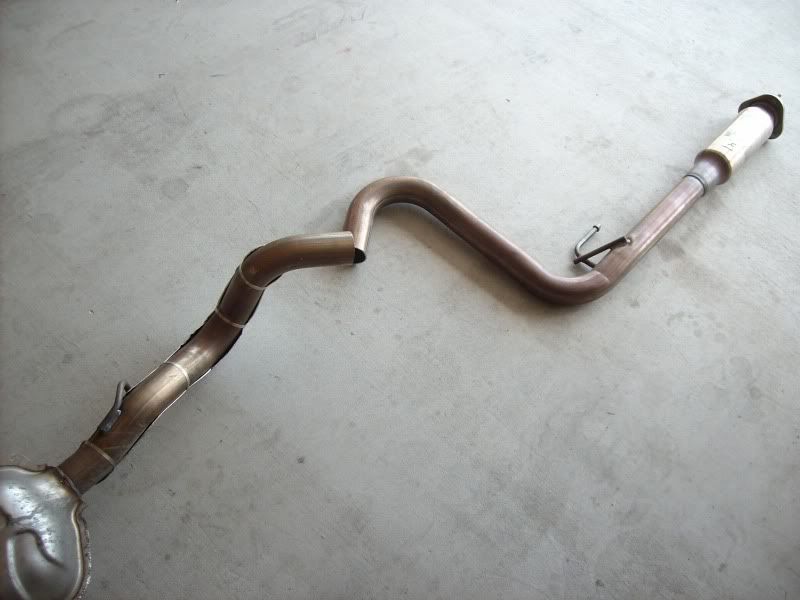
Agency again:

Couple observations on stock compared to Agency:
**Note the first (RIGHT ANGLE) bend after the resonator.. the pipe narrows down slightly (crimps) there on stock
**The next bend arching over the axel is a couple degrees sharper than the Agency
**Entrance going into muffler is narrowed (after pipe hanger)
These *subtleties* don't seem like much, but they add up. That's what was mentioned in the read. You only find out by bench flowing and doing the dyno.
Let me get this on and I'll then post my impressions and any results worth noting on the *ricer run. Dyno will come, but I don't know when. Definitely before any other mods (not likely at this point).

Ok..
So it's...
"why change anything if you are staying with this size ? "
Now...have you been reading this thread and INFO I posted??? Please read through, then ask that question again if you think it's appropriate.
Hint: Size isn't the only consideration in flow dynamics.
So it's...
"why change anything if you are staying with this size ? "
Now...have you been reading this thread and INFO I posted??? Please read through, then ask that question again if you think it's appropriate.
Hint: Size isn't the only consideration in flow dynamics.

If you want a 3 inch, stainless steel catback exhaust that will connect to your factory downpipe or the MPx downpipe you've found the best option! Furthermore, we have dyno tested and seen a 12 horsepower gain with this exhaust with a relatively stock Cobalt SS Turbo!
Notice they say *that will connect to your factory downpipe*, so you get the impression that it's the catback ALONE they are talking about. The then comes the *fly in the ointment*
with a relatively stock Cobalt SS Turbo!
does that mean?Yep..but they're not very *candid* about the explanation. It's pretty obvious that they try to *boot strap* the catback results along with the DP, but don't say so. It's really BULL **** and makes it look like they're trying to get away with it. I saw a thread..in fact posted it here....where somone basically askes the Modern Rep here about this very subject and they simply ignore it!
Here it is:
https://www.cobaltss.net/forums/4724699-post89.html
I would like to see if there is any HP gain above the D.P. part of the exhaust system. maybe I need to re read this whole post
You guys quoted a 12 hp gain and you had a high flow cat on, which sounds about right according to whats been posted fo DP's on this forum.
This was never answered (or at least clarified) on the thread. I e mailed Modern and they never responded either. I'll ask it NOW..Hey Modern, does the catback claim of 12 HP gain include the DP? Of course we already know the answer..don't we?

Last edited by ronn; Nov 10, 2010 at 12:40 AM.
3" vs 2.5"
Just found this. It was on the SS/SC, but applies to TC as well.
Crky Bell Chart on diameters required.
https://www.cobaltss.net/forums/867723-post162.html
Reference to Cobalt race team. I don't know what HP was on their cars, but it cetainly wasn't stock.
and this is a perfect example that shows why most of the road race cobalt teams have went back to a 2.5" exhaust, from a 3" even at 300whp a 2.25 isn't going to be that restrictive
Crky Bell Chart on diameters required.
https://www.cobaltss.net/forums/867723-post162.html
Reference to Cobalt race team. I don't know what HP was on their cars, but it cetainly wasn't stock.
and this is a perfect example that shows why most of the road race cobalt teams have went back to a 2.5" exhaust, from a 3" even at 300whp a 2.25 isn't going to be that restrictive