


wisconsin car club (balts and ions)


Banned
Joined: 06-11-08
Posts: 59
Likes: 0
From: Milwaukee
well curt your right bt im going to have to say it was that the dyno wasnt warmed up and it was slipping casue it seemed that all the cars in the afternoon were putting out resonable numbers dont know what to tell you otherwise
ok Mr backyardddddd tunner ..............SUSH.......... for one i wouldnt run my mouth about businesses or people unless you know from first hand. i would dare you triple dog dare you to run you mouth at there place of business your all twisted on rumors and that exactly what they are RUMORS
P.S. on another note i aint mad at you but hey hey Hows the NOS and cams coming along phssssss......

So this afternoon me and my girlfriend test drove and SS turbocharged Cobalt need less to say i was pleased but wasnt blown away i liked everything about it but the power was almost exactly the same comparison to my o5 ss supercharged but if i had the cash i wouldnt hesitate to buy one on the spot. all and all my girlfriend loved it and just about creamed in her pants lol so low and behold we are ordering one next weekend sport coat tint red fully loaded!!!
ok Mr backyardddddd tunner ..............SUSH.......... for one i wouldnt run my mouth about businesses or people unless you know from first hand. i would dare you triple dog dare you to run you mouth at there place of business your all twisted on rumors and that exactly what they are RUMORS
P.S. on another note i aint mad at you but hey hey Hows the NOS and cams coming along phssssss......
So this afternoon me and my girlfriend test drove and SS turbocharged Cobalt need less to say i was pleased but wasnt blown away i liked everything about it but the power was almost exactly the same comparison to my o5 ss supercharged but if i had the cash i wouldnt hesitate to buy one on the spot. all and all my girlfriend loved it and just about creamed in her pants lol so low and behold we are ordering one next weekend sport coat tint red fully loaded!!!
hows your blown up cobalt doing.. not to mention im not the one who spent 1000 dollars and have yet to see a single part for my car aside form supercharger grease. also you supercharger is way way over ported... in fact its so over ported that it will be less efficent then it was to start out with. porting it as far as you did your going to created turbulence inside of the supercharger intern you will create less boost because the rotors will suck air back into the supercharger.. the whole point of a supercharger is to create pressure and you just destroyed the space allotted to create the pressure. also your on crack for thinking that moving your heat exchanger to the front will effecently cool your supercharger 1 of 2 things will happen 1, your not going to notice a difference and 2, your going to run all around hotter because it is blocking the air flow to your radiator. also your a fool a fool i say for not even thinking about running any cooling mods.. specially with the pulley size you are running and the "50 shot" your an idiot for not even considering running meth injection. there are no amount of forged parts out there that can protect you from stupid.
as far as beeyond goes.. i believe they hand out decals to every honda with in a 5 county radius. and they did have people who stole parts off of cars using work computers..
WRONG..
 [/QUOTE]
RIGHT
 [/QUOTE]
Last edited by lowbalt06; Jun 14, 2008 at 11:37 PM. Reason: Automerged Doublepost


what the ****...
wholy ****, i'm going to need more than just popcorn for this one...***grabs a few beers***
wholy ****, i'm going to need more than just popcorn for this one...***grabs a few beers***
Last edited by Cobalt_SSTuner; Jun 14, 2008 at 11:51 PM. Reason: Automerged Doublepost
Banned
Joined: 06-11-08
Posts: 59
Likes: 0
From: Milwaukee
There are many different opinions and views regarding how to modify the M-Series, roots type, superchargers made by Eaton. In a recent discussion on another forum, a lot of information was uncovered, along with a solid contact within the Eaton Corporation itself. This thread will outline the findings and what is recommended by the manufacturer itself.
Both the M62 and M90 (most common on this site) are at their peak efficiency levels from the factory. Although running a smaller pulley is the easiest way to generate more power with these applications, it is also the easiest way to push the blower out of its efficiency range and produce gobs of heat. Heat, as you know, is the enemy of all F/I applications. Roots type superchargers, although extremely reliable, are the least efficient due to their drag on the engine by belt as well as their tendency to generate good amounts of heat in regards to the IAT (Intake Air Temperature). Eaton addressed some of these issues when they created their new line of TVS blowers; however, this thread is only concerned with the M-series blowers.
From Eaton.com:
"Eaton manufactures highly engineered, roots-type positive displacement superchargers. The Eaton supercharger increases torque across the entire operating range without compromising drivability or emissions. This allows vehicle manufacturers the option of using smaller, more economical 4- and 6-cylinder engines, without perceived loss in power train performance. Additionally, the supercharger incorporates a bypass system to reduce air handling losses when boost is not required, resulting in better fuel economy. Typical applications are on engines with displacements of 1.8L to 5.3L.
All aftermarket and service (rebuilds) are handled in the United States by Magnuson Products, (www.magnusonproducts.com) and in the Oceania-Asia-Pacific region by Harrop Engineering. (www.harrop.com)
The Eaton Supercharger - One Simple, Powerful Solution.
Eaton’s Air Management Systems Division designs, manufactures and markets modified Roots-type positive displacement pumps, also known as “superchargers,” for the original equipment and aftermarket industries."
When it comes to modification of these superchargers, the common areas of modification are:
Porting of the inlet portion of the housing
Porting of the internal housing
Porting of the outlet plate of the housing
Porting or Plugging of the "holes" on the outlet plate
Running a smaller pulley
Heat reduction, supporting modifications
The basic idea here is to increase CFM without raising IAT's. As most people on this site drive vehicles with the LSJ engine, M62 application, I will focus on that. These basic principles can be carried over to any other application using an M-Series blower. It should be noted, that the M-series superchargers are effectively air pumps. They do not internally compress the air themselves, but push it into the lower intake manifold. It is in the lower intake manifold that positive pressure emerges. Most folks think Eaton's roots-type units are actually squeezing the air like a screw unit. This is not the truth. No air passes between the rotors, the air is guided by the rotors along the sides of the housing; hence, no internal compression of air.
Porting the M-Series Supercharger:
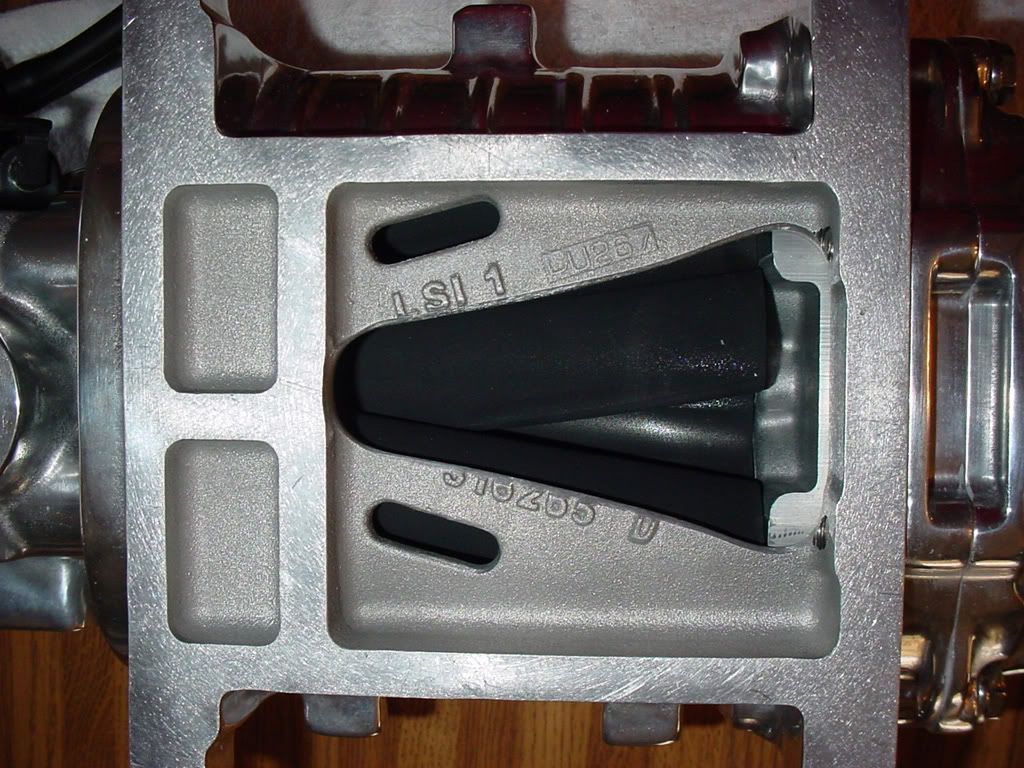
It is not a good idea to remove too much material from any portion of the blower. Extreme porting of the blower will disrupt the air and will reduce efficiency greatly. A light porting of the inlet housing will help increase intake CFM of the pump. Typically, if a TB (throttle-body) upgrade is available, it helps to match the TB port size to the inlet port for a smooth intake of air with minimal disruption. Smoothing this opening up and enlarging it slightly will help introduce more air into the rotor housing which can then be "pushed" into the lower intake manifold. The inside of the housing can also be lightly ported to increase internal surface area. It is important to note, that internal porting of the rotor housing should be very minimal. Basically, remove any and all casting flashes and ensure complete symmetry while removing as little material as possible. Removing too much material will interfere with air flow and the functionality of the rotors. The output plate at the base of the M62 housing is what can be modified the most. This plate has one large triangular and two small oval passages in it. Right now, we'll focus on the large triangle. This is the passage that air is pushed through by the rotors to create a positive pressure in the lower intake manifold. This passage can be opened up slightly and smoothed out for best flow. Opening it up too much will also disrupt airflow. This is the most porting that should be performed on an Eaton M-Series blower to maintain efficiency.
Both the M62 and M90 (most common on this site) are at their peak efficiency levels from the factory. Although running a smaller pulley is the easiest way to generate more power with these applications, it is also the easiest way to push the blower out of its efficiency range and produce gobs of heat. Heat, as you know, is the enemy of all F/I applications. Roots type superchargers, although extremely reliable, are the least efficient due to their drag on the engine by belt as well as their tendency to generate good amounts of heat in regards to the IAT (Intake Air Temperature). Eaton addressed some of these issues when they created their new line of TVS blowers; however, this thread is only concerned with the M-series blowers.
From Eaton.com:
"Eaton manufactures highly engineered, roots-type positive displacement superchargers. The Eaton supercharger increases torque across the entire operating range without compromising drivability or emissions. This allows vehicle manufacturers the option of using smaller, more economical 4- and 6-cylinder engines, without perceived loss in power train performance. Additionally, the supercharger incorporates a bypass system to reduce air handling losses when boost is not required, resulting in better fuel economy. Typical applications are on engines with displacements of 1.8L to 5.3L.
All aftermarket and service (rebuilds) are handled in the United States by Magnuson Products, (www.magnusonproducts.com) and in the Oceania-Asia-Pacific region by Harrop Engineering. (www.harrop.com)
The Eaton Supercharger - One Simple, Powerful Solution.
Eaton’s Air Management Systems Division designs, manufactures and markets modified Roots-type positive displacement pumps, also known as “superchargers,” for the original equipment and aftermarket industries."
When it comes to modification of these superchargers, the common areas of modification are:
Porting of the inlet portion of the housing
Porting of the internal housing
Porting of the outlet plate of the housing
Porting or Plugging of the "holes" on the outlet plate
Running a smaller pulley
Heat reduction, supporting modifications
The basic idea here is to increase CFM without raising IAT's. As most people on this site drive vehicles with the LSJ engine, M62 application, I will focus on that. These basic principles can be carried over to any other application using an M-Series blower. It should be noted, that the M-series superchargers are effectively air pumps. They do not internally compress the air themselves, but push it into the lower intake manifold. It is in the lower intake manifold that positive pressure emerges. Most folks think Eaton's roots-type units are actually squeezing the air like a screw unit. This is not the truth. No air passes between the rotors, the air is guided by the rotors along the sides of the housing; hence, no internal compression of air.
Porting the M-Series Supercharger:
It is not a good idea to remove too much material from any portion of the blower. Extreme porting of the blower will disrupt the air and will reduce efficiency greatly. A light porting of the inlet housing will help increase intake CFM of the pump. Typically, if a TB (throttle-body) upgrade is available, it helps to match the TB port size to the inlet port for a smooth intake of air with minimal disruption. Smoothing this opening up and enlarging it slightly will help introduce more air into the rotor housing which can then be "pushed" into the lower intake manifold. The inside of the housing can also be lightly ported to increase internal surface area. It is important to note, that internal porting of the rotor housing should be very minimal. Basically, remove any and all casting flashes and ensure complete symmetry while removing as little material as possible. Removing too much material will interfere with air flow and the functionality of the rotors. The output plate at the base of the M62 housing is what can be modified the most. This plate has one large triangular and two small oval passages in it. Right now, we'll focus on the large triangle. This is the passage that air is pushed through by the rotors to create a positive pressure in the lower intake manifold. This passage can be opened up slightly and smoothed out for best flow. Opening it up too much will also disrupt airflow. This is the most porting that should be performed on an Eaton M-Series blower to maintain efficiency.
Air Leakage Ports:
The two oval slots on the output plate are air leakage ports. Their only purpose is to decrease operational noise from the blower. Arnie, from Eaton Corp., explains their function like this, "When you stomp on the gas, the boost shoots up and the air flow goes supersonic. The air then slams back into the output plate and through the leakage slots, which reduces the hammering of the air into the housing causing less noise. The OEM can not have such loud NVH, that’s why we put them in the housing. The 2 small ports are not there to feed air, only to reduce noise." Basically, for the best flow and most efficiency, these ports can be blocked off, making the outlet port (triangle slot) the only port on the outlet plate of the housing. Closing these ports will not increase IAT's; however, it will make the supercharger much louder when in boost. As an example, aftermarket supercharger companies, such as Harrop, Roush and Magnuson do not use these slots in their blowers. It should be re-stated, that you should consult professionals regarding closing these ports; and do not, for any reason, plug them with JB Weld. Improper closure could eventually lead to pieces coming apart and loose debris destroying the rotors and housing. Opening up these ports will only have a negative effect on efficiency. Do not port them.
Please take TVS_SS' comment into consideration while modifying your Eaton Supercharger. If you choose to close the leakage ports, do so knowing the risks and consult professionals like Magnuson, Harrop or Eaton before making final decisions.
Arnie, as mentioned earlier, is Eaton's Performance Products Training Instructor and has made himself and his team available for questions regarding their product and modifying it for best performance. Please visit http://www.eatonperformance.com and you will see an area "Ask the Experts." Any questions will be answered as best as possible as time permits (they receive 100's of questions a day).
Running a smaller pulley:
Reducing the size of the pulley increases both response time and maximum RPM of the supercharger. The stock pulley sets the M-62 blower at maximum efficiency and reducing pulley sizes does reduce efficiency. Porting the supercharger and using supporting heat-reduction modifications can help negate these negative effects of increasing boost by using the smaller pulley. While they do help reduce the negative effects of increased IAT's, these supporting modifications can only help so much. The increased IAT's produced by using any smaller than a 2.8" pulley will most likely not be able to be reversed by these supporting modifications. It is not recommended to run pulleys smaller than 2.8”; however, all cooling modifications with methanol injection may make it possible to see benefits from a 2.7” pulley. 2.5” and 2.6” pulleys bring the supercharger way past its maximum RPM range and will significantly reduce the life of the supercharger. Keep that in mind.
Heat Reduction, Supporting Modifications:
The increased IAT's created by running smaller supercharger pulleys can be prevented by using several available heat reduction modifications. These modifications are the dual-pass endplate for the lower intake manifold, secondary heat exchanger, and methanol/alcohol injection. At the very least, increased cooling by running the dual-pass endplate and a secondary heat exchanger should be used when running pulleys smaller than stock. These cooling modifications will help reduce higher IAT's that may cause detonation and possible serious outcomes like blown engines. It is important to use an AFR (Air/Fuel Ratio) gauge when modifying the supercharger to make sure you maintain proper AFR and do not go too rich/lean. It is also highly recommended that you get a dyno tune after any modification to the engine to optimize performance and ensure safety. Information on any of these modifications can be found in the performance section here. Search first, if you can't find your answer, make a thread.
Comments and suggestions are welcome regarding this information. There's a lot here, but I'm sure I missed something that is important.
The two oval slots on the output plate are air leakage ports. Their only purpose is to decrease operational noise from the blower. Arnie, from Eaton Corp., explains their function like this, "When you stomp on the gas, the boost shoots up and the air flow goes supersonic. The air then slams back into the output plate and through the leakage slots, which reduces the hammering of the air into the housing causing less noise. The OEM can not have such loud NVH, that’s why we put them in the housing. The 2 small ports are not there to feed air, only to reduce noise." Basically, for the best flow and most efficiency, these ports can be blocked off, making the outlet port (triangle slot) the only port on the outlet plate of the housing. Closing these ports will not increase IAT's; however, it will make the supercharger much louder when in boost. As an example, aftermarket supercharger companies, such as Harrop, Roush and Magnuson do not use these slots in their blowers. It should be re-stated, that you should consult professionals regarding closing these ports; and do not, for any reason, plug them with JB Weld. Improper closure could eventually lead to pieces coming apart and loose debris destroying the rotors and housing. Opening up these ports will only have a negative effect on efficiency. Do not port them.
Please take TVS_SS' comment into consideration while modifying your Eaton Supercharger. If you choose to close the leakage ports, do so knowing the risks and consult professionals like Magnuson, Harrop or Eaton before making final decisions.
Arnie, as mentioned earlier, is Eaton's Performance Products Training Instructor and has made himself and his team available for questions regarding their product and modifying it for best performance. Please visit http://www.eatonperformance.com and you will see an area "Ask the Experts." Any questions will be answered as best as possible as time permits (they receive 100's of questions a day).
Running a smaller pulley:
Reducing the size of the pulley increases both response time and maximum RPM of the supercharger. The stock pulley sets the M-62 blower at maximum efficiency and reducing pulley sizes does reduce efficiency. Porting the supercharger and using supporting heat-reduction modifications can help negate these negative effects of increasing boost by using the smaller pulley. While they do help reduce the negative effects of increased IAT's, these supporting modifications can only help so much. The increased IAT's produced by using any smaller than a 2.8" pulley will most likely not be able to be reversed by these supporting modifications. It is not recommended to run pulleys smaller than 2.8”; however, all cooling modifications with methanol injection may make it possible to see benefits from a 2.7” pulley. 2.5” and 2.6” pulleys bring the supercharger way past its maximum RPM range and will significantly reduce the life of the supercharger. Keep that in mind.
Heat Reduction, Supporting Modifications:
The increased IAT's created by running smaller supercharger pulleys can be prevented by using several available heat reduction modifications. These modifications are the dual-pass endplate for the lower intake manifold, secondary heat exchanger, and methanol/alcohol injection. At the very least, increased cooling by running the dual-pass endplate and a secondary heat exchanger should be used when running pulleys smaller than stock. These cooling modifications will help reduce higher IAT's that may cause detonation and possible serious outcomes like blown engines. It is important to use an AFR (Air/Fuel Ratio) gauge when modifying the supercharger to make sure you maintain proper AFR and do not go too rich/lean. It is also highly recommended that you get a dyno tune after any modification to the engine to optimize performance and ensure safety. Information on any of these modifications can be found in the performance section here. Search first, if you can't find your answer, make a thread.
Comments and suggestions are welcome regarding this information. There's a lot here, but I'm sure I missed something that is important.
im sure this will explain how fucked up your supercharger is in a more technical aspect

Banned
Joined: 10-26-07
Posts: 1,963
Likes: 0
From: StripedHEMI766 Racine, WI
Banned
Joined: 06-11-08
Posts: 59
Likes: 0
From: Milwaukee
if he doesn't like what i have to say he can leave or ignore me either way ill be standing there telling him i told you so when it happens.
there are no arguments.. derek over ported this supercharger and is going to blow up his car if he doesn't do any cooling mods. im just throwing the facts out there. ignorance is not excuse when it comes to cars with power adders.. he needs to sit down and do some research. its sad when a n/a guy knows more about his car then he does.
We should all meet up at Jordan's house, rent jet ski's, and then go cruise around Jefferson on them!

