


Thoughts on rear twisting beam sway bars


Thread Starter
Senior Member
Joined: 02-03-08
Posts: 3,454
Likes: 1
From: Port Perry Ontario
Thoughts on rear twisting beam sway bars
The other day I got a nice note from a Member, Livewire, asking for help with suspension explanation. I wrote some stuff for him, that I asked him not to share; it was just for his use. Then recently, it came to my notice that other vendors are copying more of the products that I have introduced to the Cobalt/Redline community through Over the top Performance.
Josh and Sean there are straight up hard working lads, like the folks on this forum. So I guess you could say it sucks that things developed originally with a lot of hard work, and expense, get copied and the copiers put in no work - just copy/paste/sell, and make a profit while pumping themselves up as “helping the community” with lower prices. I guess it happens all the time in life, and the folks that do that certainly can take the position that everyone does it....but ‘buyer beware’. Some of the stuff that is cheaper may not be right.
So let me explain rear suspension and sway bars, and you can appreciate what went into the Time Attack Hardcore sway bars that I make, that Josh and Sean sell exclusively to the USA market...
Chevrolet say that Cobalt's torsion beam rear suspension provides excellent ride and handling, while maximizing interior space. A hydraulic rear suspension bushing is employed on the FE1 suspension to improve the ride and suppress road noise. Rear wheel travel, at 126.5 mm in jounce and 68.5 mm in rebound, is longer than most vehicles in the segment.
The Fe 5 cars have a “solid” rubber bushing that the twisting beam pivots on. This is a rubber bushing with voids that isolates impacts but does not pivot easily. In fact if you undo the shocks the twisting beam can be “bounced” up and down. This elasticity in the mounts creates friction and adds some spring action to the assembly. Further, as this bushing distorts, it changes the relative position of the twb compared to the structure of the car itself. The twisting beam is an interesting, I might say brilliant, suspension part. The roll center changes (unlike conventional independent rear suspension) through ‘distortion’ of the the twisting beam around the shear center of the ‘V’ beam, and the bushing center.
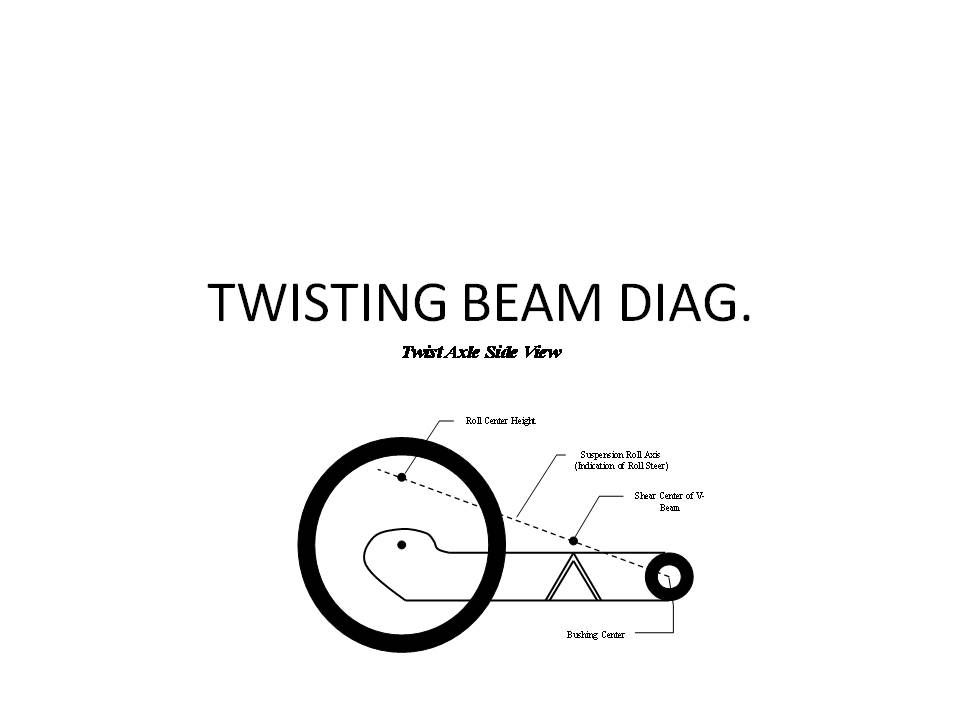
So from this picture, you can see that if the bushing center changes everything changes.
For the track we put in spherical joints here. Just as the control arm bushings distort in the front suspension the rear ones do this as well. While I have a solution in mind at the moment, it takes time and some money for me to get around to fixing this part. Until I do, the roll center changes are problematical. That means that after you bolt on a large rear sway bar, it is probable that the effect will be reduced over time as that poor twb bushing yields.
The biggest single change to the rear other than big spring rate changes, is a rear sway bar. Note how this works: the sway bars affect the car as the car rotates on turn in. Once the car has turned in and it takes a set, the sway bars don’t do much.
As FWD cars always want to go straight, if you try to use high spring rate to help turn the car in, the spring rates have to be really high at the rear which makes the car ride rough on the street.
A rear sway bar is an elegant solution to improving handling balance on a FWD car for the track and street.
For the Grand American race cars we built, we were stuck with existing rules. Developed a long time ago for Volkswagen’s racing , the rules said that if a car had a welded in sway bar, then the only change approved would be another welded in sway bar.
As the Cobalt twisting beam has a welded in sway bar, it was easy for us to do one in a larger diameter Chromalloy weld in bar.
At the same time, we changed the axle to accept Pontiac Grand Am rear wheel bearings, that have the same abs tooth count in the abs ring, and also have a 5 x 114.3 pcd. (This because back then in 2005 no one had aftermarket wheels for racing that had 5 x 110 pcd.)
The front wheel bearing is easy to change on 05 to early 07 cars for 5 x 114.3. The rear is not. I am working on a less expensive way of changing the rear twisting beam to accept 5 x 114.3 bearings. But it is not easy, and the risk of damage to your car and yourself with a cheap fix is not something I would recommend.
The next thing we did for the GA car’s rear beam was to change the lower shock position. This was to enable us to use 17 inch wheels and spherical jointed coil over shocks; with the changes to the twb we also made it a “drop spindle” axle to retain wheel travel and still have a lower car ride height.
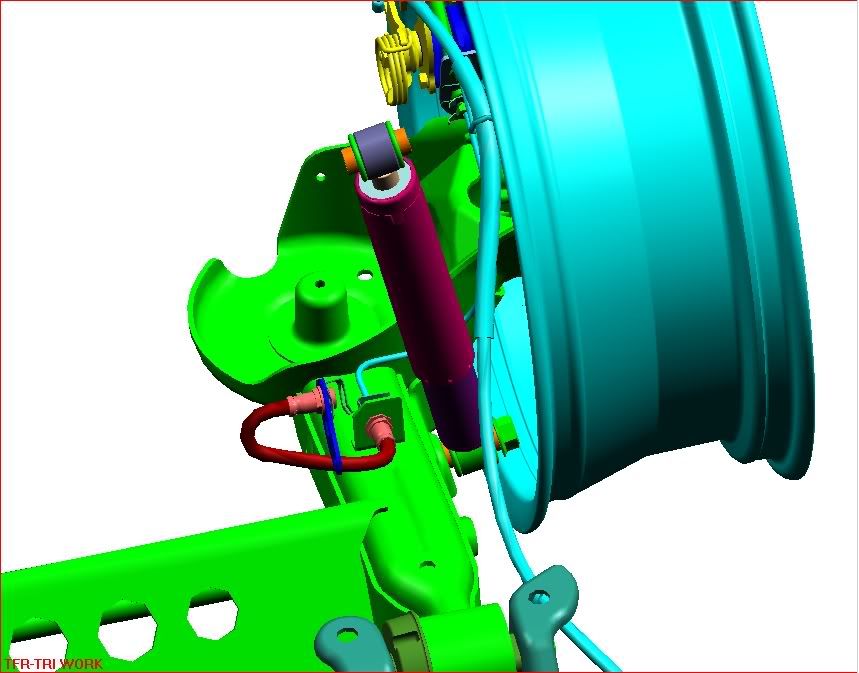
You can see the rear lower shock bolt is close to the wheel. For the race cars we had to move the lower pickup shock rearward on the twisting beam.
Later on in 2005 I sat with the suspension vehicle dynamics engineer and explored the characteristics of the rear twisting beam and my idea of a bolt on rear bar. Not a new idea. The ‘80’s Chevrolet X11 Citation had a similar rear bar.
Sway bars have to be made of proper materials and most out there –some from vendors are not made of correct materials, they are untreated mild steel.
The Eibach add-on rear bar is properly made of the correct material. The ones I supply to Over the top performance are made of correct material.
The other the important thing that is exclusive to the Over the top sway bars, is that they mount with bolt sthrough the bar rather than with a weld on a mounting tab. The bar will yield around the tab. Of course, if the bar is the wrong material, any function is just “popcorn”. Let me take an excerpt from the Pirate 4 x 4 forum for a well written explanation.“Stress and Strain
Lets lay out some initial definitions now.
Strength - a measure of how strong something is! ha ha! Seriously, this is a very important definition, as this entire series of articles is, in large part, just about how strong things are. Not only that, but the truth is not nearly as simple as my little joke above would lead you to believe.
In the broadest of terms, when we speak of a substance or products strength, we are talking of it's ability to resist an external force or load, without deforming, breaking or rupturing. Technically we say a materials strength is the greatest stress it can endure without rupturing (by rupturing - I mean the atomic bonds coming completely apart.)
There are many specific kinds of strength, from the "pure " - tensile, compressive, and shear to complicated combinations such as torsional and bending. We will examine each of these in detail throughout the article.
Stress. We all know instinctively that, generally speaking, if we have 2 things made from the same stuff, that the larger will be "stronger". In order for us to be able to discuss the strength of material, and particularly to compare different materials, we need a way to compare strength without constantly referring to how big something is. That is, we need to be able to eliminate size as a factor. We do this by employing the concept of stress. Stress is a force or load applied, divided by how big the part is, in other words force per unit of cross sectional area. It is common to measure the force applied in pounds and the cross sectional area in square inches. Thus, the unit for stress is pounds per square inch, or PSI
Using the concept of stress, we can now compare relative strengths regardless of size. Say we have 2 steel bars, one is 1 square inch in cross sectional area, the other 1/2 sq. in. If they are both made from a material having a breaking strength of 10,000 psi, one will break when 10,000 lbs is applied, the other when 5,000 lbs is applied, despite that they are made from the same material. Conversely, if we have 2 products of unknown or difficult to determine size but we know that one is made from a material with a yield strength of 75,000 psi and the other 100,000 psi, we know that the second is made of a stronger material (regardless of comparative size), and we can also say that the first would have to be 25% greater in size to be of equal strength. This logical approach can lead us to quite accurately determine that, if the sizes are similar, the second is definitely the stronger product.
Strain - closely allied to the concept of stress - the concept of strain allows us to quantify or describe how a part or material responds to an applied force or load. Quite simply: Strain is a change in shape or dimension in response to a stress. It is usually expressed in percent elongation (%) Percent elongation is the difference in length between the original length of a test specimen (often 2" in length) and that same specimen after it has been ruptured by a tension load.
In other words, materials STRAIN to resist a STRESS (much like people do to!).
Stress and strain are two separate, useful concepts but the real power of these concepts is only realized when the 2 concepts are combined. There is a defined relationship between stress and strain, discovered by an English bloke in 1680, that states the strain of any material is proportional to the stress within it. It is known as Hooke’s law and is simply stating what you already know – “the harder I push on this, the more it will bend……”. What’s important though, is that, up to a point, this relationship is proportional, or linear…meaning that if I push twice as hard, it will bend twice as far. The point up until which this is true is called the elastic limit. Realize that Hooke's law applies not only while a load (stress) is applied, but also when it is removed. Meaning, as long as we are within the elastic limit of the material (i.e. the stress is less than the elastic limit of the steel) strain is always proportional to stress, meaning if stress (load) is zero then so too is strain (distortion). What we have just described is one of the most righteous properties of steel. That is, it is "elastic" in nature - which is a fancy way of saying: up to a point, we can bend it by applying a load, then if we remove the load it will "spring" back to exactly the same shape and size it was originally. We call this elastic deformation.
Of course, we can apply a stress that exceeds the elastic limit of the steel, and if we do, the steel changes from elastic in nature (able to spring back) to plastic in nature - meaning the stress applied, once it passes the elastic limit, will result in a permanent change in shape of the metal. This we call plastic deformation. “
I worked with Carroll Smith a lot in the ‘80’s, helped him with his son’s race car, hired him for some of our projects. Carroll died a few years ago, but his books “prepare to win” and “race to win” are around still and well worth reading. Here is a quote from Mr Smith :
A solid is considered to be elastic if, after a change of shape due to an external load, the body returns to its original size and shape when the load is relaxed. Plasticity, in the metallurgical sense of the word, is the ability of a metal to be deformed beyond its range of elasticity without fracture; the result is a permanent change in shape. These two related properties are the most significant of all the characteristics of the family of metals. Plasticity gives us the ability to form metals into useful shapes and elasticity allows us to use metal fabrications as load-bearing members in our structures.
So short end to this story. Mild steel sway bars, not heat treated, may well become plastic. Chromalloy or properly heat treated spring steel bars are elastic
The way we developed the add on sway bar, we eliminated the need to change the weld in bar, and made a bolt on bar using existing holes in the twisting beam. The problem for the race cars we built is that NASCAR/Grand American would not accept this change; for the Time Attack car it didn’t matter, the rules were different, and we needed both a weld in and an add on bar. For the street/track you need just an add on bar, and when I can get to it, a pivot point change.
And that finishes up the analysis. You can buy cheap knock offs, they may be right, more often than not they will be wrong. And at the end of the day those are decisions a buyer must make. Hopefully, both Livewire who asked for the explanation, (thanks for that!) and you reading this, can make an informed buying decision. Good luck.
Josh and Sean there are straight up hard working lads, like the folks on this forum. So I guess you could say it sucks that things developed originally with a lot of hard work, and expense, get copied and the copiers put in no work - just copy/paste/sell, and make a profit while pumping themselves up as “helping the community” with lower prices. I guess it happens all the time in life, and the folks that do that certainly can take the position that everyone does it....but ‘buyer beware’. Some of the stuff that is cheaper may not be right.
So let me explain rear suspension and sway bars, and you can appreciate what went into the Time Attack Hardcore sway bars that I make, that Josh and Sean sell exclusively to the USA market...
Chevrolet say that Cobalt's torsion beam rear suspension provides excellent ride and handling, while maximizing interior space. A hydraulic rear suspension bushing is employed on the FE1 suspension to improve the ride and suppress road noise. Rear wheel travel, at 126.5 mm in jounce and 68.5 mm in rebound, is longer than most vehicles in the segment.
The Fe 5 cars have a “solid” rubber bushing that the twisting beam pivots on. This is a rubber bushing with voids that isolates impacts but does not pivot easily. In fact if you undo the shocks the twisting beam can be “bounced” up and down. This elasticity in the mounts creates friction and adds some spring action to the assembly. Further, as this bushing distorts, it changes the relative position of the twb compared to the structure of the car itself. The twisting beam is an interesting, I might say brilliant, suspension part. The roll center changes (unlike conventional independent rear suspension) through ‘distortion’ of the the twisting beam around the shear center of the ‘V’ beam, and the bushing center.
So from this picture, you can see that if the bushing center changes everything changes.
For the track we put in spherical joints here. Just as the control arm bushings distort in the front suspension the rear ones do this as well. While I have a solution in mind at the moment, it takes time and some money for me to get around to fixing this part. Until I do, the roll center changes are problematical. That means that after you bolt on a large rear sway bar, it is probable that the effect will be reduced over time as that poor twb bushing yields.
The biggest single change to the rear other than big spring rate changes, is a rear sway bar. Note how this works: the sway bars affect the car as the car rotates on turn in. Once the car has turned in and it takes a set, the sway bars don’t do much.
As FWD cars always want to go straight, if you try to use high spring rate to help turn the car in, the spring rates have to be really high at the rear which makes the car ride rough on the street.
A rear sway bar is an elegant solution to improving handling balance on a FWD car for the track and street.
For the Grand American race cars we built, we were stuck with existing rules. Developed a long time ago for Volkswagen’s racing , the rules said that if a car had a welded in sway bar, then the only change approved would be another welded in sway bar.
As the Cobalt twisting beam has a welded in sway bar, it was easy for us to do one in a larger diameter Chromalloy weld in bar.
At the same time, we changed the axle to accept Pontiac Grand Am rear wheel bearings, that have the same abs tooth count in the abs ring, and also have a 5 x 114.3 pcd. (This because back then in 2005 no one had aftermarket wheels for racing that had 5 x 110 pcd.)
The front wheel bearing is easy to change on 05 to early 07 cars for 5 x 114.3. The rear is not. I am working on a less expensive way of changing the rear twisting beam to accept 5 x 114.3 bearings. But it is not easy, and the risk of damage to your car and yourself with a cheap fix is not something I would recommend.
The next thing we did for the GA car’s rear beam was to change the lower shock position. This was to enable us to use 17 inch wheels and spherical jointed coil over shocks; with the changes to the twb we also made it a “drop spindle” axle to retain wheel travel and still have a lower car ride height.
You can see the rear lower shock bolt is close to the wheel. For the race cars we had to move the lower pickup shock rearward on the twisting beam.
Later on in 2005 I sat with the suspension vehicle dynamics engineer and explored the characteristics of the rear twisting beam and my idea of a bolt on rear bar. Not a new idea. The ‘80’s Chevrolet X11 Citation had a similar rear bar.
Sway bars have to be made of proper materials and most out there –some from vendors are not made of correct materials, they are untreated mild steel.
The Eibach add-on rear bar is properly made of the correct material. The ones I supply to Over the top performance are made of correct material.
The other the important thing that is exclusive to the Over the top sway bars, is that they mount with bolt sthrough the bar rather than with a weld on a mounting tab. The bar will yield around the tab. Of course, if the bar is the wrong material, any function is just “popcorn”. Let me take an excerpt from the Pirate 4 x 4 forum for a well written explanation.“Stress and Strain
Lets lay out some initial definitions now.
Strength - a measure of how strong something is! ha ha! Seriously, this is a very important definition, as this entire series of articles is, in large part, just about how strong things are. Not only that, but the truth is not nearly as simple as my little joke above would lead you to believe.
In the broadest of terms, when we speak of a substance or products strength, we are talking of it's ability to resist an external force or load, without deforming, breaking or rupturing. Technically we say a materials strength is the greatest stress it can endure without rupturing (by rupturing - I mean the atomic bonds coming completely apart.)
There are many specific kinds of strength, from the "pure " - tensile, compressive, and shear to complicated combinations such as torsional and bending. We will examine each of these in detail throughout the article.
Stress. We all know instinctively that, generally speaking, if we have 2 things made from the same stuff, that the larger will be "stronger". In order for us to be able to discuss the strength of material, and particularly to compare different materials, we need a way to compare strength without constantly referring to how big something is. That is, we need to be able to eliminate size as a factor. We do this by employing the concept of stress. Stress is a force or load applied, divided by how big the part is, in other words force per unit of cross sectional area. It is common to measure the force applied in pounds and the cross sectional area in square inches. Thus, the unit for stress is pounds per square inch, or PSI
Using the concept of stress, we can now compare relative strengths regardless of size. Say we have 2 steel bars, one is 1 square inch in cross sectional area, the other 1/2 sq. in. If they are both made from a material having a breaking strength of 10,000 psi, one will break when 10,000 lbs is applied, the other when 5,000 lbs is applied, despite that they are made from the same material. Conversely, if we have 2 products of unknown or difficult to determine size but we know that one is made from a material with a yield strength of 75,000 psi and the other 100,000 psi, we know that the second is made of a stronger material (regardless of comparative size), and we can also say that the first would have to be 25% greater in size to be of equal strength. This logical approach can lead us to quite accurately determine that, if the sizes are similar, the second is definitely the stronger product.
Strain - closely allied to the concept of stress - the concept of strain allows us to quantify or describe how a part or material responds to an applied force or load. Quite simply: Strain is a change in shape or dimension in response to a stress. It is usually expressed in percent elongation (%) Percent elongation is the difference in length between the original length of a test specimen (often 2" in length) and that same specimen after it has been ruptured by a tension load.
In other words, materials STRAIN to resist a STRESS (much like people do to!).
Stress and strain are two separate, useful concepts but the real power of these concepts is only realized when the 2 concepts are combined. There is a defined relationship between stress and strain, discovered by an English bloke in 1680, that states the strain of any material is proportional to the stress within it. It is known as Hooke’s law and is simply stating what you already know – “the harder I push on this, the more it will bend……”. What’s important though, is that, up to a point, this relationship is proportional, or linear…meaning that if I push twice as hard, it will bend twice as far. The point up until which this is true is called the elastic limit. Realize that Hooke's law applies not only while a load (stress) is applied, but also when it is removed. Meaning, as long as we are within the elastic limit of the material (i.e. the stress is less than the elastic limit of the steel) strain is always proportional to stress, meaning if stress (load) is zero then so too is strain (distortion). What we have just described is one of the most righteous properties of steel. That is, it is "elastic" in nature - which is a fancy way of saying: up to a point, we can bend it by applying a load, then if we remove the load it will "spring" back to exactly the same shape and size it was originally. We call this elastic deformation.
Of course, we can apply a stress that exceeds the elastic limit of the steel, and if we do, the steel changes from elastic in nature (able to spring back) to plastic in nature - meaning the stress applied, once it passes the elastic limit, will result in a permanent change in shape of the metal. This we call plastic deformation. “
I worked with Carroll Smith a lot in the ‘80’s, helped him with his son’s race car, hired him for some of our projects. Carroll died a few years ago, but his books “prepare to win” and “race to win” are around still and well worth reading. Here is a quote from Mr Smith :
A solid is considered to be elastic if, after a change of shape due to an external load, the body returns to its original size and shape when the load is relaxed. Plasticity, in the metallurgical sense of the word, is the ability of a metal to be deformed beyond its range of elasticity without fracture; the result is a permanent change in shape. These two related properties are the most significant of all the characteristics of the family of metals. Plasticity gives us the ability to form metals into useful shapes and elasticity allows us to use metal fabrications as load-bearing members in our structures.
So short end to this story. Mild steel sway bars, not heat treated, may well become plastic. Chromalloy or properly heat treated spring steel bars are elastic
The way we developed the add on sway bar, we eliminated the need to change the weld in bar, and made a bolt on bar using existing holes in the twisting beam. The problem for the race cars we built is that NASCAR/Grand American would not accept this change; for the Time Attack car it didn’t matter, the rules were different, and we needed both a weld in and an add on bar. For the street/track you need just an add on bar, and when I can get to it, a pivot point change.
And that finishes up the analysis. You can buy cheap knock offs, they may be right, more often than not they will be wrong. And at the end of the day those are decisions a buyer must make. Hopefully, both Livewire who asked for the explanation, (thanks for that!) and you reading this, can make an informed buying decision. Good luck.


Senior Member
Joined: 07-28-06
Posts: 4,994
Likes: 0
From: Waldorf, MD
Thanks for the great info. It's good to know that our aftermarket options aren't lost as of yet. I know OTTP works hard to make sure we have the best stuff.
One thing you might want to consider...
The idea on here for some is that the cobalts (especially the blown app) is in need of a front strut bar. Would you mind elaborating on that if you could?
One thing you might want to consider...
The idea on here for some is that the cobalts (especially the blown app) is in need of a front strut bar. Would you mind elaborating on that if you could?
Thread Starter
Senior Member
Joined: 02-03-08
Posts: 3,454
Likes: 1
From: Port Perry Ontario
Thanks for the great info. It's good to know that our aftermarket options aren't lost as of yet. I know OTTP works hard to make sure we have the best stuff.
One thing you might want to consider...
The idea on here for some is that the cobalts (especially the blown app) is in need of a front strut bar. Would you mind elaborating on that if you could?
One thing you might want to consider...
The idea on here for some is that the cobalts (especially the blown app) is in need of a front strut bar. Would you mind elaborating on that if you could?
FE1 suspension – standard on LS, LT and LTZ models, it provides a smooth ride and includes a 19-mm front stabilizer bar and a 16-mm rear stabilizer bar
FE3 suspension – standard on SS models, it delivers a firmer, more direct ride and includes 22-mm front and rear stabilizer bars, four-wheel disc brakes, monotube shocks and 17-inch wheels and performance tires
FE5 suspension – standard on the SS Supercharged, it was developed on the racetrack to deliver sports car levels of handling and grip; 24-mm front stabilizer bar and 22-mm rear stabilizer bar, higher-rate springs and bushings, four-wheel disc brakes, monotube shocks and 18-inch forged aluminum wheels with complementing performance tires
Update FE5 Turbocharged cars 08 09: 25 mm front stab bar, 24 mm rear stab bar, higher rate front and rear springs, re valved shocks and struts, front knuckles with shorter steering arm (steering rack is the same) resulting in quicker steering.
Cobalt's strut-type front suspension is compact yet provides long wheel travel, with 90 mm of compression travel and 87 mm of rebound, which is substantially more than most competitors and enhances overall ride and handling. Monotube rear shocks are used for a more precise road feel. L-shaped front control arms contain a forward pivot bushing, which transmits most of the cornering force, and a larger, high-damped composite rear elastomeric bushing that allows rearward movement to minimize harshness from road surface impacts. The front control arms are made from steel on the FE1 suspension and are aluminum on the FE3 and FE5 suspensions.
The direct-acting front stabilizer bar connects to each strut for precise steering response and improved cornering agility with decreased body roll. All front suspension components are mounted to a new, rigid cradle assembly comprised of four large hydroformed steel tubes and two side members that are integrally welded to front and rear cross members. The cradle is mounted to the Cobalt's space frame at four widely spaced points.
So 19, 22, 24 and 25 mm front bars on FE1,3, FE5 LSJ and FE5 LNF Respectively.
The early Grand Am cars ran no front bar; it took a while to get the geometry right on the sway bar end link pickups with coil overs, and after that we had to modify the front bar bushing clamp to 2 bolt as the 1 bolt and tab is useless and yields.
After awhile we went to the stock 24 mm front bar.
The LNF got a rear bar increase, hence the 25 mm bar at the front. Note the incremental increase is just 1 mm.
Side bar:[I] IMHO BTW Hotchkiss so the best job/materials spec/tuned results for volume production of aftermarket bars in the industry. They dont do a Cobalt one....I am impressed with Pedders products, our shop put Pedders Sport Ryders on an Avalance
Saturday. Awesome product...[/I]Generalisation #1. The front bar keeps the rear wheels on the ground/ the rear bar keeps the front wheels on the ground.
Generalisation #2. Big front bars make the car go straight (push) resist turning.
Generalisation #3 All FWD cars push (you cant alter the slip angles at the rear with throttle)
So the risk is going to a larger front bar may make the car push a lot on turn in.
Hence I would not go to anything bigger than a 25 mm bar. Thats what I use with a Hardcore 1.25 rear.
Hope this helps.










 ... but some people, won't realize still. with how today is, people are for cheaper not quality
  n ...
n ...

Senior Member
iTrader: (1)
Joined: 02-08-08
Posts: 3,726
Likes: 0
From: Fayetteville/Linden, NC/Myrtle Beach, SC
Beautiful write up, I will admit I skimmed through the Pirate 4x4 reference but I also have a metalergy background. I already have a high trust for OTTP and thier Products and already plan on the hardcore bar as soon as I get the email back from Sean about getting it PC in yellow. You guys do some great stuff just need to show a little more love to the 2.2 guys :-P
Side note, I noticed there are some GMPerformance parts up on OTTP, Think they could get their hands on some SC parts?
Side note, I noticed there are some GMPerformance parts up on OTTP, Think they could get their hands on some SC parts?




Thread Starter
Senior Member
Joined: 02-03-08
Posts: 3,454
Likes: 1
From: Port Perry Ontario
Thanks for the great info. It's good to know that our aftermarket options aren't lost as of yet. I know OTTP works hard to make sure we have the best stuff.
One thing you might want to consider...
The idea on here for some is that the cobalts (especially the blown app) is in need of a front strut bar. Would you mind elaborating on that if you could?
One thing you might want to consider...
The idea on here for some is that the cobalts (especially the blown app) is in need of a front strut bar. Would you mind elaborating on that if you could?
Tying the top of the struts together is a time honored way of improving structural torsional stiffness. If the tower is up alone in space, (Bimmer, Honda CTSV) you can tie it together, or triangulate it forward or (even better) back to the firewall. Or you can go underneath the car and tie the frame rails together.
In the case of the Delta platform, GM placed the strut towers right against the firewall, and their computer studies showed no gain tying the strut towers together at the top, at all.
But GMSPO did release a strut bar for it. They dont always listen to engineers at GM this is the company that put trunk racks on justa bout any car that moved including Corvette back in the day. Ever see a trunk rack in use?
aNYWAY. For the Cobalt the towers are good by themselves. On the race cars which we built up from bodies in white (no paint no sealer) we seam welded here and there.
End of story? On a 'balt, Strut bars are good for hanging decals
Senior Member
iTrader: (1)
Joined: 02-08-08
Posts: 3,726
Likes: 0
From: Fayetteville/Linden, NC/Myrtle Beach, SC

Senior Member
Joined: 08-03-07
Posts: 2,098
Likes: 0
From: Blaine, MN
OK, quick question for the front sway...
I have an LS if you can't figure that out....I have Sportlines and will be adding SS/TC struts and shocks come summer time. I will be adding my OTT steering rack spacers at the same time. I have the OTT "street" bar (1.0")...I want to upgrade the front bar...
I know many times many people (including Maven) have mentioned the SS/SC bar (24mm)...my question is this....would the 25mm (SS/TC) bar fit?
Without searching, I kind of remember someone saying something about the 05 clamps being used on the FE1 suspension, so can I only use the LSJ sway bar and clamps and insulators? Otherwise, are there or will there be any good aftermarket matches to my setup?
The only thing that may change in my setup is eventually I may wind up with Pedders (yeah right...only if I find used ones) or something else that is somewhat similar...maybe the Pro-kit. Will the springs themselves have a big effect on the choice of sway bar for the front?
Thanks for any and all help.
Mike
I have an LS if you can't figure that out....I have Sportlines and will be adding SS/TC struts and shocks come summer time. I will be adding my OTT steering rack spacers at the same time. I have the OTT "street" bar (1.0")...I want to upgrade the front bar...
I know many times many people (including Maven) have mentioned the SS/SC bar (24mm)...my question is this....would the 25mm (SS/TC) bar fit?
Without searching, I kind of remember someone saying something about the 05 clamps being used on the FE1 suspension, so can I only use the LSJ sway bar and clamps and insulators? Otherwise, are there or will there be any good aftermarket matches to my setup?
The only thing that may change in my setup is eventually I may wind up with Pedders (yeah right...only if I find used ones) or something else that is somewhat similar...maybe the Pro-kit. Will the springs themselves have a big effect on the choice of sway bar for the front?
Thanks for any and all help.
Mike
Last edited by 007CobaltLS; Jan 25, 2010 at 10:26 PM. Reason: Automerged Doublepost


