


What is the Point?


What is the Point?
What is the point of having a 3 inch down pipe into a 2.5 inch exhaust, your exhaust is only 2.5 inches wide. I would see having a 3 inch exhaust all the way back. But wouldn't the 3 inch downpipe with a 2.5 inch cat-back make the flow bottleneck and actually loose power? Just a thought.


Senior Member
Joined: 01-25-06
Posts: 4,493
Likes: 0
From: Maryland


Senior Member
Joined: 08-06-07
Posts: 1,286
Likes: 0
From: Denver, CO
https://www.cobaltss.net/forums/show...t=backpressure
 some light reading
some light readingThe most common misconceptions, the concerns and the state of mind of tuners
This is by no means saying what my opinion is the end all and say all to car tuning but it's something to think about or even something to question if you feel to. Hopefully this will raise some discussion either on the forum boards or in real life.
---------------------------------------------------------------------------------------------------------------------------
2. Backpressure is something you need
First understand that your engine is a big air pump. It ingests oxygen (or maybe even is forced fed oxygen) and expels wastes. The most important part to also understand is that velocity of air traveling plays effect in both parts. If you don't understand what velocity is:
When talking about your exhaust system, increasing the diameter of your exhaust system or even increasing the primaries on your manifold/header, it effects the velocity of the exhaust leaving your engine. If it doesn't make much sense to you, think of it like this:
Take a straw that is 3 centimeters in diameter and blow into it. The air from your lungs is now traveling through your mouth and into a closed area at a certain rate of speed. When it reaches into the straw, what determines the speed is the force of the air travel in this inclosed space. Now take a straw that is 6 centimeters in diameter and the same length. Lets also assume that the air leaving your lungs and traveling through your mouth is going at the same speed/velocity. With having a larger diameter straw, this is going to change how fast air will travel through the straw...hence change the velocity of the air.
Using the example above, your lungs is the engine, your mouth is the ports on the cylinder head(s) and the straw is your exhaust system.
Now that you understand what velocity is, understand what backpressure is.
Backpressure is exactly that, air (or in this case exhaust waste) traveling back torwards the engine. Now most of us understand that it's about how fast the exhaust gets out of the motor and the exhaust system. If there is a force of air traveling out of engine into one direction, backpressure would be a force of air attempting to travel in the opposite direction.
Backpressure is caused by restriction, whether it be a crimp in the exhaust system, for example, a crush bent pipe:
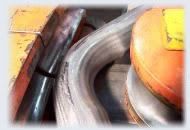
or it be because of a very small diametered exhaust system (including primaries on the manifold/header).
The most important thing to understand in the cases of having an engine that is naturally aspirated or supercharged (turbocharged engines don't run off this method post-turbocharger) is that when you increase the diameter, you are getting rid of backpressure...yes but you are at the same time effecting the velocity of air traveling out of your exhaust system. It's basically taking the good with the bad.
Why is exhaust velocity important? Exhaust velocity does have a direct relation to your powerband and where it is located which is why it's very important for you to pick the proper size exhaust system in the first place. The wrong size can effect your powerband in the negative way (well, negative to you as the user of the vehicle). The slower the velocity, the later in the RPM Band your powerband will be moved to. If off extremely, it will make the performance of your engine very peaky or at worst, make you lose power.
Overall, everything should be considered and it is important to think about exhaust velocity...not backpressure. I would also suggest reading up on scavenging effects.
This is by no means saying what my opinion is the end all and say all to car tuning but it's something to think about or even something to question if you feel to. Hopefully this will raise some discussion either on the forum boards or in real life.
---------------------------------------------------------------------------------------------------------------------------
2. Backpressure is something you need
First understand that your engine is a big air pump. It ingests oxygen (or maybe even is forced fed oxygen) and expels wastes. The most important part to also understand is that velocity of air traveling plays effect in both parts. If you don't understand what velocity is:
When talking about your exhaust system, increasing the diameter of your exhaust system or even increasing the primaries on your manifold/header, it effects the velocity of the exhaust leaving your engine. If it doesn't make much sense to you, think of it like this:
Take a straw that is 3 centimeters in diameter and blow into it. The air from your lungs is now traveling through your mouth and into a closed area at a certain rate of speed. When it reaches into the straw, what determines the speed is the force of the air travel in this inclosed space. Now take a straw that is 6 centimeters in diameter and the same length. Lets also assume that the air leaving your lungs and traveling through your mouth is going at the same speed/velocity. With having a larger diameter straw, this is going to change how fast air will travel through the straw...hence change the velocity of the air.
Using the example above, your lungs is the engine, your mouth is the ports on the cylinder head(s) and the straw is your exhaust system.
Now that you understand what velocity is, understand what backpressure is.
Backpressure is exactly that, air (or in this case exhaust waste) traveling back torwards the engine. Now most of us understand that it's about how fast the exhaust gets out of the motor and the exhaust system. If there is a force of air traveling out of engine into one direction, backpressure would be a force of air attempting to travel in the opposite direction.
Backpressure is caused by restriction, whether it be a crimp in the exhaust system, for example, a crush bent pipe:
or it be because of a very small diametered exhaust system (including primaries on the manifold/header).
The most important thing to understand in the cases of having an engine that is naturally aspirated or supercharged (turbocharged engines don't run off this method post-turbocharger) is that when you increase the diameter, you are getting rid of backpressure...yes but you are at the same time effecting the velocity of air traveling out of your exhaust system. It's basically taking the good with the bad.
Why is exhaust velocity important? Exhaust velocity does have a direct relation to your powerband and where it is located which is why it's very important for you to pick the proper size exhaust system in the first place. The wrong size can effect your powerband in the negative way (well, negative to you as the user of the vehicle). The slower the velocity, the later in the RPM Band your powerband will be moved to. If off extremely, it will make the performance of your engine very peaky or at worst, make you lose power.
Overall, everything should be considered and it is important to think about exhaust velocity...not backpressure. I would also suggest reading up on scavenging effects.

Senior Member
Joined: 01-05-06
Posts: 10,877
Likes: 2
From: East Brunswick, NJ
Besides the copy and paste of what I stated in the write up
Scavenging effects play into it as well.
Just to add
A supercharged vehicle still works on the same principle as far as exhaust velocity as a naturally aspirated car. Too big can still be a bad thing. Even though it's forced induction, it's not in the same principal as a Turbocharged car.
Scavenging effects play into it as well.
Just to add
A supercharged vehicle still works on the same principle as far as exhaust velocity as a naturally aspirated car. Too big can still be a bad thing. Even though it's forced induction, it's not in the same principal as a Turbocharged car.
Last edited by NJHK; Nov 5, 2007 at 03:04 PM. Reason: Automerged Doublepost

Senior Member
Joined: 06-28-06
Posts: 2,755
Likes: 0
From: Illinois
Besides the copy and paste of what I stated in the write up
Scavenging effects play into it as well.
Just to add
A supercharged vehicle still works on the same principle as far as exhaust velocity as a naturally aspirated car. Too big can still be a bad thing. Even though it's forced induction, it's not in the same principal as a Turbocharged car.
Scavenging effects play into it as well.
Just to add
A supercharged vehicle still works on the same principle as far as exhaust velocity as a naturally aspirated car. Too big can still be a bad thing. Even though it's forced induction, it's not in the same principal as a Turbocharged car.
and to complicate things further, you still need back pressure on a turbocharged car but the turbo provides the back pressure for the engine. The idea is to open the exhaust up as much as you can after the turbo so that there is no back pressure on the turbine.
I think we are skipping over the point of this question which was not clearly defined. He is probably wondering why ZZP offers a 3" dp that goes down to a 2.5" flange.
The reason is the catalytic converter. A 3" high flow catalytic converter flows more then a 2.5" cat. So a 3" high flow cat probably flows similar to a 2.5" exhaust. If you put a 2.5" cat on a 2.5" dp your flow would be reduced thus eliminating the need for a 2.5" cat-back.
Its sort of like the people who upgrade their dp or manifold when running a GMPP cat-back. The stock manifold and dp already flow more then their GMPP cat-backs. So they are waisting their money. But they don't like to hear that!
Read this thread.
https://www.cobaltss.net/forums/2-0l-lsj-performance-tech-47/flow-calculation-some-lsj-parts-67539/
The reason is the catalytic converter. A 3" high flow catalytic converter flows more then a 2.5" cat. So a 3" high flow cat probably flows similar to a 2.5" exhaust. If you put a 2.5" cat on a 2.5" dp your flow would be reduced thus eliminating the need for a 2.5" cat-back.
Its sort of like the people who upgrade their dp or manifold when running a GMPP cat-back. The stock manifold and dp already flow more then their GMPP cat-backs. So they are waisting their money. But they don't like to hear that!
Read this thread.
https://www.cobaltss.net/forums/2-0l-lsj-performance-tech-47/flow-calculation-some-lsj-parts-67539/

Senior Member
Joined: 06-28-06
Posts: 12,577
Likes: 2
From: Canada
I have the 3 inch catless to 2.5 neck.
I really like it.
Do you know how a wind tunnel works? your kinda getting a similar effect with this.
With the larger 3 inch chamber there, your allowing the exhaust gasses to exit the hot head/header quicker, and then hitting the smaller neck and exhaust, your exhaust velocity will increase, causing a vacuum effect, thereby helping to extract the gasses quickly.
I really like it.
Do you know how a wind tunnel works? your kinda getting a similar effect with this.
With the larger 3 inch chamber there, your allowing the exhaust gasses to exit the hot head/header quicker, and then hitting the smaller neck and exhaust, your exhaust velocity will increase, causing a vacuum effect, thereby helping to extract the gasses quickly.



Senior Member
Joined: 10-05-06
Posts: 2,263
Likes: 0
From: DFW, TX
I think we are skipping over the point of this question which was not clearly defined. He is probably wondering why ZZP offers a 3" dp that goes down to a 2.5" flange.
The reason is the catalytic converter. A 3" high flow catalytic converter flows more then a 2.5" cat. So a 3" high flow cat probably flows similar to a 2.5" exhaust. If you put a 2.5" cat on a 2.5" dp your flow would be reduced thus eliminating the need for a 2.5" cat-back.
Its sort of like the people who upgrade their dp or manifold when running a GMPP cat-back. The stock manifold and dp already flow more then their GMPP cat-backs. So they are waisting their money. But they don't like to hear that!
Read this thread.
https://www.cobaltss.net/forums/showthread.php?t=67539
The reason is the catalytic converter. A 3" high flow catalytic converter flows more then a 2.5" cat. So a 3" high flow cat probably flows similar to a 2.5" exhaust. If you put a 2.5" cat on a 2.5" dp your flow would be reduced thus eliminating the need for a 2.5" cat-back.
Its sort of like the people who upgrade their dp or manifold when running a GMPP cat-back. The stock manifold and dp already flow more then their GMPP cat-backs. So they are waisting their money. But they don't like to hear that!
Read this thread.
https://www.cobaltss.net/forums/showthread.php?t=67539


Thread
Thread Starter
Forum
Replies
Last Post
TheSandMan
Problems/Service/Maintenance
1
Sep 20, 2015 06:02 AM