


Torque?


heres a good article
Comparing Two Cars
I think at this point, it is clear that the car's acceleration ability is related to its engine's power output. Now, let's compare two different cars with two very different engines.
Both vehicles will have the same curb weight, and peak horsepower figures. They will also have the same transmission, tire radius, and so on. In fact, the only difference between the two cars will be the engines. One car will be equipped with a 500hp turbocharged 4 cylinder engine, and the other will have a 500hp big-block V8. The 4 cylinder will be named Ricer, and the V8 will be named Redneck. The 4 cylinder is able to rev to 9000rpm and produce a fair bit of torque, while the V8 can rev to only 6000rpm, but produce a ton of torque. To keep the math very simple, the Redneck's engine idles at 600rpm, and the Ricer's idles at 900rpm.
Below are plots of the two fictitious engine's torque and horsepower curves.
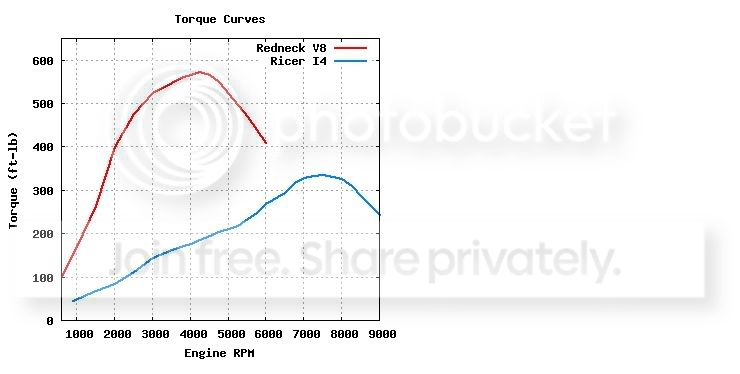
Figure 1: Torque versus RPM for Redneck and Ricer. These are unrealistic curves which have been exaggerated to help illustrate certain concepts.
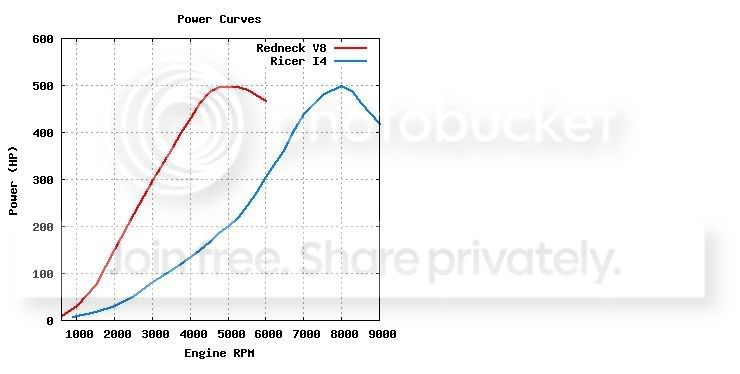
Figure 2: Horsepower versus RPM for Redneck and Ricer. This is calculated from the torque at each RPM.
Both engines produce a peak of 500hp, just like I promised. The V8 produces 500hp at 5000rpm, and 573tq at 4250rpm, while the I4 produces 500hp at 8000rpm, and 337tq at 7500rpm.
Ricer Redneck Difference
Rev Range 900 - 9000RPM 600 - 6000RPM 50% more for Ricer
Peak Torque 337tq 573tq 70% more for Redneck
Peak Power 500hp 500hp Equal
Because the V8 was revving lower, it needed to produce more torque than the I4 to reach the same peak power figure. Conversely, the I4 needed to rev higher than the V8 to produce the same power, because it offers up less torque.
The Power Band
A very important aspect of an engine's output is its power band. The power band is the rev range where the engine is producing an arbitrary percentage of its peak power figure. I will use 80%, which is 400hp or more on our two 500hp engines.
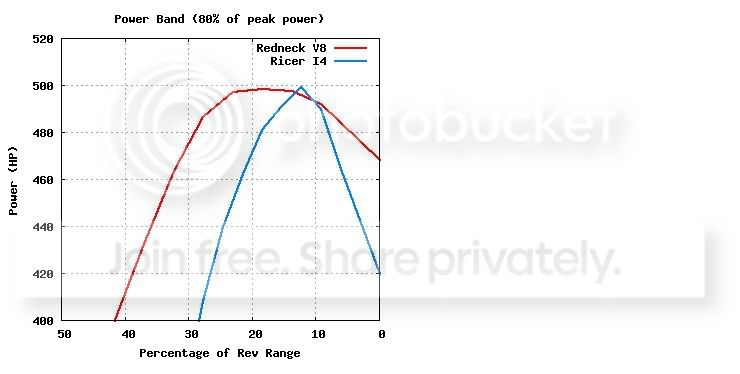
Figure 3: Power band comparison of both motors. Note that the Redneck's average power production (area under the curve) is higher, and that the peak power is the same, at 500hp.
The x-axis may seem unusual. Because the Redneck's engine revs from 600rpm to 6000rpm, while the Ricer's engine revs from 900rpm to 9000rpm, the power production cannot be compared directly with revs. The Ricer has a 50% greater rev range than the Redneck, so the Redneck's graph has to (or "gets to") be stretched by 50%. Showing the x-axis as a fraction of each engine's rev range helps to equal the comparison.
If this seems confusing, there is a separate page on comparing power curves which explains why the rev ranges can't be compared directly.
We will see later on that Figure 3 is a more accurate comparison of the two engines ability to accelerate a car than Figure 2.
Notice that while both engines have the same peak power figures, the Redneck's engine has a much wider 80% power band. This situation is a considerable advantage for the Redneck. Between the two cars, the one with the made-up V8 is going to be faster than the one with the made-up I4, because the V8 has a higher average power level throughout it's rev range.
An exotic sportscar, such as a Lamborghini Murcielago, will have such a wide power band that it can accelerate very hard from almost any RPM. This means that it can do things like go from 0-60mph in one gear. This is why exotics have such impressive performance.
Force on the Road
Let's now look at how much force the Redneck and Ricer are putting to the road, which as we talked about earlier, is the force which accelerates the car. For simplicity, both drivers will race by rolling from 20mph, flooring it, and then shifting at their redlines in each gear. Top speed will be considered redline in top gear, because we are ignoring aerodynamic drag.
We'll start off by giving both of them a good old TH350 3-speed automatic transmission, and a 3.73:1 final drive (axle) ratio.
Drivetrain Layout
TH350 and 3.73 Axle Gears
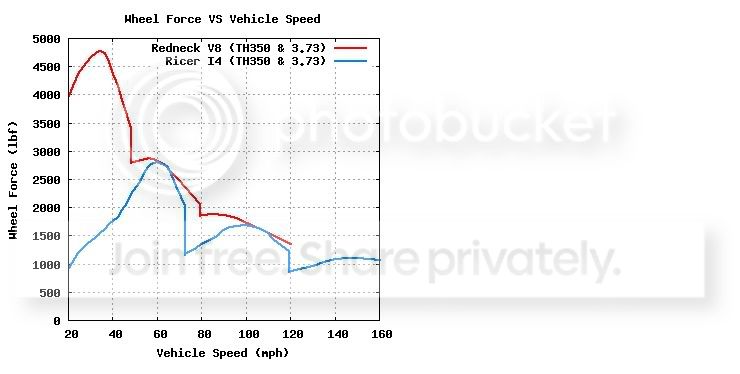
Figure 4: Rear wheel force versus vehicle speed for Redneck and Ricer when using a TH350 transmission and 3.73 axle ratio. The steep vertical drops are the gear changes at redline. Gear changes take place instantaneously for simplification.
Notice that the Redneck has a considerable advantage over the Ricer in first gear, but then not so much in second or third gear. This is because when he shifts into 2nd gear, the transmission doesn't bring him back to idle, but to approximately 3600rpm instead. The Ricer's engine also stays in reasonably high revs after the first gear change, and we saw in Figure 2 that he has plenty of power at high revs. Also note that the Redneck had to shift into second before the Ricer, so his ability to accelerate between 60-65 and 100-115mph is about the same as the Ricer's.
Now, let's move into modern day by giving them both a Tremec T56 6-Speed close-ratio manual transmission.
Drivetrain Layout
Tremec T56 6-Speed and 3.73 Axle Gears
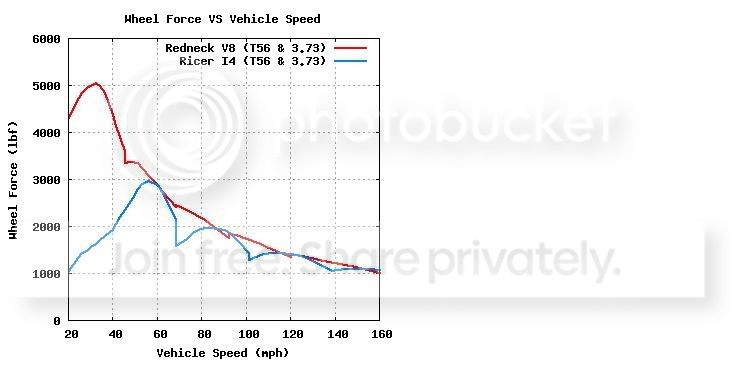
Figure 5: Rear wheel force versus vehicle speed for Redneck and Ricer when using a Tremec T56 transmission and 3.73 axle ratio. Note that the close ratio transmission has reduced the drops in power at each gear change for both motors, especially for the Redneck's.
At certain speeds, the Ricer has caught up slightly. The close-ratio 6-speed transmission helps keep his engine revving near his power peak, and that has helped narrow the gap. The small dips on the Ricer's graph show the effects of having a narrow power band.
The Ricer's acceleration in first gear is still very poor, but the Ricer has a trick up his sleeve. He is going to install a set of 5.67:1 gears in his axle without the Redneck knowing.
Drivetrain Layout
Tremec T56 6-Speed
3.73 Axle Gears for Redneck
5.67 Axle Gears for Ricer
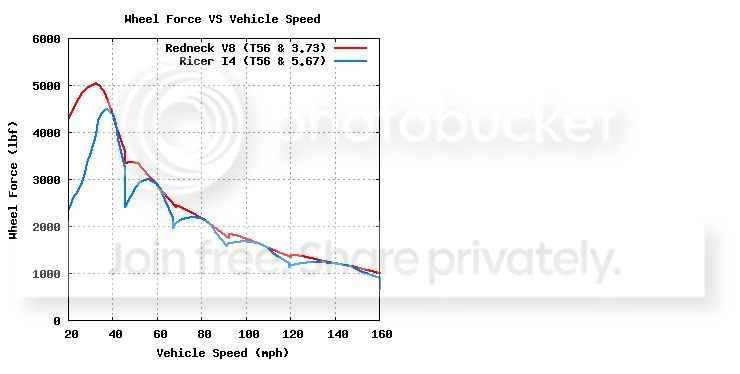
Figure 6: Rear wheel force versus vehicle speed when using a Tremec T56 transmission and 3.73 axle ratio for the Redneck, and 5.67 for the Ricer. Note that both cars shift gears at about the same vehicle speeds as each other now.
The Ricer has pretty much completely caught up now, especially at speeds above 40mph. With those gears he put in, he has traded his higher revs for higher torque to the wheels. Now, for certain vehicle speeds, he can accelerate alongside the Redneck.
The Redneck would also see benefit from putting in different axle gears. However, this "arms race" cannot go on for long, because as the wheel torque is increased, speed is traded away. It would be very embarrassing for the drivers if they crossed the finish line sitting at redline in 6th gear, not accelerating. The Ricer can use a lot more gear because of his extra revs. Conversely, the Redneck doesn't need them because he has so much flywheel torque that he doesn't need to multiply it as much. There is not a significant benefit to either driver in this regard.
If we fitted both cars with a Continuously Variable Transmission (CVT) that had an infinite ratio spread, which can hold both engines at their horsepower peaks, the acceleration of both cars would be identical at any vehicle speed.
Low-Speed Acceleration
Even after changing the rear axle gears, the Ricer's car still could not match the Redneck's acceleration from a slow roll up to about 35-40mph. This shows that the benefits of a having a very wide power band are most significant in first gear, and is therefore an important part of tuning an engine for drag racing, where the cars start from rest.
I think at this point, it is clear that the car's acceleration ability is related to its engine's power output. Now, let's compare two different cars with two very different engines.
Both vehicles will have the same curb weight, and peak horsepower figures. They will also have the same transmission, tire radius, and so on. In fact, the only difference between the two cars will be the engines. One car will be equipped with a 500hp turbocharged 4 cylinder engine, and the other will have a 500hp big-block V8. The 4 cylinder will be named Ricer, and the V8 will be named Redneck. The 4 cylinder is able to rev to 9000rpm and produce a fair bit of torque, while the V8 can rev to only 6000rpm, but produce a ton of torque. To keep the math very simple, the Redneck's engine idles at 600rpm, and the Ricer's idles at 900rpm.
Below are plots of the two fictitious engine's torque and horsepower curves.
Figure 1: Torque versus RPM for Redneck and Ricer. These are unrealistic curves which have been exaggerated to help illustrate certain concepts.
Figure 2: Horsepower versus RPM for Redneck and Ricer. This is calculated from the torque at each RPM.
Both engines produce a peak of 500hp, just like I promised. The V8 produces 500hp at 5000rpm, and 573tq at 4250rpm, while the I4 produces 500hp at 8000rpm, and 337tq at 7500rpm.
Ricer Redneck Difference
Rev Range 900 - 9000RPM 600 - 6000RPM 50% more for Ricer
Peak Torque 337tq 573tq 70% more for Redneck
Peak Power 500hp 500hp Equal
Because the V8 was revving lower, it needed to produce more torque than the I4 to reach the same peak power figure. Conversely, the I4 needed to rev higher than the V8 to produce the same power, because it offers up less torque.
The Power Band
A very important aspect of an engine's output is its power band. The power band is the rev range where the engine is producing an arbitrary percentage of its peak power figure. I will use 80%, which is 400hp or more on our two 500hp engines.
Figure 3: Power band comparison of both motors. Note that the Redneck's average power production (area under the curve) is higher, and that the peak power is the same, at 500hp.
The x-axis may seem unusual. Because the Redneck's engine revs from 600rpm to 6000rpm, while the Ricer's engine revs from 900rpm to 9000rpm, the power production cannot be compared directly with revs. The Ricer has a 50% greater rev range than the Redneck, so the Redneck's graph has to (or "gets to") be stretched by 50%. Showing the x-axis as a fraction of each engine's rev range helps to equal the comparison.
If this seems confusing, there is a separate page on comparing power curves which explains why the rev ranges can't be compared directly.
We will see later on that Figure 3 is a more accurate comparison of the two engines ability to accelerate a car than Figure 2.
Notice that while both engines have the same peak power figures, the Redneck's engine has a much wider 80% power band. This situation is a considerable advantage for the Redneck. Between the two cars, the one with the made-up V8 is going to be faster than the one with the made-up I4, because the V8 has a higher average power level throughout it's rev range.
An exotic sportscar, such as a Lamborghini Murcielago, will have such a wide power band that it can accelerate very hard from almost any RPM. This means that it can do things like go from 0-60mph in one gear. This is why exotics have such impressive performance.
Force on the Road
Let's now look at how much force the Redneck and Ricer are putting to the road, which as we talked about earlier, is the force which accelerates the car. For simplicity, both drivers will race by rolling from 20mph, flooring it, and then shifting at their redlines in each gear. Top speed will be considered redline in top gear, because we are ignoring aerodynamic drag.
We'll start off by giving both of them a good old TH350 3-speed automatic transmission, and a 3.73:1 final drive (axle) ratio.
Drivetrain Layout
TH350 and 3.73 Axle Gears
Figure 4: Rear wheel force versus vehicle speed for Redneck and Ricer when using a TH350 transmission and 3.73 axle ratio. The steep vertical drops are the gear changes at redline. Gear changes take place instantaneously for simplification.
Notice that the Redneck has a considerable advantage over the Ricer in first gear, but then not so much in second or third gear. This is because when he shifts into 2nd gear, the transmission doesn't bring him back to idle, but to approximately 3600rpm instead. The Ricer's engine also stays in reasonably high revs after the first gear change, and we saw in Figure 2 that he has plenty of power at high revs. Also note that the Redneck had to shift into second before the Ricer, so his ability to accelerate between 60-65 and 100-115mph is about the same as the Ricer's.
Now, let's move into modern day by giving them both a Tremec T56 6-Speed close-ratio manual transmission.
Drivetrain Layout
Tremec T56 6-Speed and 3.73 Axle Gears
Figure 5: Rear wheel force versus vehicle speed for Redneck and Ricer when using a Tremec T56 transmission and 3.73 axle ratio. Note that the close ratio transmission has reduced the drops in power at each gear change for both motors, especially for the Redneck's.
At certain speeds, the Ricer has caught up slightly. The close-ratio 6-speed transmission helps keep his engine revving near his power peak, and that has helped narrow the gap. The small dips on the Ricer's graph show the effects of having a narrow power band.
The Ricer's acceleration in first gear is still very poor, but the Ricer has a trick up his sleeve. He is going to install a set of 5.67:1 gears in his axle without the Redneck knowing.
Drivetrain Layout
Tremec T56 6-Speed
3.73 Axle Gears for Redneck
5.67 Axle Gears for Ricer
Figure 6: Rear wheel force versus vehicle speed when using a Tremec T56 transmission and 3.73 axle ratio for the Redneck, and 5.67 for the Ricer. Note that both cars shift gears at about the same vehicle speeds as each other now.
The Ricer has pretty much completely caught up now, especially at speeds above 40mph. With those gears he put in, he has traded his higher revs for higher torque to the wheels. Now, for certain vehicle speeds, he can accelerate alongside the Redneck.
The Redneck would also see benefit from putting in different axle gears. However, this "arms race" cannot go on for long, because as the wheel torque is increased, speed is traded away. It would be very embarrassing for the drivers if they crossed the finish line sitting at redline in 6th gear, not accelerating. The Ricer can use a lot more gear because of his extra revs. Conversely, the Redneck doesn't need them because he has so much flywheel torque that he doesn't need to multiply it as much. There is not a significant benefit to either driver in this regard.
If we fitted both cars with a Continuously Variable Transmission (CVT) that had an infinite ratio spread, which can hold both engines at their horsepower peaks, the acceleration of both cars would be identical at any vehicle speed.
Low-Speed Acceleration
Even after changing the rear axle gears, the Ricer's car still could not match the Redneck's acceleration from a slow roll up to about 35-40mph. This shows that the benefits of a having a very wide power band are most significant in first gear, and is therefore an important part of tuning an engine for drag racing, where the cars start from rest.

Banned
Joined: 01-12-07
Posts: 6,449
Likes: 0
From: N. Side Chi-Town
here's a simple answer.....anything under 60mph thats where the trq does the job...anything over 60mph is where the hp does the job...
look at the s2000's....horrible cars off the line,but highway they are pretty solid cars since they got 250hp but only 150ish trq
look at the s2000's....horrible cars off the line,but highway they are pretty solid cars since they got 250hp but only 150ish trq
even this isnt really accurate though...but its a simple way to look at it

Thread
Thread Starter
Forum
Replies
Last Post
Sl0wbaltSS
2.0L LNF Performance Tech
18
Nov 21, 2018 11:11 PM
Cptnslo
Complete Cars
9
Sep 24, 2015 09:32 AM