


Turbo set up question


Thread Starter
Member
Joined: 06-11-09
Posts: 206
Likes: 0
From: sherwood park
Turbo set up question
Hey just wondering if trifecta will be enough of a tune to hold a turbo at 5 to 7lbs of boost? And what kind of injectors should I buy or can I use some off a ss/sc or a ss/tc?

injectors. get some from zzp. they sell 2.4 specific injectors. if u have a 2.4 not sure on 2.2s

Senior Member
Joined: 10-20-07
Posts: 675
Likes: 0
From: Fayett-Evil NC
INJECTOR SIZING DEPENDS DIRECTLY ON TURBO SIZING, BOOST PRESSURE ALSO RELIES ON TURBO SIZING....
I can run a small turbo at 25psi @ 250cfm but a bigger turbo running 10psi can push 250cfm also...
so before you "decide" on what boost pressure you want to "tune" to and what are good "injectors" do some research first...
you will need to have a turbo that is going to be able to run in it's efficiency range yet have enough room both ways to both decrease output and increase input, depending on the turbo and it's flow rates will determine what sizing your injectors have to be....More air, More fuel, if your stock injectors aren't at max duty cycle then a small turbo @ 10psi may be okay with them....however...choose an injector with a duty cycle that has room to expand and decrease as well....keep it in the middle, this gives you options down the road
so here is a formula for you to use....
Pounds of fuel per hour per injector = expected brake horsepower x 0.55 / number of injectors
so, you want 200 horsepower, then 200x0.55=110
110/4 (if you have a 4cyl) = 27.5pounds per hour
but with 27.5 being said.....you SHOULD go the next size up to give you room for improvement later down the line if you should choose,
lets say your car is 140hp stock and you want 200hp, injector size has already been computed so lets work on turbo size
performance gain = (desired bhp/original hp) - 1
so 200/140=1.43
1.43-1 = .43, so 43% power increase over stock
so lets say you have a 2.2 4 cyl, L61 engine Bore is 86mm (3.386in) Stroke is 94.6mm (3.724in)
so Cubic Inch Displacement = #of Cyl x .7854 x Bore^2 x Stroke
CID = 4 x .7854 x 3.386^2 x 3.724
CID = about 134 cubic inches
for the sake explanation lets say the engine has 85% Volumetric efficiency.....so choosing the turbo would be done like this for choosing your airflow rate
airflow rate = CID x RPM x .5 x VE / 1728
so lets say AR=134x6500x.5x.85 / 1728
AR = 214 CFM natually aspirated
now multiply that by the expected performance gain 1.43
306 CFM
Now you have your CFM Rate and your Pressure Ratio....time to start looking at compressor maps X axis is the CFM, Y axis is the Pressure Ratio
find a turbo that is at a target of 70ish in the efficiency range on the map using your newly found numbers....
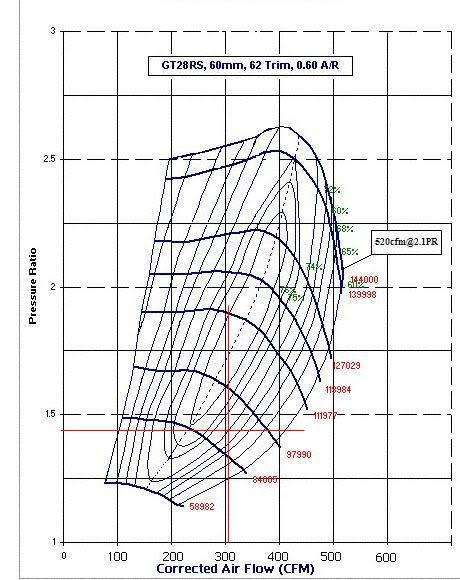
The RED lines indicate approx where the two meet for this GT28rs Turbo...
The approx PSI of the turbo would be about the same as the performance gain percentage of 43%, so
14.7 (atmospheric pressure) x .43 = approx boost pressure
Approx boost pressure would therefore equal 6-7psi
6-7psi with a GT28rs Turbo on a an L61 engine in theory would give a 60hp increase
but all these numbers are for explanation sake...do your own research and see what you find out there
sorry for the complex explanation, hopefully this will help somebody..
here is a link that explains more
http://www.turbobygarrett.com/turbob...o_tech101.html
there are 2 more pages that explain more, Good Luck
Advice....buy a kit with an all inclusive package then have it tuned Right
Last edited by FacelessKhaos; Jan 30, 2010 at 12:20 AM. Reason: Correction in my injector math
so here is a formula for you to use....
Pounds of fuel per hour per injector = expected brake horsepower x 0.55 / number of injectors
so, you want 200 horsepower, then 200x0.55=110
110/4 (if you have a 4cyl) = 27.5pounds per hour
but with 55 being said.....you SHOULD go the next size up to give you room for improvement later down the line if you should choose
Its a tune, I hope they can do any amount of boost you want. And the SS/TC injectiors are DI, wont work.
Last edited by SCcobaltSS; Jan 29, 2010 at 02:11 PM. Reason: Automerged Doublepost
Senior Member
Joined: 10-20-07
Posts: 675
Likes: 0
From: Fayett-Evil NC
The static flow rate of a fuel injector can be used to estimate the maximum power that can be supported. It is also possible to decide what size injector is necessary based on how much power is expected. Both calculations are tied to air/fuel ratio and engine efficiency. The common measure of this is brake specific fuel consumption (BFSC), expressed in terms of grams per kilowatt hour or pounds per horsepower hour. Since most fuel injectors are listed in units of lb/hr, it makes sense here to depart from the metric system for an example.
Most naturally aspirated engines consume fuel at WOT with a brake specific fuel consumption somewhere between 0.3 and 0.5 lb/hp-hr. Supercharged engines, which run richer under high load, will be slightly higher at 0.55 to 0.7 lb/hp-hr. Using this basic efficiency unit, one can simply multiply the target maximum horsepower by anticipated BSFC to show total engine fuel delivery needs:
Mff Total = BSFC x Power
For Example, a 500 hp supercharged engine operating at an anticipated 0.6 lb/hp-hr BSFC would need 300lb/hr of total fuel flow. This represents the fuel being delivered to all cylinders combined, so it can be split across any number of available injectors. With one injector per cylinder, the minimum individual injector flow is found by:
Min Injector Flow = (Mff Total)/(# of injectors)
In this example, a 500 hp V-8 engine using 300lb/hr of total fuel flow would need an absolute minimum of 37.5 lb/hr static flow rate from each individual injector. Some may stop here and go out to purchase injectors for their 500 hp engine. This would be a mistake because the injector drivers in the ECU should not be run at full capacity on a continuous basis. Doing so will often overheat the transistors that drive the fuel injector from the continuously high current flow. To avoid this, some safety margin should be used to give the injector drivers a rest between shots. A 20% safety margin will usually be sufficient to prevent the overheating of the injector drivers. The safety margin is applied to the minimum injector flow rate.
Most naturally aspirated engines consume fuel at WOT with a brake specific fuel consumption somewhere between 0.3 and 0.5 lb/hp-hr. Supercharged engines, which run richer under high load, will be slightly higher at 0.55 to 0.7 lb/hp-hr. Using this basic efficiency unit, one can simply multiply the target maximum horsepower by anticipated BSFC to show total engine fuel delivery needs:
Mff Total = BSFC x Power
For Example, a 500 hp supercharged engine operating at an anticipated 0.6 lb/hp-hr BSFC would need 300lb/hr of total fuel flow. This represents the fuel being delivered to all cylinders combined, so it can be split across any number of available injectors. With one injector per cylinder, the minimum individual injector flow is found by:
Min Injector Flow = (Mff Total)/(# of injectors)
In this example, a 500 hp V-8 engine using 300lb/hr of total fuel flow would need an absolute minimum of 37.5 lb/hr static flow rate from each individual injector. Some may stop here and go out to purchase injectors for their 500 hp engine. This would be a mistake because the injector drivers in the ECU should not be run at full capacity on a continuous basis. Doing so will often overheat the transistors that drive the fuel injector from the continuously high current flow. To avoid this, some safety margin should be used to give the injector drivers a rest between shots. A 20% safety margin will usually be sufficient to prevent the overheating of the injector drivers. The safety margin is applied to the minimum injector flow rate.
The numbers I used where merely for example but within the correct realm of the BSFC, and for forced induction cars, it's between .55 and .65 depending on who you talk to, some even take it from .55 to .70
by the way Mff stands for Minimum Fuel Flow
As for the tune holding a certain boost pressure that part is wrong. The ONLY way that would work is you had an additional electrically operated valve, similar to the N75 Valve found in VW and Audi vehicles, the computer uses this valve to open and close the wastegate. So basically the boost feed line is plumbed into the N75 valve and the vacuum output is plumbed out of the N75 into the wastegate actuator. The N75 reacts based on what the ECU is reading from the MAP Sensor, so if the MAP is saying the boost is too high, it opens the N75 valve and the wastegate opens and the pressure goes to what is tuned. Other than that, you will HAVE to have a mechanical or electrical boost controller. So before that is misinterpreted, the wastegate CAN be set for a certain boost pressure via springs and shims. Depending on boost depends on the spring. Now if you are wanting to be able to adjust the boost that you get, you will have to have boost controller that is plumbed into the wastegate vacuum port. Since springs are NOT precise and a boost controller is, this setup is ideal. I do not know if Vince can "add a valve" like the N75 but it could be logically possible if he is in fact tuning via the binaries in the ECU and not just tricking the ECU into false readings. (He is notorious for doing this)

Thread
Thread Starter
Forum
Replies
Last Post