


Changing Pistons....


Changing Pistons....
ok so for those of you that have changed your own pistons,
from 1-10, 1 being the easiest, how hard is it to install them?
any special tools?
any suggestions?
Spec of the torque need for the bolts?
my buddy works at HONDA and he is going to do it for me but he need all the information since its not a honda....
some can help me out please?
Bump?!?
from 1-10, 1 being the easiest, how hard is it to install them?
any special tools?
any suggestions?
Spec of the torque need for the bolts?
my buddy works at HONDA and he is going to do it for me but he need all the information since its not a honda....
some can help me out please?
Bump?!?
Last edited by cardelino18; Jan 22, 2010 at 04:42 AM. Reason: Automerged Doublepost

Banned
Joined: 07-14-09
Posts: 742
Likes: 0
From: Morgantown, WV
I would wait for Maven to chime in. Probably not that bad for a mechanic to do, but someone that has never torn apart an engine, now that's a different story.
Anyways bump for you till someone can answer...
Anyways bump for you till someone can answer...

Member
Joined: 02-19-09
Posts: 309
Likes: 0
From: MI/NC/Iraq
Well, changing pistons is really not all that hard if you've done it before. As for someone that hasn't done it before, it's not too terribly difficult. I have found the easiest way to do them is from the bottom of the car. I usually take out all the plugs, drain the oil, drop the oil pan, and from there I can unbolt the connecting rods from the crank and by spinning the motor by hand I can remove the pistons 1 by 1 and re-insert them the same way (this way you don't have to take off the timing chain and screw your timing up). Now, there WILL be a special tool you are going to need to get the pistons back in, and that is the piston ring compressor (make sure your piston rings are offset before compressing them this way you won't have blow-by), compress the rings put the tool to the cylinder and push the piston into the cylinder (you can tap lightly on them with a soft-face deadblow hammer if you can't push them in completely). Align the crank with the rods and connect the connecting rod end cap/bearings (Make sure to TORQUE them down to spec, and put the bearings on the right way (as they will scorch your crank and blow your bearings if they aren't)). After all that, put pan back on, fill with oil, start it up and let it run for about 10 minutes at an idle at about 1500-2000 RPMS to set the rings. Then you are good! 
If I missed anything or someone has a better way, please chime in.
If I missed anything or someone has a better way, please chime in.
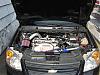
really should take the motor out, with it in the car it is a bit of a bitch to line up the timing chain correctly.
and all the tq specs and ring gap specs are on www.gmtunersource.com plus the install intructions you can print out and give to your freind.
if you have to ask, you shouldn't really try it yourself, especially on a brand new car.
and all the tq specs and ring gap specs are on www.gmtunersource.com plus the install intructions you can print out and give to your freind.
if you have to ask, you shouldn't really try it yourself, especially on a brand new car.

Platinum Member
Platinum Member
Joined: 04-12-09
Posts: 4,869
Likes: 16
From: Connecticut
Well, changing pistons is really not all that hard if you've done it before. As for someone that hasn't done it before, it's not too terribly difficult. I have found the easiest way to do them is from the bottom of the car. I usually take out all the plugs, drain the oil, drop the oil pan, and from there I can unbolt the connecting rods from the crank and by spinning the motor by hand I can remove the pistons 1 by 1 and re-insert them the same way (this way you don't have to take off the timing chain and screw your timing up). Now, there WILL be a special tool you are going to need to get the pistons back in, and that is the piston ring compressor (make sure your piston rings are offset before compressing them this way you won't have blow-by), compress the rings put the tool to the cylinder and push the piston into the cylinder (you can tap lightly on them with a soft-face deadblow hammer if you can't push them in completely). Align the crank with the rods and connect the connecting rod end cap/bearings (Make sure to TORQUE them down to spec, and put the bearings on the right way (as they will scorch your crank and blow your bearings if they aren't)). After all that, put pan back on, fill with oil, start it up and let it run for about 10 minutes at an idle at about 1500-2000 RPMS to set the rings. Then you are good!
If I missed anything or someone has a better way, please chime in.
If I missed anything or someone has a better way, please chime in.
Maybe I speak for myself here, but I'm pretty awestricken with how "easy" people seem to make this process out to be. It really not that cut and dry, and unless you expect your car to ever run propperly again, I would highly recommend bringing it to a professional engine builder.
Just my oppinion....
really should take the motor out, with it in the car it is a bit of a bitch to line up the timing chain correctly.
and all the tq specs and ring gap specs are on www.gmtunersource.com plus the install intructions you can print out and give to your freind.
if you have to ask, you shouldn't really try it yourself, especially on a brand new car.
and all the tq specs and ring gap specs are on www.gmtunersource.com plus the install intructions you can print out and give to your freind.
if you have to ask, you shouldn't really try it yourself, especially on a brand new car.

DAMN people are goddamn lazy these days
http://www.gmtunersource.com/index.p...lsj-build-book
http://www.gmtunersource.com/index.p...lsj-build-book

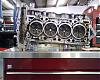
On your 1-10 scale, this is a 9 on the engine scale.
Youre not gonna get the pistons out the bottom of the engine. You need to remove the head. You dont need to remove the engine
You need torque wrench, a way to accurately measure bolt angle if you use stock type headbolts and rod bolts, piston ring compressor.
You should just by the service manual. If youre putting pistons in this soon then a manual set will be the best $135 you ever spend on this car.
Youre not gonna get the pistons out the bottom of the engine. You need to remove the head. You dont need to remove the engine
You need torque wrench, a way to accurately measure bolt angle if you use stock type headbolts and rod bolts, piston ring compressor.
You should just by the service manual. If youre putting pistons in this soon then a manual set will be the best $135 you ever spend on this car.

Senior Member
Joined: 02-09-09
Posts: 4,374
Likes: 5
From: Tejas
When they replaced my piston, they kept the crank in place, disconnected the rod from the crank, took off the head, and took out and put in the piston through the top. They kept the engine in the car.

Senior Member
Joined: 07-25-08
Posts: 12,450
Likes: 6
From: Florida
That sounds like how you would get it done without removing the engine from the car.
Senior Member
Joined: 02-09-09
Posts: 4,374
Likes: 5
From: Tejas

New Member
Joined: 11-28-09
Posts: 81
Likes: 0
From: Okotoks, AB
I'm kind of wondering how on earth are you going to hone the cylinder walls to get the new rings to seal if you don't clear the cylinders (or your gonna get TONS of filings everywhere and just destroy the engine).
Also... WHY are you replacing the pistons?
Also... WHY are you replacing the pistons?

New Member
Joined: 10-08-09
Posts: 88
Likes: 0
From: Ohio
i really suggest taking the engine out.. just like im sure most people would. not only is it more difficult to to with the motor in the car.. when your working with something this important to your car running you dont want to be all crammed under your car with limited visibility... plus you said you think you cracked one?
id definitely take the engine out if not because its safer, because you dont know exactly what the problem is.. i have a story i could go into.. https://www.cobaltss.net/forums/2-0l-lsj-performance-tech-47/cracked-piston-1-a-198277/ ... i posted in this thread about it.
also youre going to need a hone tool idk if anyone had mentioned that.
id definitely take the engine out if not because its safer, because you dont know exactly what the problem is.. i have a story i could go into.. https://www.cobaltss.net/forums/2-0l-lsj-performance-tech-47/cracked-piston-1-a-198277/ ... i posted in this thread about it.
also youre going to need a hone tool idk if anyone had mentioned that.
Senior Member
Joined: 07-25-08
Posts: 12,450
Likes: 6
From: Florida
New Member
Joined: 10-08-09
Posts: 88
Likes: 0
From: Ohio
Would not suprise me at all. You need to do a leak down test to determine if all cylinders have the proper amount of compression. Should be approx 9.4 CR X 14.5 psi atm = 136.3psi.

Last edited by Kozy; Jan 26, 2010 at 04:14 PM. Reason: put html instead of quotes
Its honestly no harder in the car(assuming you have a lift)
And as far as compression i would honestly hope to see more than 135psi, you have to remember a compression test is a dynamic thing, we have air moving, its not just A*B=C.
For example a healthy LSJ with its 9.5:1 compression ration will easily hit 210psi on a compresion check.
I would say 100-125 is a safe MINIMUM pressure to see. As always the variances from cylinder to cylinder are very important.
And as far as compression i would honestly hope to see more than 135psi, you have to remember a compression test is a dynamic thing, we have air moving, its not just A*B=C.
For example a healthy LSJ with its 9.5:1 compression ration will easily hit 210psi on a compresion check.
I would say 100-125 is a safe MINIMUM pressure to see. As always the variances from cylinder to cylinder are very important.

Thread
Thread Starter
Forum
Replies
Last Post
importkiller
Problems/Service/Maintenance
11
Sep 30, 2015 07:18 PM
roth
Problems/Service/Maintenance
2
Sep 26, 2015 12:16 PM