


Official Turbo LSJ thread!!!

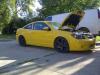
Hey guys. My tuner needs help tuning my car with the new ID1000s i just put in and getting my speedo correct with the new 6spd. Any one help? My afrs are 10.3 wot. Im on e85. Turbo swap. I can email logs
My idle jumps a bit. Any help is appreciated
My idle jumps a bit. Any help is appreciated





FWIW, the idle will never be perfect, if you are running enough fuel pressure to support solid boost. What is your base pressure? IIRC Josh's car is around 50psi and the idle is a bit higher than stock to be smooth, but the injectors are 3x the size of stock so that's to be expected. The car drives awesome though.
I have a file setup for ID1000's and E85 from Blazin's car, if you wanna shoot me a copy I can see what's different and advise. Italianjoe1@hotmail.com
FWIW, the idle will never be perfect, if you are running enough fuel pressure to support solid boost. What is your base pressure? IIRC Josh's car is around 50psi and the idle is a bit higher than stock to be smooth, but the injectors are 3x the size of stock so that's to be expected. The car drives awesome though.
Ill have him email the file to me and get it over to you asap. Thank you

Your idle as italianjoe said wont be perfect, the thing to make sure is that your stft and ltft are within a few percent. You afr, crusing, and just drinving around in general should bounce around 14-15, under WOT depends on your boost level but if you are referring to e85 stoich then 10.3 is bad as you have indicated.

I have a file setup for ID1000's and E85 from Blazin's car, if you wanna shoot me a copy I can see what's different and advise. Italianjoe1@hotmail.com
FWIW, the idle will never be perfect, if you are running enough fuel pressure to support solid boost. What is your base pressure? IIRC Josh's car is around 50psi and the idle is a bit higher than stock to be smooth, but the injectors are 3x the size of stock so that's to be expected. The car drives awesome though.
FWIW, the idle will never be perfect, if you are running enough fuel pressure to support solid boost. What is your base pressure? IIRC Josh's car is around 50psi and the idle is a bit higher than stock to be smooth, but the injectors are 3x the size of stock so that's to be expected. The car drives awesome though.
Well he doesnt seem to think he needs to adjust cells individually. Hes richining and leaning all cells together. I dont like this. First he tells me hes tuned a few LSJs and now hes like im the first one..... im still waitinf for him to email me the tune

Is he a subaru tuner by chance?
The vc port IS a fresh air inlet. Study some basic physics. At part throttle the post tb vac is greater than the intake tube, so the check valve in the head/IM pulls vac on the case. It wouldn't do any good to just suck on the case though; the while point it to get the vapors out. That's what the fresh air inlet is for.
Some of you really need to do some research on how the system works. It's NOT that ******* hard to understand.
An internal combustion engine is built around a series of hollow cylinders, in each of which is a moveable piston designed to glide up and down inside it. A mixture of air and gasoline is pumped through a system of tubes called the intake manifold through each cylinder's intake valve (or valves), where a spark from a spark plug causes the mixture to explode in the open space at the top of the cylinder called the combustion chamber. The pressure from this explosion drives the piston in the cylinder downward, where it causes the crankshaft to rotate. The rotation of the crankshaft not only pushes the piston back up into the cylinder so it can do all this again, but it also turns the gears within the car's transmission that eventually make the car move. Meanwhile, the rising piston pushes the air and gas left over from the explosion back out of the cylinder through an exhaust valve.
However -- and this is where crankcase ventilation comes in -- a certain amount of that mixture of air and gasoline is pulled down by the piston and slips through the piston rings into the crankcase, which is the protective cover that insulates the crankshaft. This escaping gas is called blow-by and it's unavoidable. It's also undesirable because the unburned gasoline in it can gunk up the system and produce problems in the crankcase. Until the early 1960s, these blow-by gases were removed simply by letting air circulate freely through the crankcase, wafting away the gases and venting them as emissions. Then, in the early 1960s, positive crankshaft ventilation (PCV) was invented. This is now considered the beginning of automobile emission control.
Positive crankcase ventilation involves recycling these gases through a valve (called, appropriately, the PCV valve) to the intake manifold, where they're pumped back into the cylinders for another shot at combustion. It isn't always desirable to have these gases in the cylinders because they tend to be mostly air and can make the gas-air mixture in the cylinders a little too lean -- that is, too low on gasoline -- for effective combustion. So the blow-by gases should only be recycled when the car is traveling at slow speeds or idling. Fortunately, when the engine is idling the air pressure in the intake manifold is lower than the air pressure in the crankcase, and it's this lower pressure (which sometimes approaches pure vacuum) that sucks the blow-by gases through the PCV valve and back into the intake. When the engine speeds up, the air pressure in the intake manifold increases and the suction slows down, reducing the amount of blow-by gas recycled to the cylinders. This is good, because the blow-by gases aren't needed when the engine speeds up. In fact, when the car is up to speed, the pressure in the intake manifold can actually become higher than the pressure in the crankcase, potentially forcing the blow-by gases back into the crankcase. Since the whole point of positive crankcase ventilation is to keep these gases out of the crankcase, the PCV valve is designed to close off when this happens and block the backflow of gases.
Last edited by mrbelvedere; Aug 8, 2013 at 11:05 AM.

im gonna have to call bull **** on that and this is how I know when I bought my intake from ottp I put it on fired up the car and setting there idling about 10 min the dipstick popped up I didn't think anything about it went to meet a buddy and on the way home the dipstick belw out and oil was everywhere the next day cleaned **** up and got to looking and you run the engine and hear the pressure building in the engine pull the vent line off of the the intake and air pressure would run out of the vent line after looking at the intake I seen they put the bung on for the vent line but didn't drill the hole so I drilled the hole problem solved