


Possible Intercooler Pump Upgrade (Pump Information)


New Member
Joined: 01-24-12
Posts: 161
Likes: 0
From: Conroe area
You have some issues if you are pulling timing on a 1/4.
I am sitting in Houston. It's hot here!!
Here is what I had the other day.
2.9 pulley with 60"s canned ZZP tune and NO I repeat NO cooling mods at all!
Cruising down the interstate.

Sitting at a light after coming off the interstate packed and I mean PACKED in traffic.

Then about 15 min later stopped in a parking lot after WOT to 80MPH racing a rumble bee. He gave up after 60 LOL

So I see no issues with the current setup but if you want more cooling I stand by my post.
And no I have no proof of my statements but these are done to several other brands of cars and there is no reason for it to not work on ours.
The point is option B and all that crap with a higher flow pump is NOT going to help. The only way to get better temps is to do one of my two recommendations. If you really want to make things better then make the second one a reality.
Oh and just for fun the condensor/heat exchanger swap is decent but again it wont help WOT as much.
You need the water to be cooler then you can make it flow faster, and option 2 can make both happen!
Oh and a tip that helped two guys out BIG time who decided to do the dual core(option 1) be sure that the laminova output(hot water) goes into the rear exchanger then feeds into the one in front of it(most forward). you don't want the hot water heating the air going though the H/E in front causing the second H/E core to heat up lol. They both seen a 15+ degree drop in temps after swapping the hoses around.
I am sitting in Houston. It's hot here!!
Here is what I had the other day.
2.9 pulley with 60"s canned ZZP tune and NO I repeat NO cooling mods at all!
Cruising down the interstate.
Sitting at a light after coming off the interstate packed and I mean PACKED in traffic.
Then about 15 min later stopped in a parking lot after WOT to 80MPH racing a rumble bee. He gave up after 60 LOL
So I see no issues with the current setup but if you want more cooling I stand by my post.
And no I have no proof of my statements but these are done to several other brands of cars and there is no reason for it to not work on ours.
The point is option B and all that crap with a higher flow pump is NOT going to help. The only way to get better temps is to do one of my two recommendations. If you really want to make things better then make the second one a reality.
Oh and just for fun the condensor/heat exchanger swap is decent but again it wont help WOT as much.
You need the water to be cooler then you can make it flow faster, and option 2 can make both happen!
Oh and a tip that helped two guys out BIG time who decided to do the dual core(option 1) be sure that the laminova output(hot water) goes into the rear exchanger then feeds into the one in front of it(most forward). you don't want the hot water heating the air going though the H/E in front causing the second H/E core to heat up lol. They both seen a 15+ degree drop in temps after swapping the hoses around.
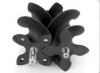
be sure that the laminova output(hot water) goes into the rear exchanger then feeds into the one in front of it(most forward). you don't want the hot water heating the air going though the H/E in front causing the second H/E core to heat up lol. They both seen a 15+ degree drop in temps after swapping the hoses around.[/I]
we did that years ago but the addition to another H.E. hurts over all airflow through the stack best option is to get griffen
New Member
Joined: 01-24-12
Posts: 161
Likes: 0
From: Conroe area
If done correctly and the cores "lines" are aligned as closely as possible then the restriction should not be that much.
Also for those that are thinking of more flow.....
Lamiflow Intercooler FAQ
snippet from the site
More hidden secrets of Laminova cores
There are several hidden advantages of Laminova heat exchangers. One is fast exchange time of heat. Another is a hidden cooling advantage of the way you drive. Water actually shouldn't be pumped at a high pressure or speed so it has time to absorb the charge heat. "More" isn't always better.
Also Mr Belvedere is right on the alignment of the cores. Make sure when you put them back in that they are setting with the "open" slots just like in the diagram or else you run the risk of damaging the fins and restricting flow. And not to mention wasting LOTS of cooling surface because the air cannot flow through crushed fins.snippet from the site
More hidden secrets of Laminova cores
There are several hidden advantages of Laminova heat exchangers. One is fast exchange time of heat. Another is a hidden cooling advantage of the way you drive. Water actually shouldn't be pumped at a high pressure or speed so it has time to absorb the charge heat. "More" isn't always better.
A look at the Laminova core in our intake.
Can you see that one of the cores is turned really wrong? Go by Mr Belvederes post not by this pic as this pic does not show proper alignment for our intake flow.

Last edited by reddragon72; Aug 29, 2014 at 11:52 AM.

What else could be wrong with my car that is making my temps so high then?
Maybe I should vacuum bleed my aftercooler system?
I never have thought it was normal, ive just been accepting of it.
Maybe I should vacuum bleed my aftercooler system?
I never have thought it was normal, ive just been accepting of it.


you are fighting 3 heat sources on our cars
engine heat
the heat of compressing air in the manifold
load heat from the snout
the blower does not generate heat persay as it does not compress air in the case the heat comes from air being stacked(compressed)in the manifold that puts a load on the blower which in turns causes a lot of heat to be generated by the snout that heat which is then transferred back through the rotors and case and that adds to also heating up the air the engine heats up the manifold to op temp so your heat exchanger system if you really look at it is working its ass off
how to combat all the heat
lower the engine temp lower temp
increase the airflow across the lam cores(port the manifold to make the opening even) you increase air flow you relieve heat from stacking air in the manifold but becarefull not to over do it you could make things worse
cool the snout a cooler snout is less heat in the rotors and case
add capacity to the system also when choosing a new H.E. you need to take in to effect of quality of material that is used into your new heat exchanger the lower the quality the poorer the cooling you get
engine heat
the heat of compressing air in the manifold
load heat from the snout
the blower does not generate heat persay as it does not compress air in the case the heat comes from air being stacked(compressed)in the manifold that puts a load on the blower which in turns causes a lot of heat to be generated by the snout that heat which is then transferred back through the rotors and case and that adds to also heating up the air the engine heats up the manifold to op temp so your heat exchanger system if you really look at it is working its ass off
how to combat all the heat
lower the engine temp lower temp
increase the airflow across the lam cores(port the manifold to make the opening even) you increase air flow you relieve heat from stacking air in the manifold but becarefull not to over do it you could make things worse
cool the snout a cooler snout is less heat in the rotors and case
add capacity to the system also when choosing a new H.E. you need to take in to effect of quality of material that is used into your new heat exchanger the lower the quality the poorer the cooling you get
I am on a 2.7 tvs at the end of the 1/4 I usually set around 150/160 all I have is a griffen and option b the manifold is stock

Senior Member
Joined: 08-31-12
Posts: 3,154
Likes: 54
From: MD
I second cleaning the cores, my manifold hadn't been apart either(too my knowledge) but when I pulled my cores out a few weeks ago there was so much crud on them I couldn't believe it. Floated them in a soapy water solution with simple green and kept changing out the water until they were clean again

Also for those that are thinking of more flow.....
Lamiflow Intercooler FAQ
snippet from the site
More hidden secrets of Laminova cores
There are several hidden advantages of Laminova heat exchangers. One is fast exchange time of heat. Another is a hidden cooling advantage of the way you drive. Water actually shouldn't be pumped at a high pressure or speed so it has time to absorb the charge heat. "More" isn't always better.
snippet from the site
More hidden secrets of Laminova cores
There are several hidden advantages of Laminova heat exchangers. One is fast exchange time of heat. Another is a hidden cooling advantage of the way you drive. Water actually shouldn't be pumped at a high pressure or speed so it has time to absorb the charge heat. "More" isn't always better.
New Member
Joined: 01-24-12
Posts: 161
Likes: 0
From: Conroe area
yep and your air filter brand makes all the diff. K and N are good because the employ oil to catch the little stuff tumbling through but that also means oil can get into your electronics and destroy it. I don't care what K and N or anyone says been there done that!
Paper filter suck until you have 2K of driving on them to get all the holes clogged with crap.
I recommend examining/cleaning every 100K. I have heard that from a few others as well. The big reason is the piping of the engine crude into the intake to burn off the gas. This right there introduces oil that over time can accumulate and clog the fins.
However, if you look at the pic I posted above of our core you can see that there is acutally a lot of space for air to flow. roughly three times that of the intake tube alone. So you have some wiggle room. remember that a clogged fin is bad but a dirty fin is even worse so clean those babies out but be super careful they are super delicate.
No I believe that is not your problem and it is related to the water flow. I think your pump is shot or the fluid is crap or your clogged up somewhere. Don't worry about those pesky bubbles unless its a massive air bubble but it should have worked its way out by now.
Oh and to "burp" the system simply find a 20+ degree slop and park your car on it the passenger side lower than the driver side and leave it there for 5 min engine running. That will allow the air to flow out of the cores. Don't be drilling holes in that crap introducing more issues for a one time fix.
Paper filter suck until you have 2K of driving on them to get all the holes clogged with crap.
I recommend examining/cleaning every 100K. I have heard that from a few others as well. The big reason is the piping of the engine crude into the intake to burn off the gas. This right there introduces oil that over time can accumulate and clog the fins.
However, if you look at the pic I posted above of our core you can see that there is acutally a lot of space for air to flow. roughly three times that of the intake tube alone. So you have some wiggle room. remember that a clogged fin is bad but a dirty fin is even worse so clean those babies out but be super careful they are super delicate.
No I believe that is not your problem and it is related to the water flow. I think your pump is shot or the fluid is crap or your clogged up somewhere. Don't worry about those pesky bubbles unless its a massive air bubble but it should have worked its way out by now.
Oh and to "burp" the system simply find a 20+ degree slop and park your car on it the passenger side lower than the driver side and leave it there for 5 min engine running. That will allow the air to flow out of the cores. Don't be drilling holes in that crap introducing more issues for a one time fix.
New Member
Joined: 01-24-12
Posts: 161
Likes: 0
From: Conroe area
No. Thats wrong, turbulent flow will remove more heat. Additional flow increases the Reynolds number increasing the turbulent flow (i'm to lazy to do the calc to determine if flow is lamnar or turbulent). The more flow the more fluid come in contact with the heated surface, therefore the more heat that can be removed. Thats why with 32F with a breeze feels much colder than 32F without a breeze because the heat is removed quicker due to the increased airflow, same applies to fluids.
water flowing at 10mph is not going to have time to absorb the outside temp.... lakes freeze before rivers....
Think of it like this. Cover an empty pool with fiber glass insulation on a 50 degree day. Take one space heater and turn it on. You will be able to heat that area up to 80 degrees rather quickly.
Now take the same pool and fill it up with 50 degree water. Add and equivalent heat source as the space heater and see how long it takes to heat up the water.... almost 10X as long.
Water does not transfer heat and cold as quickly as air does. Known fact! Water must sit around to absorb the heat before moving on. If you put a faster pump on the system and ran it then the water would never work to it's full potential and most of the heat will remain in the cores. And what does get whisked away will never leave the water because the heat exchanger wont be able to remove the heat from the water quickly enough.
Hell they are actually doing doing laminova cores with oil now because it transfers the heat 5 time more efficiently than water.
dude that's not even close to applying here....
water flowing at 10mph is not going to have time to absorb the outside temp.... lakes freeze before rivers....
Think of it like this. Cover an empty pool with fiber glass insulation on a 50 degree day. Take one space heater and turn it on. You will be able to heat that area up to 80 degrees rather quickly.
Now take the same pool and fill it up with 50 degree water. Add and equivalent heat source as the space heater and see how long it takes to heat up the water.... almost 10X as long.
Water does not transfer heat and cold as quickly as air does. Known fact! Water must sit around to absorb the heat before moving on. If you put a faster pump on the system and ran it then the water would never work to it's full potential and most of the heat will remain in the cores. And what does get whisked away will never leave the water because the heat exchanger wont be able to remove the heat from the water quickly enough.
Hell they are actually doing doing laminova cores with oil now because it transfers the heat 5 time more efficiently than water.
water flowing at 10mph is not going to have time to absorb the outside temp.... lakes freeze before rivers....
Think of it like this. Cover an empty pool with fiber glass insulation on a 50 degree day. Take one space heater and turn it on. You will be able to heat that area up to 80 degrees rather quickly.
Now take the same pool and fill it up with 50 degree water. Add and equivalent heat source as the space heater and see how long it takes to heat up the water.... almost 10X as long.
Water does not transfer heat and cold as quickly as air does. Known fact! Water must sit around to absorb the heat before moving on. If you put a faster pump on the system and ran it then the water would never work to it's full potential and most of the heat will remain in the cores. And what does get whisked away will never leave the water because the heat exchanger wont be able to remove the heat from the water quickly enough.
Hell they are actually doing doing laminova cores with oil now because it transfers the heat 5 time more efficiently than water.
Your lake and poll example, first lake, kinetic energy is actually heating the water to slightly above the freezing point, water molecules are violently crashing into one another. Second example you're speaking of heat capacity not heat transfer coefficients. Which for your information air has a heat transfer coefficient of 10-100W/m2K, where as water has a heat transfer coefficient of 500-10000W/m2K, hence why you get hypothermia in 5mins with water at 34F and it takes hours in air at 34F.
Sit down learn some engineering before acting like you know it from an article you read on the internet (which I couldn't even get to load). You're missing the entire point, circulate the water more then you have a greater heat removal at your heat exchanger keeping the fluid in the system cooler.
They are using oil in the heat exchange system because water is corrosive and does not have good lubricating properties. Also then they can charge you an arm and a leg for the fluid.
New Member
Joined: 01-24-12
Posts: 161
Likes: 0
From: Conroe area
No no no. Seriously stop. Your engineering is horrid to say the least.
Your lake and poll example, first lake, kinetic energy is actually heating the water to slightly above the freezing point, water molecules are violently crashing into one another. Second example you're speaking of heat capacity not heat transfer coefficients. Which for your information air has a heat transfer coefficient of 10-100W/m2K, where as water has a heat transfer coefficient of 500-10000W/m2K, hence why you get hypothermia in 5mins with water at 34F and it takes hours in air at 34F.
Sit down learn some engineering before acting like you know it from an article you read on the internet (which I couldn't even get to load). You're missing the entire point, circulate the water more then you have a greater heat removal at your heat exchanger keeping the fluid in the system cooler.
They are using oil in the heat exchange system because water is corrosive and does not have good lubricating properties. Also then they can charge you an arm and a leg for the fluid.
Your lake and poll example, first lake, kinetic energy is actually heating the water to slightly above the freezing point, water molecules are violently crashing into one another. Second example you're speaking of heat capacity not heat transfer coefficients. Which for your information air has a heat transfer coefficient of 10-100W/m2K, where as water has a heat transfer coefficient of 500-10000W/m2K, hence why you get hypothermia in 5mins with water at 34F and it takes hours in air at 34F.
Sit down learn some engineering before acting like you know it from an article you read on the internet (which I couldn't even get to load). You're missing the entire point, circulate the water more then you have a greater heat removal at your heat exchanger keeping the fluid in the system cooler.
They are using oil in the heat exchange system because water is corrosive and does not have good lubricating properties. Also then they can charge you an arm and a leg for the fluid.
remember buddy this is a two way street you need to heat and cool the same source and you simply cannot do it if there is not enough time to allow the transfer of the "kinetic energy".
Ok back on track...

Oh and to "burp" the system simply find a 20+ degree slop and park your car on it the passenger side lower than the driver side and leave it there for 5 min engine running. That will allow the air to flow out of the cores. Don't be drilling holes in that crap introducing more issues for a one time fix.
Last edited by mrbelvedere; Aug 29, 2014 at 08:38 PM.

Let me call up laminova (I think they were bought out) as well as all the automotive manufactures in the world and tell them they all have it wrong.... Let me tell them that some guy on the internet says we should put faster pumps on the all the cars intercoolers and engine cooling systems because faster water flow cools more... I think because you said faster moving water generates heat.... but never mind that you can't possibly be wrong with your classroom physics.
remember buddy this is a two way street you need to heat and cool the same source and you simply cannot do it if there is not enough time to allow the transfer of the "kinetic energy".
Ok back on track...
remember buddy this is a two way street you need to heat and cool the same source and you simply cannot do it if there is not enough time to allow the transfer of the "kinetic energy".
Ok back on track...
Let me call up laminova (I think they were bought out) as well as all the automotive manufactures in the world and tell them they all have it wrong.... Let me tell them that some guy on the internet says we should put faster pumps on the all the cars intercoolers and engine cooling systems because faster water flow cools more... I think because you said faster moving water generates heat.... but never mind that you can't possibly be wrong with your classroom physics.
remember buddy this is a two way street you need to heat and cool the same source and you simply cannot do it if there is not enough time to allow the transfer of the "kinetic energy".
Ok back on track...
remember buddy this is a two way street you need to heat and cool the same source and you simply cannot do it if there is not enough time to allow the transfer of the "kinetic energy".
Ok back on track...


New Member
Joined: 01-24-12
Posts: 161
Likes: 0
From: Conroe area
Again this has all been done and my two ideas stand as proven methods in the racing world. People can either put a high speed pump on there and watch the iat2s steadily increase and never rebound or they can try and cool the water more and watch the iat2s drop and rebound quicker.
Me I am happy with what I have today but will probably add a second core in the near future.
